
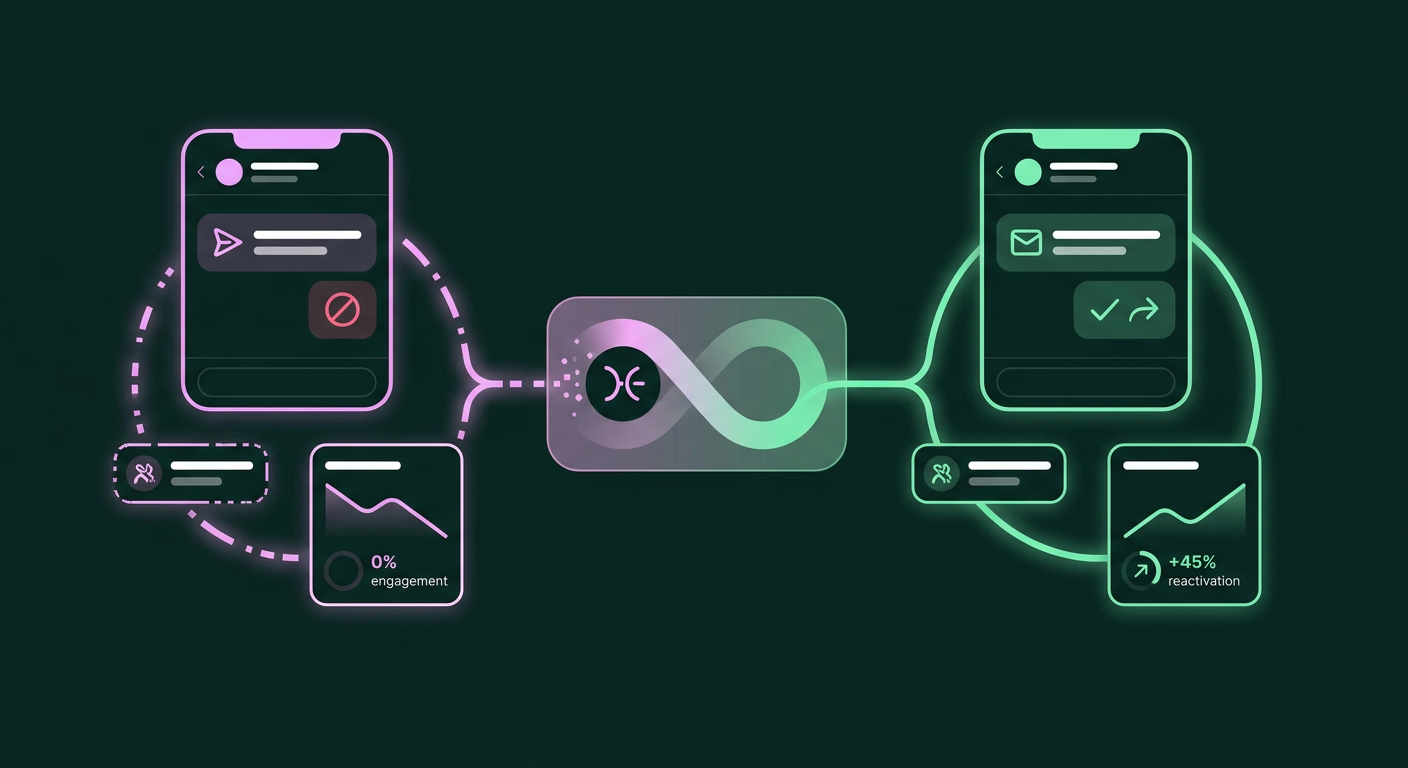
Many mobile game studios pour effort into reactivation marketing, only to see underwhelming results. Despite carefully timed emails and push notifications, engagement is low, the return on investment feels negligible, and the whole exercise seems to create more noise than it brings back actual players. This frustration is common because the standard playbook of generic "we miss you" messages is broken. In an industry focused on retaining and monetizing existing users, which costs far less than acquiring new ones (opens in a new tab), a failing win-back strategy isn't just an annoyance. It's a significant drain on potential lifetime value.
Your Win-Back Campaigns Aren't Working
Your player reactivation marketing isn't working because it relies on generic, one-size-fits-all messages sent to poorly segmented audiences. This approach ignores why a player left, so it can't offer a compelling, personalized reason to return. The messages get ignored or, worse, confirm the player’s decision to leave, resulting in low engagement and wasted resources. Most studios fall into a familiar pattern: a player goes inactive for 30 or 60 days and gets dropped into an automated sequence of "We Miss You!" emails. The low open rates and minimal impact on daily active users that follow aren't proof that lapsed players are gone for good. They’re symptoms of this deeper strategic flaw.
Why Generic Messages Fail to Re-Engage Players
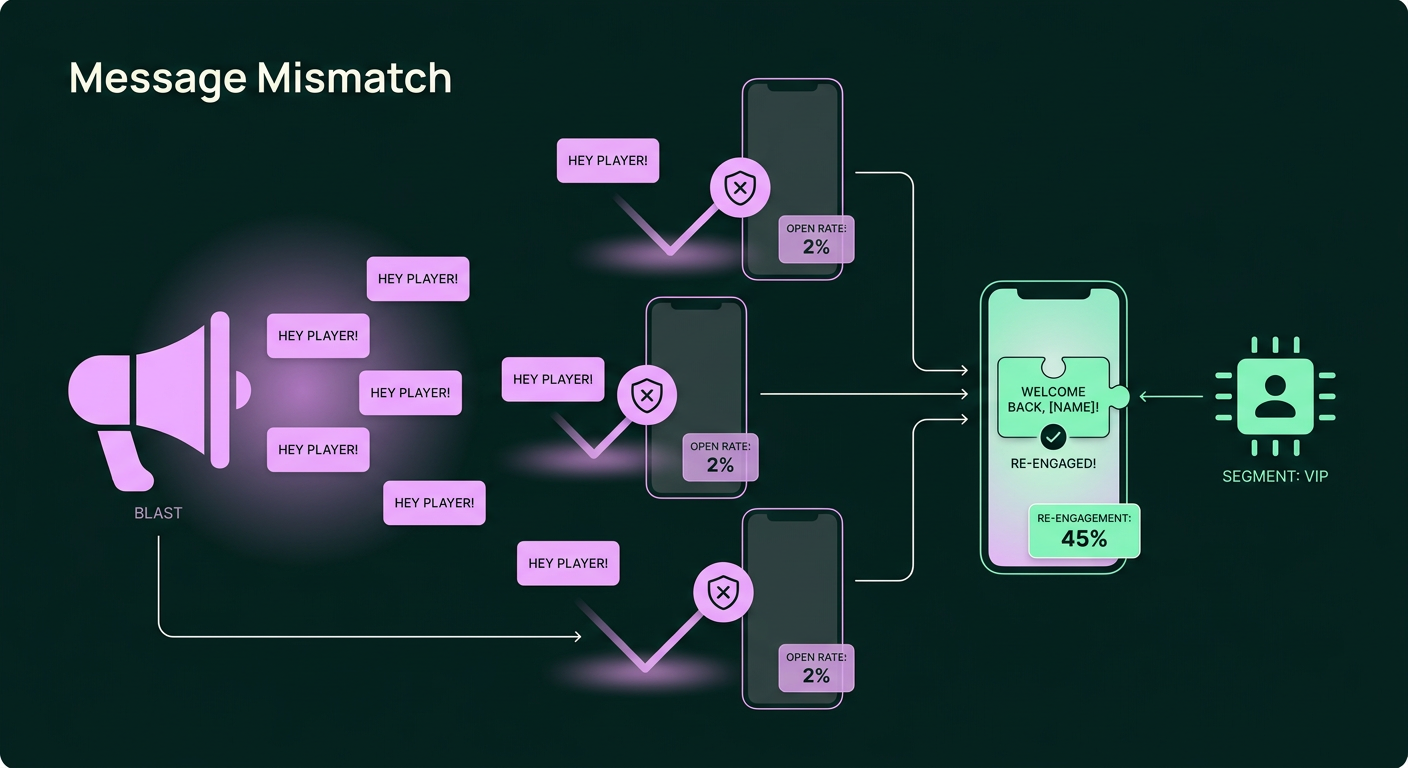
Generic reactivation campaigns fail because they lack the context to be relevant, a problem rooted in disconnected and poorly managed player data. When a campaign underperforms, it’s tempting to blame the channel and assume players just ignore push notifications or email. But the real issue is almost never the delivery mechanism; it’s the message itself. Sending the same offer to every lapsed player guarantees it will resonate with almost no one.
The real reason your messages get ignored
The core problem is that most reactivation campaigns are run with a one-to-many mindset. Sending a single "we miss you" email to an entire dormant list (opens in a new tab) feels impersonal and is often why those players went quiet in the first place. With a reported [85% of marketing campaigns failing](https://linkedin.With (opens in a new tab) a reported 85% of marketing campaigns failing, a primary cause is a breakdown in how customer data is used to inform the message. Without context about a player's history, preferences, or the specific point where they disengaged, your message is just a shot in the dark, lacking any compelling reason for that person to come back.
It's not the channel, it's the data
A generic strategy can render even the most proven channels useless. Consider email: its effectiveness is often crippled before the message is even seen. Gmail's algorithms are designed to route promotional content directly to the Promotions tab (opens in a new tab), where your win-back email gets lost in a sea of retail discounts and newsletters. This isn't a failure of email as a channel. It's a failure of a strategy that produces messages that feel like marketing noise. When you don't use data to create a personalized, relevant message, even the most direct channel just adds to the clutter.
Diagnosing Your Churn and Reactivation Data Gap
You can diagnose your data gap by analyzing if your segments reflect why a player churned, not just that they churned. If your main segment is simply "all users inactive for 90 days," you have a data gap. To be effective, you need to understand whether a player left during a frustrating onboarding, after hitting a progression wall, or after finishing all the endgame content. Pinpointing these gaps in your own approach starts with looking critically at how you segment lapsed players, which a few key questions can help reveal.
Did they churn from onboarding or endgame?
A player who downloaded your game, struggled with the tutorial, and churned on day two is fundamentally different from a highly engaged, paying player who simply ran out of content after a year. Yet, in many reactivation marketing strategies, both are bucketed into the same "inactive" list and receive the same message. The player who was confused by the core loop doesn't need to know about a new raid boss; they need a reason to give the initial experience a second try. The endgame veteran doesn't need a "welcome back" bonus of 100 coins; they need to know that a substantial new expansion has arrived. If your messaging doesn't differentiate between these two scenarios, it's destined to fail for both.
Are you messaging players who can't receive it?
Another common failure point is trying to reach players on channels where they're no longer listening. A user who turned off push notifications after a few days of frequent alerts won't see your win-back message. An email sent to the address they used for their App Store login might go unchecked for months. A strong data strategy means understanding which channels are actually viable for a given player segment and focusing your efforts there instead of sending messages out into the void.
Do your segments reflect why players left?
This is the most critical diagnostic question. Effective reactivation hinges on segmentation that goes beyond simple inactivity. Using your CRM and game data, you can create segments based on the likely reason for churn. For example, inactivity scoring can identify contacts who haven't engaged in 90 to 180 days (opens in a new tab), but the real work is creating sub-segments. Did a player's session length dramatically decrease after a specific level, suggesting they hit a paywall or a difficulty spike? Did they stop playing right after a major, potentially confusing update? These behavioral signals are clues to the root cause of their churn.
Segmenting by root cause before sending any message is the single highest-leverage action a practitioner can take. A campaign built around three churn archetypes, each matched to distinct CRM signals, will outperform a blanket bulk send every time. List segmentation before outreach is not optional; it is the foundation of a credible reactivation effort. , Outport.ai
By building segments around these churn archetypes, you move from generic pleading to specific, problem-solving communication. This is the foundational shift required for any credible reactivation effort.
How to Fix It: From Segmentation to Personalization
The fix is to connect your player behavior data to your messaging tools, build segments based on the root cause of churn, and craft personalized 1:1 messages that address that specific cause. Instead of a generic send, a targeted offer goes to a player who hit a progression wall, or an announcement about new content goes to a player who completed the game. This requires a system that can both understand player context and act on it with individualized outreach.
After diagnosing the data gap, the fix is to shift from a broad, impersonal model to a "segment and personalize" one. The goal is to make every reactivation message feel like it was written for the person receiving it, because, in a sense, it was. This requires rethinking how data flows through your systems and understanding how to connect player behavior with your messaging (opens in a new tab).
The process begins by unifying your data. Player event data from your game (like last login, level reached, purchases made, and social features used) must be connected to your lifecycle marketing platform to create a rich behavioral profile for every player. With this foundation, you can build meaningful segments, such as:
- Segment 1: Onboarding Churn. Players who completed fewer than three sessions and didn't finish the tutorial.
- Segment 2: Progression Wall. Players with high engagement for 30+ days who churned after repeated failures on a specific level.
- Segment 3: Content Complete. High-LTV players who completed all available story content and haven't logged in since.
With these segments, you can stop sending generic messages and start crafting personalized, helpful interventions. The player who churned during onboarding might receive a DM with a link to a short video explaining a key game mechanic. The player stuck on a hard level could get an offer for a specific power-up that helps them get past it. The endgame player gets an exclusive sneak peek at the next big update. This is what true personalization looks like, a far cry from just putting a player's first name in a subject line. Since a key reason campaigns fail is a lack of ongoing monitoring and adjustment, your system must also be able to track performance in real time to optimize these personalized flows. A successful approach for re-engaging inactive users in your community app depends on this kind of responsive, data-driven personalization.
Even with this approach, the channel matters. While email can be effective, especially as deliverability improves (one 2024 analysis found that conversion improved by 27.6% year-over-year), the most powerful messages are often sent on channels where players are already active and engaged, like social DMs.
What Success Looks Like: From Open Rate to Win-Back Rate
Success is measured not by superficial engagement metrics like email open rates, but by the actual win-back rate and its impact on long-term player lifetime value. A working reactivation strategy moves the needle on core business KPIs. You'll know it's fixed when you can confidently report an increase in reactivated players who not only return for a single session but re-engage with the game meaningfully over weeks and months.
Once you've shifted your strategy, your metrics for success will shift too, moving from vanity to value. Instead of celebrating a 20% open rate on a generic email send, you’ll measure the percentage of a churn segment that reactivates and makes a purchase. The goal is no longer just getting a message opened; it's restarting a valuable player relationship.
A successful program is one where you can draw a direct line from a specific, personalized message to a cohort of players returning to your game. You’ll see that your intervention for players stuck on level 50 resulted in a 15% reactivation rate for that segment, and that those players went on to have a 30-day retention rate comparable to active users. This level of granular measurement allows for continuous improvement, as you can test different offers and messages to see what works best for each churn archetype.
Ultimately, success is economic. A powerful reactivation strategy contributes directly to revenue and profitability. With some reports showing that email marketing can generate an average return of $38 for every dollar spent, a well-executed, data-driven reactivation program across multiple channels promises an even greater return. It transforms reactivation marketing from a cost center into a reliable engine for growth, helping you understand how to increase customer lifetime value without more ads and building a more resilient, profitable game. Looking ahead, industry reports like the 2026 IDC MarketScape for AI-enabled CDPs for B2C Users, which named MoEngage a Leader, underscore the growing importance of sophisticated data platforms in driving these personalized customer journeys.
Frequently asked questions
How do I start a personalized reactivation campaign for my mobile game?
Start small by choosing one specific, high-value churn point, such as players who leave after the first week. Use your game analytics to build a segment of these players. Instead of a generic message, craft a highly specific offer or piece of content that addresses a likely reason for their churn, like a bonus for completing a difficult early-game quest, and deliver it via a direct channel like an email or social DM.
What's the best way to test audiences and copy for a player win-back campaign?
Use A/B testing on small, representative samples of your churned player segments. For a given segment, test different offers (e.g., in-game currency vs. a specific item), different messaging tones (e.g., helpful vs. exciting), and different timing (e.g., 30 days vs. 60 days post-churn). Measure which variant produces the highest rate of players returning and completing a key action, then roll out the winner to the broader segment.
What retention metrics do I need to build useful player segments?
To build effective reactivation segments, you need to look beyond just the last login date. Key metrics include tutorial completion rate, session frequency and duration, progression milestones (e.g., level reached), monetization events (first purchase, repeat purchases), and social feature usage. Combining these data points allows you to create behavioral archetypes that hint at why a player churned.
How do I turn player retention data into messaging experiments?
Start by forming a hypothesis based on your data. For example: "We believe players who churned after reaching level 20 did so because of the difficulty spike. We hypothesize that offering them a bundle of three free power-ups will encourage them to return and overcome this challenge." This hypothesis becomes the basis for a targeted messaging experiment for that specific player segment.
How can I use behavior signals to stop players from churning in the first place?
Proactive retention involves monitoring for leading indicators of churn. These can include a sudden drop in session frequency, players repeatedly failing the same level, or a player's in-game currency balance dwindling to zero without a new purchase. You can set up automated triggers to send a helpful, personalized message, like a tip for the hard level or a special currency offer, at the first sign of this disengagement, intervening before they become inactive.
How can my game re-engage players without just sending more push notifications?
Focus on channels where you can have a 1:1 conversation. Direct messages on platforms like Instagram, WhatsApp, or Facebook Messenger can feel more personal and are less likely to be ignored than a generic push notification. By securing consent to message players on these platforms, you open up a high-engagement channel for sending personalized offers and content that feels like a direct conversation, not a broadcast.