
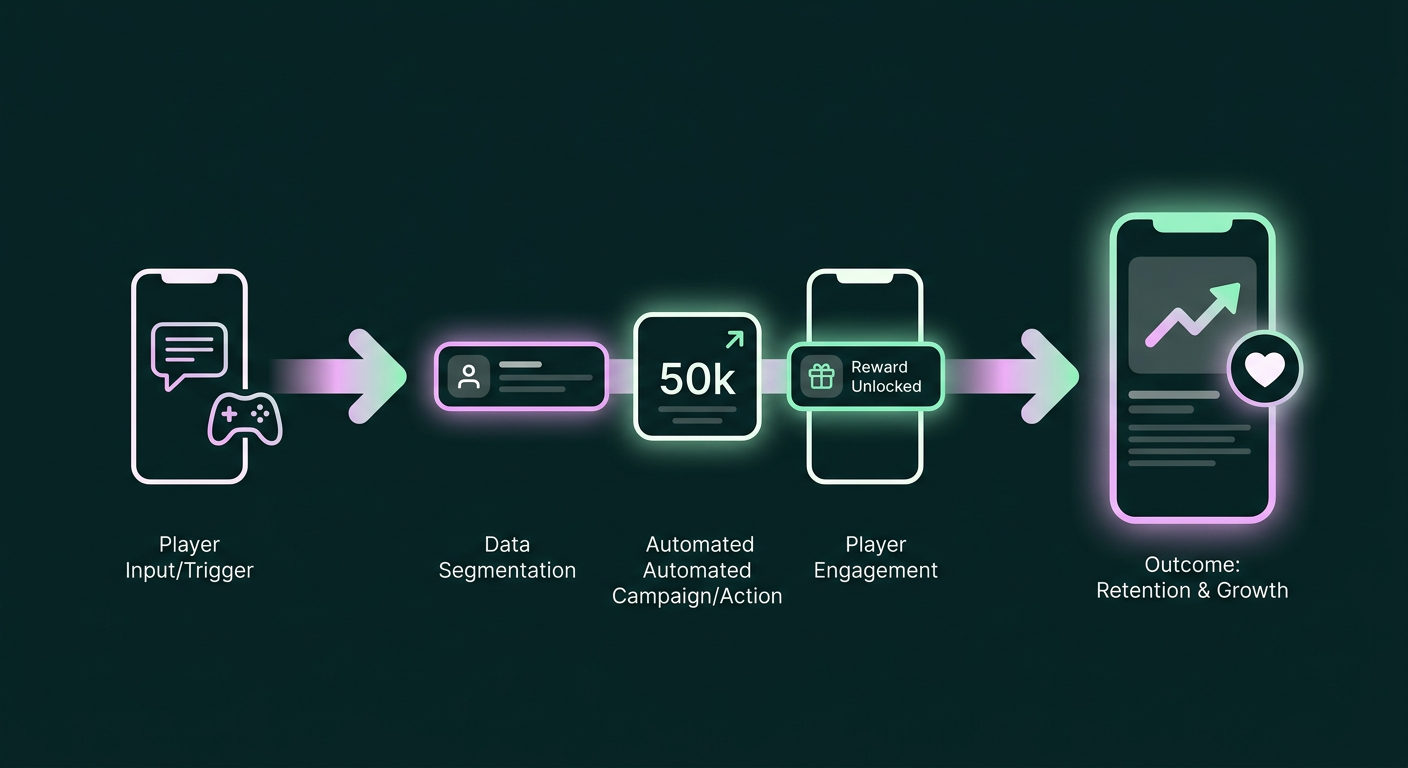
If you're in charge of a mobile game's lifecycle, you know the frustration of trying to win back lapsed players. Your current efforts, most likely built on generic push notifications, are seeing diminishing returns. Players are simply ignoring them, and your team is stuck in a frustrating cycle of manual campaign management that feels neither personal nor measurable. The goal is to build an automated system that connects your rich player data to individualized messages players actually want to receive, turning churn into a strategic re-engagement opportunity.
Why Your Generic Win-Back Campaigns Are Falling Short
The core problem is a lack of personalization at scale. Generic "we miss you" push notifications fail because they ignore the specific context of each player's journey, making them easy to dismiss. Effective player retention automation uses systems and workflows to minimize churn by delivering relevant, timely messages that feel personal, not like an impersonal announcement.
Every player drifts away for a different reason. Some hit a frustratingly difficult level, others run out of content, and many just get pulled away by other games or the distractions of life. When you send the same notification to all of them, a high-spending whale who hasn't logged in for a week and a free-to-play user who dropped off during the tutorial, you're treating them as a monolith. This undifferentiated approach is why so many win-back campaigns fall flat.
True re-engagement requires a more nuanced strategy. A well-designed re-engagement campaign is a coordinated effort (opens in a new tab) that combines different messaging channels and in-game mechanics to give a player a compelling reason to return. It’s not just about reminding them the game exists; it's about showing them what they're missing and why they should come back now. But coordinating this for thousands or millions of individual players is impossible to do manually. This is precisely the problem that customer retention automation is designed to solve (opens in a new tab). It uses technology to deliver the right message to the right player at the right moment based on their specific behavior, without a team member needing to press "send" each time.
Why Automated, Personalized Outreach Matters
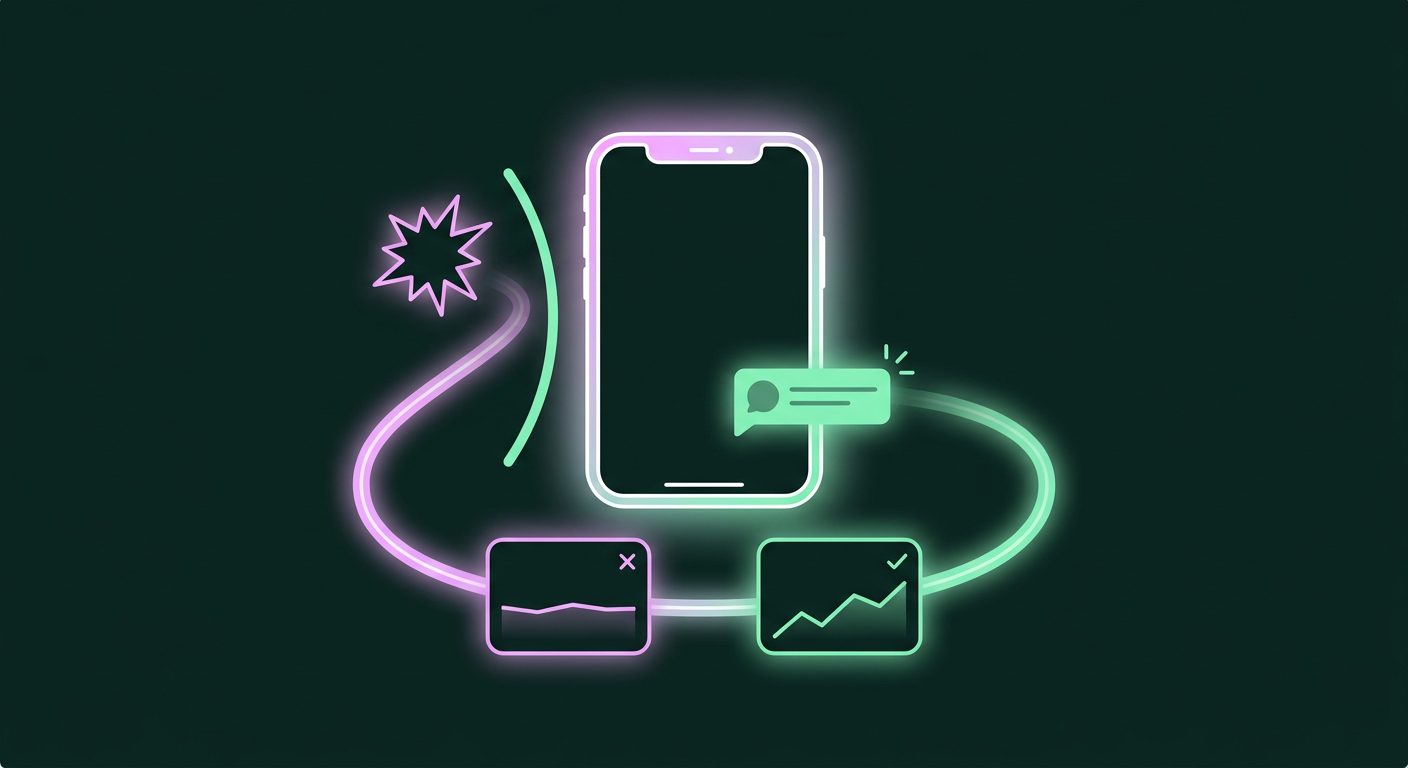
Implementing a robust automation strategy is critical because it directly impacts your bottom line by unlocking significant revenue and making your retention efforts scalable. While acquiring new players is expensive, effectively re-engaging your existing player base through lifecycle campaigns can generate a substantial portion of your game's total revenue.
The stakes here are incredibly high. With the cost of user acquisition continuing to climb, every player you've already acquired is a valuable asset. Letting them churn without a fight is like leaving money on the table. In fact, by building successful lifecycle marketing campaigns, mobile game studios can often generate 5-15% of their total app revenue from channels like email and push notifications alone. This isn't just about sending more messages; it's about sending smarter ones that resonate with players and encourage them to spend more time and money in your game.
This is where the power of automation becomes clear. Manually crafting and sending personalized messages to different player segments isn't a sustainable or scalable process. By automating your retention workflows, you make your efforts far more efficient. As one industry analysis notes, automation makes retention scalable (opens in a new tab) by lowering the marginal cost of bringing back each customer. For mobile games, this means you can systematically re-engage more players with tailored offers and updates, increasing repeat engagement and in-app purchases without having to proportionally increase your team's size or workload.
A 3-Step Playbook for Automated Player Retention
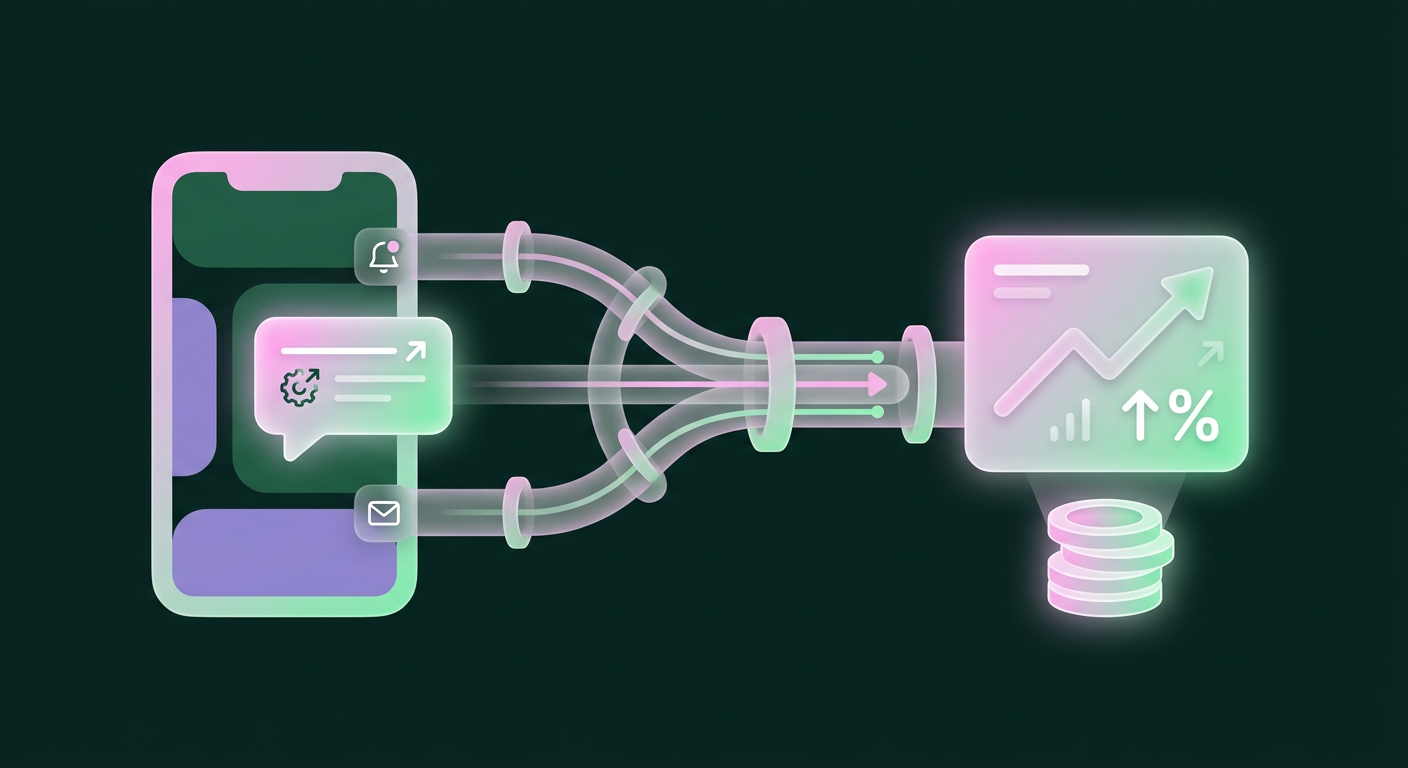
A successful automated retention strategy breaks down into three core phases: connecting your data, segmenting your players, and triggering personalized messages. This framework moves you away from reactive, manual campaigns and toward a proactive, scalable engine for player re-engagement.
Now that you understand what's at stake, the path forward involves building a system that turns player behavior into automated, personalized outreach. A late-2023 survey found that an overwhelming 74% of mobile game developers identified lifecycle marketing and community and social features as having a strong impact on retention, on par with community features. This playbook provides a structured approach to building that capability within your team.
Phase 1: Connect Your Player and Event Data
Before you can send a single personalized message, you need a unified view of each player. The first and most critical step is to consolidate your player data from various sources into a single system your marketing automation tool can access. This isn't just about contact information; it's about behavior. You need to track key in-game events and attributes like last login date, session duration, tutorial completion, level progression, purchase history, and interactions with live-ops events. Without this rich, event-based data flowing from your game's backend into your CRM or messaging platform, any attempt at personalization will be superficial. The goal is a comprehensive profile for each player that helps you understand their journey and predict their needs.
Phase 2: Segment Lapsed Players Based on Behavior
With your data connected, you can move beyond the generic "lapsed player" bucket and create meaningful, behavior-based segments. This is the heart of personalization. Instead of one large group, you can now define highly specific audiences, like "High-Value Players Lapsed 7-14 Days," "Free Players Who Churned After Level 10," or "Players Who Haven't Engaged with the Latest Feature." These segments are far more actionable. The criteria for these groups should be tied directly to standard mobile game retention benchmarks (opens in a new tab), which measure user activity at specific intervals like Day 1, Day 7, and Day 30. By segmenting based on where players are in their lifecycle and what they did (or didn't do), you can craft messages and offers that are significantly more relevant.
Phase 3: Trigger and Test Personalized Messages
The final phase is putting your data and segments to work. For each segment you've identified, you can now build automated workflows that trigger personalized messages based on specific criteria. When a player enters the "Lapsed High-Value" segment, the system can automatically send a DM or email with an exclusive offer for an item they might value. If a player stalls on a difficult level for several days, you can trigger a message with a helpful tip or a free power-up. This is where you can explore a variety of different retention use cases (opens in a new tab) to find what works for your game. The key is to shift from broadcasting to conversing. These automated messages should be designed as experiments, constantly testing different copy, offers, channels, and timing to optimize performance and learn what brings your players back. This continuous loop of testing and learning is essential for building a truly effective retention engine and exploring how to increase customer lifetime value without more ads (opens in a new tab).
Common Pitfalls in Retention Automation (and How to Avoid Them)
Now that you have a clear path forward, it's crucial to be aware of the common mistakes that can derail your efforts. The most frequent errors include ignoring channel consent, sending uninspired messages, and over-relying on a single channel like push notifications, all of which can alienate players instead of re-engaging them.
Building a powerful retention engine isn't just about having the right tools; it’s about using them thoughtfully. Even with the best data and segmentation, a few missteps can undermine your entire strategy.
Mistake 1: Ignoring Channel Consent and Eligibility
Just because you have a player's contact information doesn't mean you have a blanket right to message them on every channel. A player might have push notifications turned off but be opted-in to email, or they may have engaged with you on a social messaging app. Sending messages on channels where you don't have explicit consent is poor practice that can harm your brand's reputation and can also violate platform policies or regulations. Always respect player preferences and use a system that can track and honor consent on a per-channel basis.
Mistake 2: Sending Messages That Feel Obligatory, Not Enticing
An automated message should never feel automated. A win-back message that simply says "We've missed you!" is unlikely to be effective. The goal is to provide value and create a compelling reason to return. What new content have you added since they last played? Can you offer them a special "welcome back" bonus, like in-game currency or a powerful item? Is there a new event starting that they would enjoy? Your message should be an enticing invitation, not a bland reminder. It should feel less like a system notification and more like a personal note from a community manager who understands what they love about the game.
Mistake 3: Relying Solely on Push Notifications
Push notifications are a valuable tool, but they are also easily ignored and frequently disabled. An effective retention strategy is multi-channel. For players who have opted out of push, other channels become essential. For example, automated email campaigns can be used to deliver a great experience and can offer a significant return on investment. Even better are direct messaging channels like WhatsApp or Instagram DMs, which have much higher open rates and feel more personal. The best approach is to meet players on the channels they actually use and prefer, using each one's unique strengths to deliver the right message in the right format.
What 'Done' Looks Like: A Scalable Retention Engine
By avoiding these common errors, you can build a true retention engine. Success isn't a single "campaign complete" moment; it's a scalable, always-on system that automatically identifies at-risk players, re-engages lapsed ones with personalized outreach, and continuously learns and optimizes itself over time. This frees your team to focus on high-level strategy.
The ultimate outcome is a shift from manual, reactive firefighting to a proactive, strategic approach to player lifecycle management. Instead of your team spending hours pulling lists and scheduling generic sends, the system does the heavy lifting. It watches player behavior 24/7, identifies when a player is drifting away, and intervenes with a tailored message designed to bring them back. This automated process ensures every re-engagement opportunity is acted upon. This is a fundamental change in how you think about your user base, moving beyond acquisition and toward a new direct to consumer marketing strategy (opens in a new tab).
This engine becomes a powerful strategic asset. For instance, data for 2025 showed that in the US market, the Puzzle and Lifestyle genres were responsible for 41.3% of IAP revenue but attracted 56.2% of ad spend. In such a competitive environment, an automated system that can efficiently retain those hard-won, high-value players is not just a nice-to-have; it's a critical competitive advantage. With the engine handling the day-to-day tactical execution, your lifecycle team is empowered to think bigger: analyzing performance trends, designing new strategic interventions, and developing more creative ways to delight and retain your player community.
"A re-engagement campaign is a coordinated effort to bring lapsed mobile game players back into active play. It typically combines paid retargeting, owned channel messaging (push, email, in-app), and in-game mechanics designed to reward the return and prevent immediate re-churn." , Helpshift Blog
Frequently asked questions
How do I pilot a personalized reactivation campaign for my mobile game?
To pilot a personalized campaign, start by focusing on a small, high-value segment. For example, identify players who have made in-app purchases but have been inactive for 14-30 days. Instead of a generic message, craft a specific offer relevant to their past behavior, like a bonus for a game mode they frequently played or a discount on an item they might like. Use a combination of owned channel messaging and in-game rewards to make the offer compelling. Measure the return rate and spend of this group against a control group that receives no message to prove the ROI before scaling.
How can my team test the audience, timing, and copy for a player win-back campaign?
Systematic A/B testing is the best way to optimize your win-back campaigns. Start by defining a clear hypothesis for each test. For audience testing, you could send the same offer to "high spenders lapsed 7 days" versus "high spenders lapsed 30 days" to see which group is more receptive. For timing, you might test sending a message at 10 AM versus 7 PM local time. For copy and offers, you can test a direct, offer-led message ("Get 500 free gems!") against a more emotional, content-focused one ("See the new world you're missing!"). Track engagement rates, return rates, and post-return spend for each variant to determine the winner.
Which retention metrics are most important for building useful player segments?
To build useful player segments, you need to go beyond just "active" or "inactive." Key metrics include Day 1, Day 7, and Day 30 retention to understand early lifecycle behavior. Beyond that, focus on behavioral data: last seen date, session frequency and duration, purchase history (including amount and frequency), progression (level reached, tutorials completed), and engagement with specific features or events. Combining these metrics allows you to create nuanced segments like "Whales at risk of churn" (high spenders with decreasing session times) or "Engaged non-spenders" (frequent players who haven't made a purchase).
How can we use player retention data to create targeted messaging experiments?
Player retention data is the foundation for creating testable hypotheses for your messaging. For example, if you see a significant player drop-off at Level 15, you can hypothesize that "Players are churning at Level 15 because it is too difficult." You can then design an experiment to automatically trigger a message to players who have been stuck on that level for over 24 hours, offering them a free power-up or a hint. By measuring whether this message improves the progression rate past Level 15, you use data to identify a problem and test a targeted, automated solution.
How can we use behavior signals to intervene before a player churns?
Proactive intervention relies on identifying the leading indicators of churn. Instead of waiting for a player to become fully inactive, monitor subtle changes in their behavior. Are their session lengths getting shorter? Are they logging in less frequently? Have they stopped participating in daily quests or guild activities? These are all signals that their engagement is waning. You can set up automated triggers based on these signals to send a preemptive message, perhaps highlighting a new feature, offering a small bonus for logging in, or reminding them of their recent progress to encourage them to stick around.
What tools can connect player data to personalized retention messaging for mobile games?
To effectively automate personalized messaging, you need a platform that can act as the central hub for your retention efforts. This type of tool should integrate directly with your game's backend to ingest a live stream of player and event data. It needs robust segmentation capabilities to group players based on complex behavioral criteria. Finally, it must connect to various messaging channels, like push, email, and especially direct messaging platforms like WhatsApp or Instagram, to trigger and send personalized, automated messages based on the segments and rules you define.