
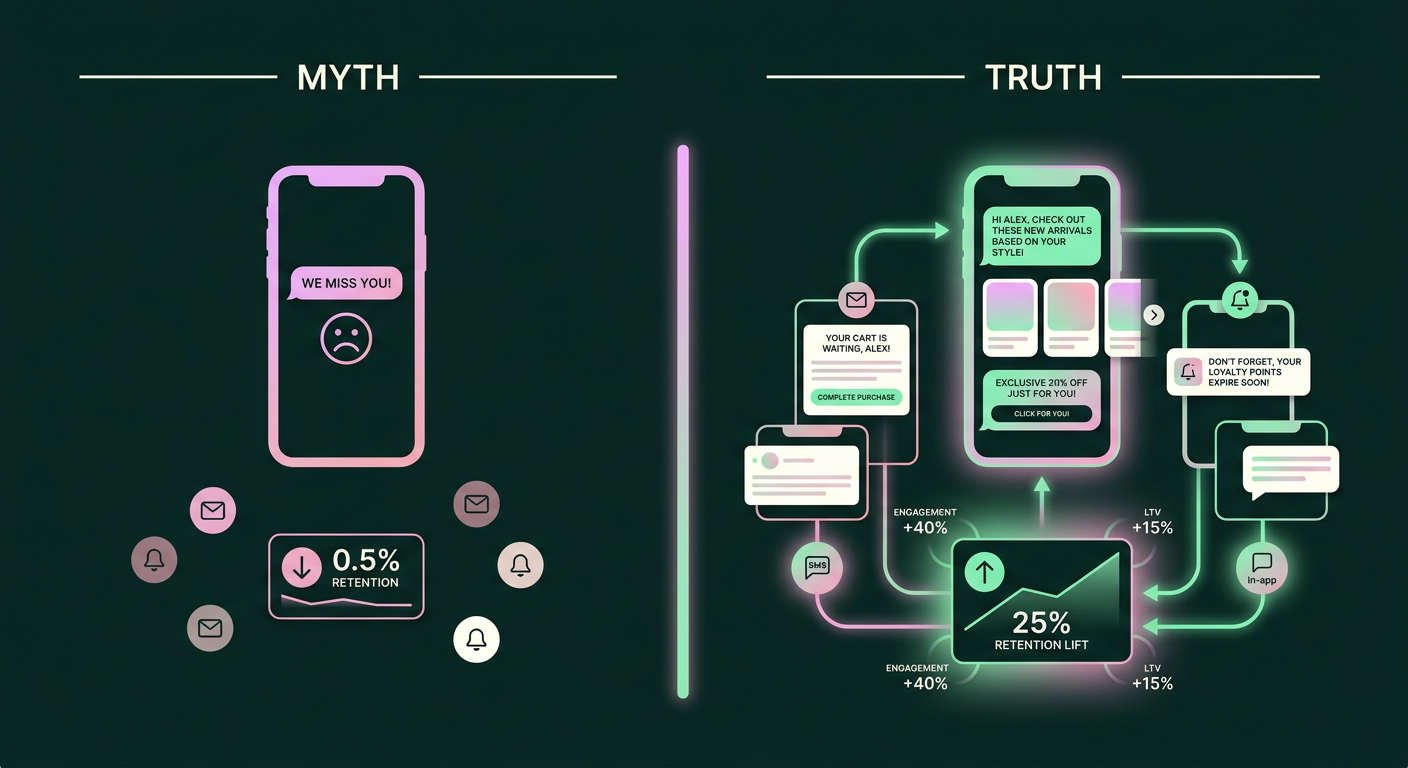
For too long, retention marketing has been treated like a numbers game. The standard playbook involves sending a generic "We miss you!" push notification to every player who hasn't logged in for a week, hoping a small percentage might return. This approach isn't just outdated; it’s actively counterproductive. It treats players like entries on a spreadsheet, burning out your audience with irrelevant noise while wasting the huge financial opportunity in genuine player retention. Since the cost to acquire a new customer is four to seven times higher (opens in a new tab) than keeping an existing one, every player you alienate with generic messaging represents a significant and unnecessary expense.
You think retention is a numbers game. It's not.
The belief that retention is just a matter of message volume is fundamentally flawed. Real retention marketing automation is about precision, not power. It’s a system of intelligent, individualized outreach triggered by specific player behaviors, not a cannon aimed at everyone who has gone quiet.
This "spray-and-pray" approach to re-engagement is a relic from a time when player data was siloed and messaging tools were blunt instruments. It completely ignores why players stay or leave: their individual experience. A high-level player who hasn't logged in for three days has a different motivation than a new player who dropped off during the tutorial. Sending them the same message isn't just lazy, it’s a missed opportunity to connect in a way that feels personal and relevant, the only thing that truly inspires a return. Ultimately, the numbers-game mentality is better at annoying people into unsubscribing than it is at actually winning back valuable players.
Why every studio defaults to generic push notifications
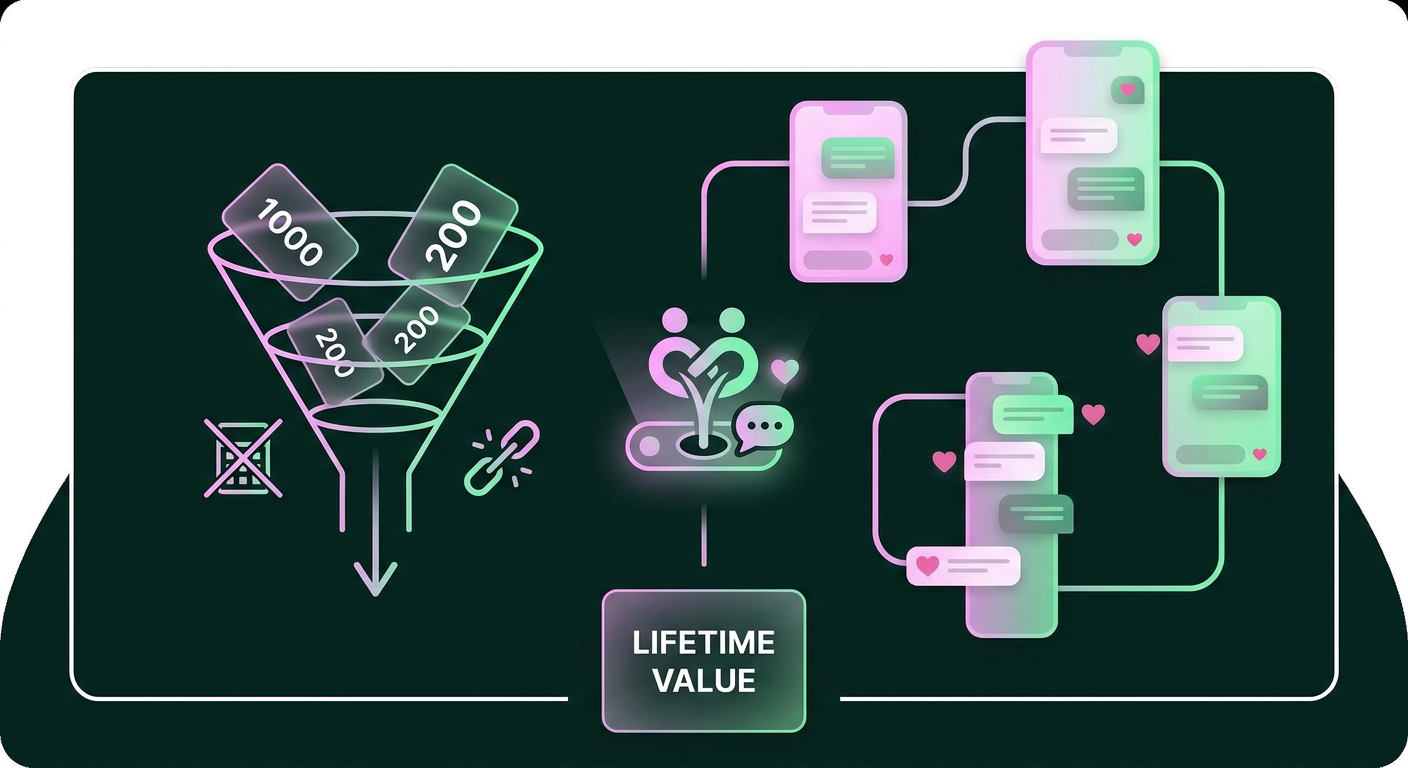
So if this approach is so ineffective, why do so many smart teams keep doing it? The default to generic, high-volume campaigns happens because it's technically simple, requires less data integration, and creates the illusion of productive action. It’s the path of least resistance, even when the results are consistently poor.
For many mobile game studios, player data, churn signals, and live-ops context are scattered across different systems. The analytics team has the behavioral data, the CRM team has the messaging platform, and the two systems don't talk to each other in a truly dynamic way. In this environment, setting up a simple, time-based trigger, "if player inactive for 7 days, send push notification", is the easiest thing to do. It lets a manager look at a dashboard and report that 50,000 re-engagement messages were sent this week. It feels like progress.
This approach often gets bundled into what the industry calls a coordinated re-engagement program (opens in a new tab), which typically combines paid retargeting with messages on owned channels like push notifications, in-app messages, and email. While the coordination sounds sophisticated, the messaging itself usually remains generic. The core problem persists: without a deep connection to individual player behavior, the "what" of the message is just a guess, resulting in a lot of noise that most players simply ignore.
The data that changes the retention game
The data makes it clear why this shift is so important. The evidence overwhelmingly shows that personalized retention isn't just a "nice-to-have" but the single most powerful lever for profitability, with channels like DMs dramatically outperforming traditional push notifications.
The economic argument is impossible to ignore. A mere 5% increase in customer retention can boost profits by a staggering 25% to 95% (opens in a new tab). This isn't just because you're saving on acquisition costs; you're building on an existing relationship. A recent analysis confirmed this, showing the likelihood of making a sale to a current player is between 60-70%, while the chance of converting a brand-new prospect is a meager 5-20%.com/blog/4-ways-marketing-automation-can-improve-your-customer-retention), while the chance of converting a brand-new prospect is a meager 5-20%. When you invest in keeping a player, you are investing in your most valuable asset.
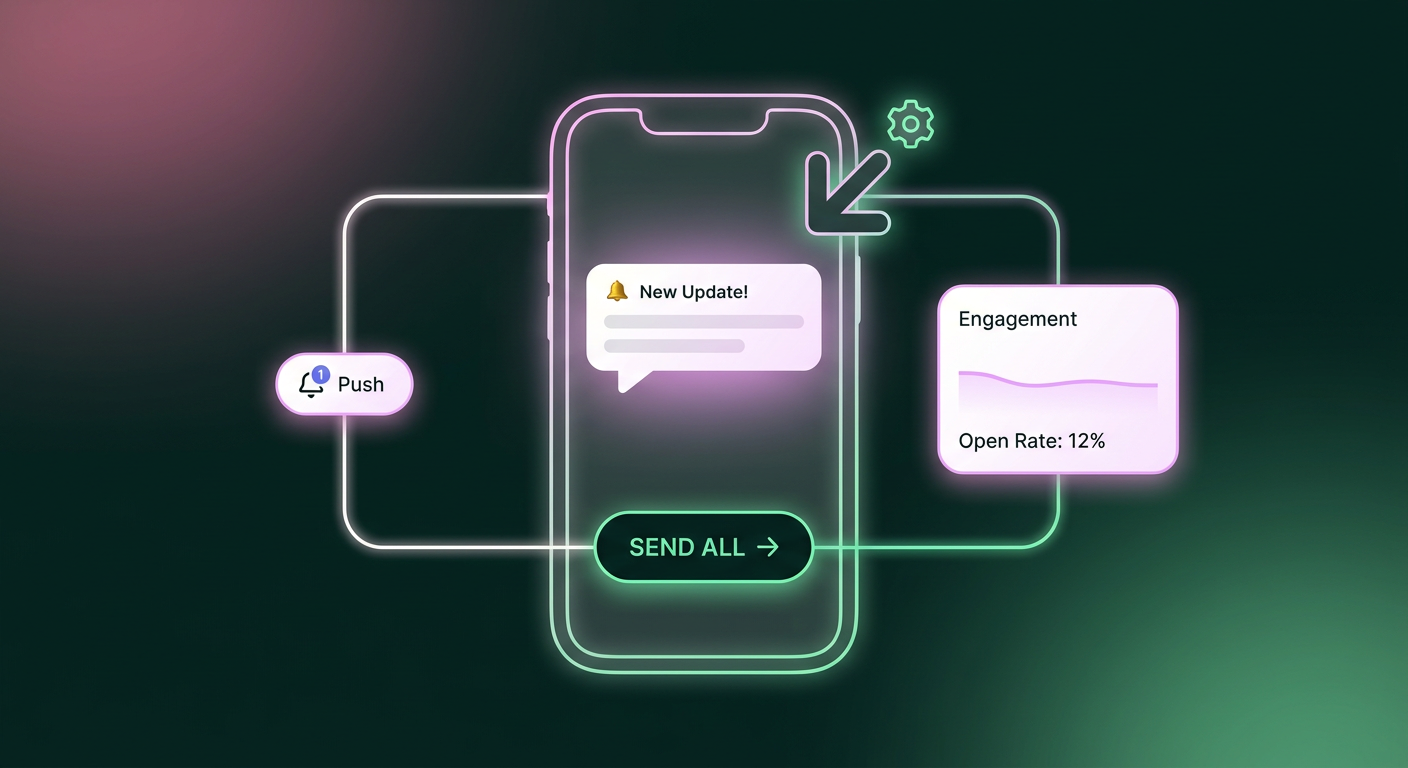
This is where the channel and the message become critical. Generic push notifications are easily dismissed, having become background noise for most mobile users. In contrast, a personalized direct message (DM) on a platform like Instagram or WhatsApp feels like a one-to-one conversation. The engagement numbers bear this out: DM open rates are typically above 80% (with WhatsApp hitting as high as 98%), and their conversion rates are three to five times higher than push notifications. A well-timed, relevant DM isn't an interruption; it's a personal invitation that lands where players are already having conversations, making it far more likely to be seen and acted upon.
What player retention actually looks like now
So if generic messaging is out, what's the alternative? Modern player retention is a sophisticated system that uses behavioral data to deliver the right message to the right player segment at the right moment. It's about turning player actions, or inactions, into triggers for personalized, helpful, and timely outreach.
Instead of a single, blunt automation for all lapsed players, an effective retention strategy involves dozens of smaller, smarter campaigns. For example, imagine a player completes the tutorial but doesn't return the next day. A modern system wouldn't wait a week to send a generic "We miss you." It would trigger a DM the very next day with a specific tip about what they were doing last, or maybe a small reward to encourage them to try the first level. Another player might be a high-spending veteran who suddenly stops making purchases. Here, the trigger isn't inactivity but a change in purchasing behavior, which could prompt a personalized message about a new high-level event or an exclusive offer.
This level of orchestration is rapidly becoming the new standard. According to industry analysis, by 2026, retention marketing automation platforms capable of orchestrating and measuring the entire player lifecycle (opens in a new tab) will be the benchmark for high-performing teams. The same analysis notes that in 2026, the ROI gap between retention and acquisition efforts will have widened even further due to rising ad costs, making this shift from generic to personal not just an advantage but a necessity for survival. This is a core part of a more thoughtful approach to rethinking post-install engagement for app growth (opens in a new tab).
How to automate without being generic
This smarter approach comes down to changing your perspective from bulk messaging to individualized conversations. You can do this by connecting player data directly to your messaging triggers, using behavior to intervene proactively, and personalizing outreach around meaningful events and rewards.
The goal is to make every automated message feel like it was sent by a person who understands the player's journey. This requires a few key shifts in strategy and technology.
Connect player data to messaging triggers
The first step is to break down the silos between your game's analytics and your messaging tools. Your retention automation system needs a live feed of player behavior. This means knowing when a player last logged in, what level they reached, if they're part of a guild, what they've purchased, and where they tend to drop off. When this data is connected, "lapsed player" is no longer a single bucket but a collection of distinct segments, each with its own story and motivation.
Use behavior to intervene before a player churns
The most effective retention happens before a player has already churned. By monitoring behavioral signals, you can identify players who are at risk of leaving and intervene proactively. For example, a player who fails the same level five times in a row might be getting frustrated. Instead of waiting for them to quit, your system could automatically send a DM with a helpful tip or a free power-up. This transforms your messaging from a reactive win-back tool into a proactive engagement engine.
Personalize outreach around events and rewards
Personalization goes far beyond using a player's first name. True personalization uses their in-game context to deliver value. Is a player's favorite event starting soon? Send them a direct reminder. Did they just unlock a powerful new character? Send a message celebrating that achievement and suggesting a good team composition. By tying messages to a player's actual progress and interests, you create a retention program that feels less like marketing and more like a helpful concierge for their gaming experience. Exploring various use cases for this kind of automation (opens in a new tab) can spark ideas for your own game.
Your first personalized win-back campaign
Here's a concrete first step. Instead of trying to boil the ocean, start small with a single, highly-targeted win-back campaign. Pick one specific, measurable player segment and craft a personalized message just for them.
A perfect place to start is with players who complete the tutorial but drop off before coming back for a second session. This is a critical moment where many games lose potential fans. Your segment is clearly defined: "players who finished the tutorial and have not logged in for 48 hours."
Instead of a generic push notification, craft a specific DM. It could say something like, "Hey [PlayerName], great job finishing the training missions! That first boss on level 2 can be tough. Here’s a free health potion to give you an edge when you give it another try." This message is timely, context-aware, and offers immediate value.
Run this small experiment for a few weeks and measure the results. You can test different messages, offers, and timing to see what works best. A well-executed campaign can be incredibly effective. As one industry guide notes:
"The first time you run a reactivation campaign on a real database, you will book more appointments in 3 days than the sales team did in 30." , RevSquared
While gaming isn't about booking appointments, the principle holds: a targeted campaign can produce dramatic results quickly. For mobile games, successful win-back campaigns should aim for reactivation rates of 20-40%. By proving the model on a small scale, you build the case for a more sophisticated, personalized, and ultimately more profitable retention strategy. It's a key part of an effective user activation strategy to fix onboarding drop-off (opens in a new tab).
Frequently asked questions
How do I start a personalized reactivation campaign for my mobile game?
Start by identifying a specific, high-value segment of lapsed players, such as those who dropped off after the tutorial or after their first purchase. Use your player data to craft a message that is relevant to their last in-game action and offers a clear incentive to return, like a small reward or a helpful tip. According to some experts, a well-run reactivation campaign on a real database can produce significant results in just a few days, demonstrating the power of targeted outreach.
What's the best way to test audiences, timing, and copy for a player win-back campaign?
Begin with one specific player segment to create a controlled testing environment. From there, you can run A/B tests on different elements. For example, you can test sending a message after 3 days of inactivity versus 7 days. You can also test different copy approaches, one focused on a reward and another on a story update, to see which resonates more. Track open rates, click-through rates, and, most importantly, the rate of players who return and complete a desired action.
What metrics do I need to build useful player segments for retention?
To move beyond generic segments, you need access to behavioral data. Key metrics include last login date, session frequency and duration, tutorial completion status, level or milestone achieved, purchase history (including frequency and amount), and social actions like joining a guild or inviting friends. Combining these data points allows you to create nuanced segments like "high-value players with declining session times" or "new players stuck on level 5."
How can my mobile game stop relying on push notifications to re-engage players?
The most effective way to reduce reliance on push notifications is to adopt channels with higher engagement, such as DMs on platforms like WhatsApp or Instagram. These channels have significantly higher performance, with DM open rates often exceeding 80% and conversion rates that are three to five times higher than push. By shifting your most critical re-engagement messages to DMs, you can reach players in a more personal and effective way, reserving push notifications for broader, less time-sensitive announcements.