
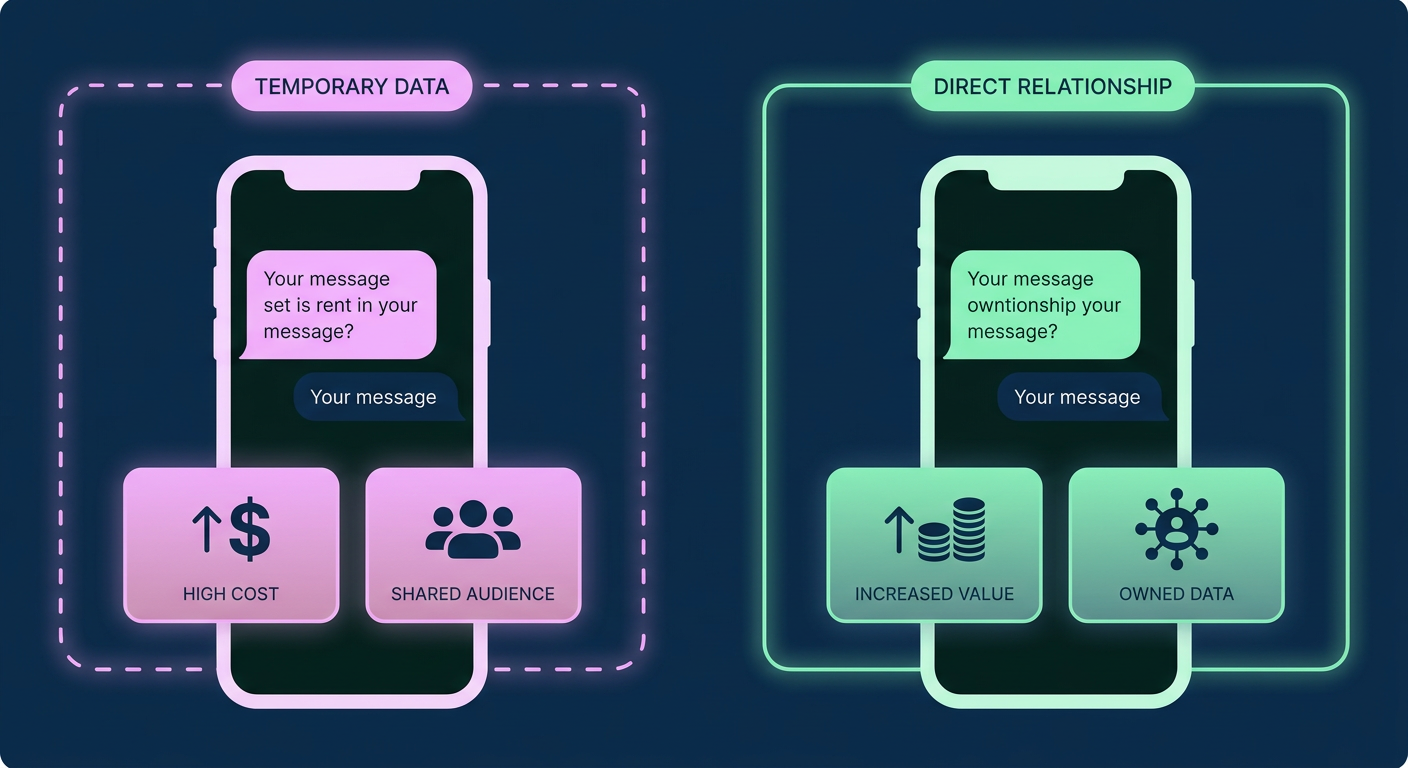
For many scaling direct-to-consumer brands, the math on paid acquisition just doesn't work anymore. You’re pouring an ever-increasing budget into Meta and Google to bring in new customers, only to watch most of them buy once and disappear. The whole operation feels like running on a treadmill, where a high volume of sales somehow never translates into a healthier bottom line. This forces a look at your tech stack, and the search often starts with “Klaviyo alternatives,” based on the assumption that your email platform is the root of the problem.
The hard truth, however, is that swapping one email service for another is like changing the tires on a car when the engine is broken. The issue isn’t the specific tool you’re using; it’s the over-reliance on email as your primary channel for customer retention. Genuine loyalty isn't built in a crowded inbox where your messages fight for attention, it's built through personal, timely communication on the channels customers actually use. The right alternative isn't a different email platform, but a different retention strategy altogether.
Why "Klaviyo Alternative" Is the Wrong Question
In short, your retention problem isn't about your email tool. It's about the limitations of email itself for building lasting customer relationships. While Klaviyo is a powerful platform for email and SMS, relying on it as your sole retention engine is why you’re stuck paying to re-acquire customers who should already be loyalists. The real challenge is finding a way to engage customers profitably after their first purchase.
This struggle is a common reason many direct-to-consumer brands find it incredibly difficult to grow past the $20 million revenue mark (opens in a new tab). After the initial boom many DTC brands experienced, particularly the lifeline they received in 2020 (opens in a new tab), the landscape grew saturated and ad costs skyrocketed. At the core of the problem are unit economics: it consistently costs five times more to acquire a new customer (opens in a new tab) than to retain an existing one. When your business model depends on constantly refilling a bucket with expensive new customers while old ones leak out, you can't achieve sustainable profitability.
Focusing your search on a Klaviyo alternative misses this fundamental point. You're looking at a tool problem when you actually have a channel problem. With declining email open rates and cluttered inboxes, even the best-crafted campaigns are often ignored. To truly fix retention, you need to shift from mass communication in a noisy channel to personalized, 1:1 conversations in a direct one, like Instagram DMs.
How to Choose a Retention-Focused Platform
To find a true retention solution, you have to evaluate platforms on their ability to create high-LTV relationships, not just on their ability to send messages. This means moving beyond metrics like email open rates and focusing on what a platform must do to actually drive repeat purchases and deeper customer loyalty. A modern retention platform should be judged on its channel effectiveness, automation depth, personalization capabilities, and integration with your existing data stack.
Here are the criteria that matter most for a scaling DTC brand trying to fix its retention problem:
- Channel Effectiveness: Where do the messages actually land? The platform’s primary channel should be one where customers are highly engaged and messages feel like personal communication, not just marketing. This is where channels like Instagram or WhatsApp DMs have a distinct advantage over email or even SMS, creating a space where a real conversation can happen.
- Full-Funnel Automation: True retention isn't about a single abandoned cart reminder; it’s about orchestrating a full lifecycle journey. The ideal platform should automate sophisticated workflows for post-purchase education, cross-selling, loyalty program engagement, and win-back campaigns for inactive customers.
- Personalization at Scale: Effective retention depends on making each customer feel seen. The platform must go beyond "Hi {{first_name}}" to use deep customer data, like purchase history, browsing behavior, and past interactions, to deliver genuinely relevant and timely 1:1 messages that feel less like a broadcast and more like a personal shopper.
- CRM and Data Integration: A retention tool can't create another data silo. It needs to plug seamlessly into your central source of customer truth, whether that's Klaviyo, Braze, or another CRM. This allows you to use the rich segments you've already built to trigger DM conversations based on behaviors tracked across your entire ecosystem. After all, a modest 5% increase in customer retention can boost revenue by 25% to 95% (opens in a new tab), and using your existing data is the key to unlocking that growth.
Comparison: Three Approaches to Customer Retention
Based on these criteria, it’s clear that traditional email platforms, basic DM tools, and full-lifecycle DM automation platforms offer vastly different capabilities for retention. While email remains a staple and basic DM tools offer a novel channel for engagement, only a full-lifecycle approach truly addresses the core challenge of systematically increasing customer lifetime value. Each has its place, but for a brand hitting the acquisition wall, the trade-offs are critical.
Table: Retention Platform Trade-Offs
| Decision Criteria | Email-Only Platforms | Basic DM Automation | Full-Lifecycle DM Automation |
|---|---|---|---|
| Channel Effectiveness | Low; cluttered inboxes | High for top-of-funnel | High across the entire funnel |
| Lifecycle Automation | Strong, but in a weak channel | Limited to simple triggers | Sophisticated, multi-step flows |
| Personalization at Scale | Basic (merge tags, segments) | Minimal (keyword-based) | Deep (1:1 from CRM data) |
| CRM & Data Integration | Excellent (as the source) | Poor to moderate | Excellent (reads existing segments) |
Interpreting the Results
The table highlights a clear progression in capability. Email-only platforms like Klaviyo are powerful hubs for data and segmentation, but their effectiveness is handicapped by the limitations of the email channel itself. Your perfectly crafted campaign is still just one of hundreds of messages in a customer's inbox.
Basic DM automation tools, like many of the most common ManyChat alternatives, represent a step in the right direction by using the high-engagement nature of social DMs. Many are excellent at comment-to-DM automation, which is perfect for capturing leads from posts or Reels by automatically sending a DM when a user comments a specific keyword. However, their strength is primarily at the top of the funnel. Because they often lack deep CRM integration and sophisticated flow-building, they can't run complex, personalized retention campaigns based on a customer's full history. They’re great for starting a conversation, but as one review notes, this type of automation is a flagship feature that works incredibly well for initial engagement, not for managing the entire relationship that follows.
Full-lifecycle DM automation platforms, like Dynamo, represent the synthesis of these two worlds. They combine the channel effectiveness of Instagram and WhatsApp DMs with the strategic depth of a CRM. By plugging directly into platforms like Klaviyo or Braze, they can use the rich customer segments you've already built to trigger highly personalized, 1:1 conversations across the entire customer journey. This means you can automate everything from a post-purchase thank you to a six-month win-back offer, all within a conversational channel where you know the customer is listening. This is how you stop paying to re-acquire your own customers and start systematically increasing their lifetime value.
Which Retention Strategy Is Right for You?
With those trade-offs in mind, the right path forward depends on your brand's current scale, strategic priorities, and willingness to move beyond the status quo. Not every brand is ready for a full-funnel DM strategy, but for those feeling the pain of the acquisition treadmill, it's the most direct path to sustainable growth.
For Brands Committed to Email-Only
If your business relies on a small, highly engaged email list and your customer acquisition costs are manageable, then sticking with a powerful email platform like Klaviyo might still make sense. You understand its workflows, you've built your segments, and it's getting the job done. Be aware, however, that you will likely hit a growth ceiling as your brand scales and your audience's inboxes become more crowded. This is a strategy for stability, not for breaking through a revenue plateau.
For Brands Just Starting with DM Automation
If you're intrigued by the high engagement of DMs but aren't ready for a full-funnel strategy, a basic DM automation tool can be a great starting point. These platforms are perfect for running top-of-funnel campaigns, like using comment-to-DM flows to distribute lead magnets or discount codes. It's a low-risk way to get familiar with the channel and see immediate engagement from your social followers. Just know that this approach won’t solve your core retention problem or significantly move the needle on customer LTV, and you'll need to be mindful of how pricing tiers can change, like when some tools shift to contact-based billing.
For Brands Scaling Past the Acquisition Treadmill
If you're leading growth at a scaling DTC brand and your primary pain point is the unsustainable cycle of acquiring one-time buyers, then you're past the point of simple tricks. You need a system that automatically turns new buyers into repeat purchasers. For you, a full-lifecycle DM automation platform is the clear choice. By integrating with your existing CRM to power personalized conversations, you can finally build the retention engine you've been missing. This strategy directly addresses the problem of paying to re-acquire customers by engaging them where they prefer, using AI-powered tools to handle the entire conversation from the first message to a booked appointment.co/blog/manychat-alternatives). You can explore how Dynamo enables these full-funnel DM use cases (opens in a new tab) to see what's possible.
Next Step: Automate Your Retention in DMs
Searching for Klaviyo alternatives is a signal that your current strategy isn't working. Instead of looking for a slightly different version of the same tool, it’s time to address the root cause of your retention problem: the channel. Email is no longer enough to build the kind of loyal customer relationships that lead to breakout growth.
The most effective way to increase your second purchase rate and boost customer lifetime value is to meet your customers where they already are: in their DMs. By implementing a full-funnel DM automation strategy, you can move from broadcasting into a crowded inbox to having personalized, 1:1 conversations that drive real business results. Stop paying to acquire the same customers over and over. Start retaining them automatically.
Frequently asked questions
How do I know if I should prioritize customer acquisition or retention right now?
You should prioritize retention as soon as customer acquisition becomes unprofitable on the first purchase. While acquisition is everything early on, you're on a treadmill if acquiring a customer costs more than their first order is worth. Given that it can cost five times more to acquire a new customer than to keep an existing one, shifting focus to retention becomes the only path to sustainable profitability.
What is customer lifetime value (CLV) and why is it so important for my DTC brand?
Customer lifetime value (CLV) is the total revenue a business can expect from a single customer over the course of their relationship with the brand, and it's the most important metric for long-term health. It shifts the focus from one-time transactions to long-term relationships. A high CLV means your customers are loyal and keep coming back, which is far more profitable than constantly acquiring new ones. For example, existing customers spend 67% more over time than first-time buyers, directly increasing your profitability without more ad spend. For a deeper look, you can explore the differences between tools focused on acquisition versus retention in this Klaviyo vs. Dynamo analysis.
How can I turn my one-time buyers into repeat customers?
The key is timely, relevant, and personal communication in a high-visibility channel immediately after their first purchase. Don't wait weeks to send a generic email. Use a channel like Instagram DMs to send an automated thank you message, offer tips on using the product, and follow up a few weeks later with a personalized cross-sell or replenishment reminder based on what they bought. This makes the customer feel valued and keeps your brand top-of-mind.
Can Instagram DMs really get my first-time buyers to purchase again without more ad spend?
Yes, absolutely. This is one of the primary strengths of DM automation for retention. Instead of paying Meta to show retargeting ads to someone who has already purchased from you, you can send them a direct message at no marginal cost. By delivering a compelling offer, a new product announcement, or a simple check-in via a channel with 80%+ open rates, you create a direct path back to your store without adding to your ad spend.
Why do I keep hitting a revenue plateau even with high sales volume?
You're likely on the acquisition treadmill, where high churn cancels out your new sales. Many DTC brands get stuck here, often struggling to break past a $20 million revenue ceiling, because if nearly every customer is a one-time buyer, you have to spend enormous amounts on ads just to stay flat. True growth comes from layering repeat purchases from your existing customer base on top of your new customer acquisition. Without a strong retention engine, you're just refilling a leaky bucket.
Why aren’t my Facebook retargeting ads increasing my customer lifetime value?
Because you're paying to communicate with a customer you've already acquired, which eats into the profit margin on their repeat purchase. While retargeting can work, it's an expensive way to talk to your own customer base. Every dollar you spend on those ads makes their second or third purchase less profitable, suppressing LTV growth. Using an owned channel like DMs to encourage that repeat purchase costs you nothing and makes every subsequent sale more profitable.