
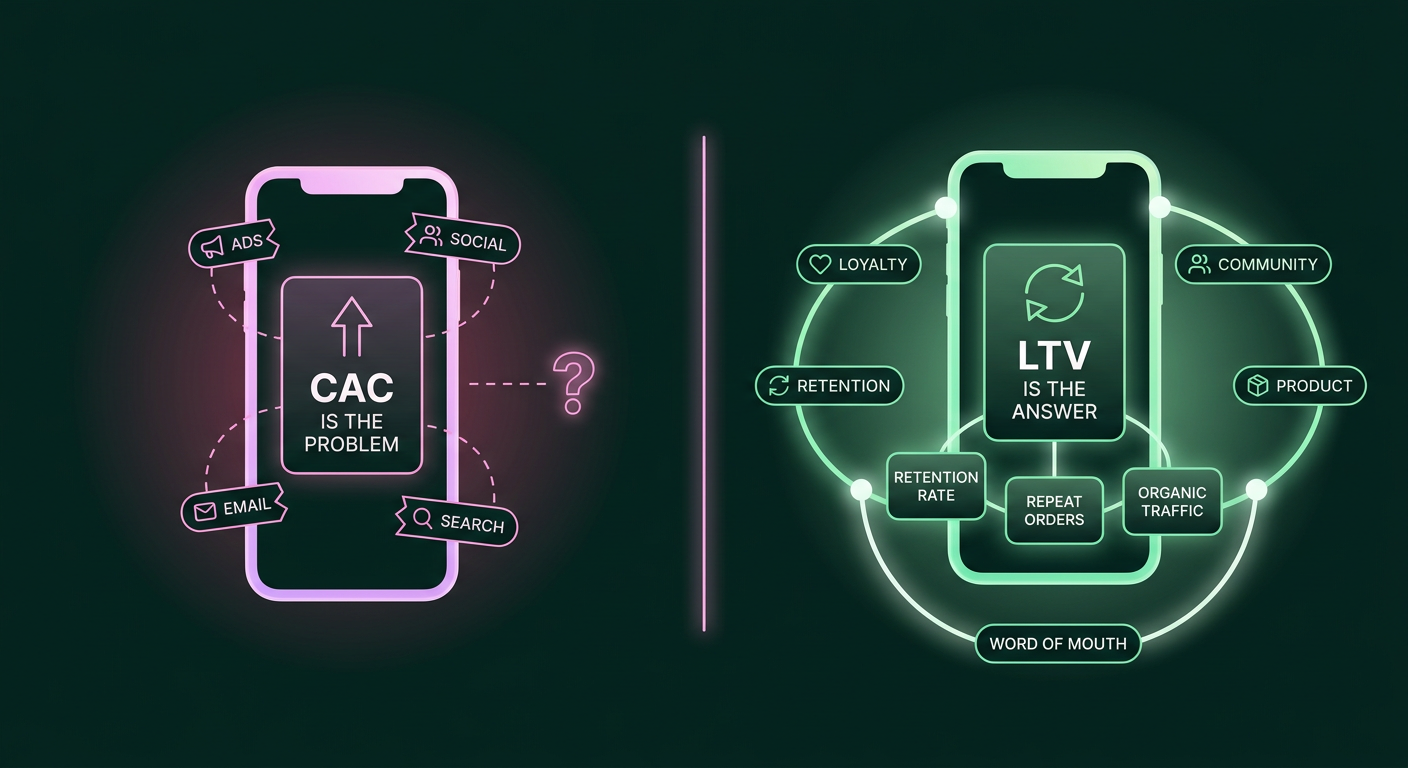
It’s easy to blame rising customer acquisition costs for thinning margins. Every month, the numbers on your Meta Ads dashboard seem to get a little worse, and the pressure from leadership gets a little heavier. You see these climbing costs as the enemy, a force outside your control working against your brand’s growth. But that’s a symptom, not the disease. The real issue is strategic: your growth model depends too much on channels you don't control, and you haven't evolved your strategy as the platforms themselves have changed. For 63% of ecommerce brands, ad costs are climbing faster than revenue (opens in a new tab), which is a clear sign that simply spending more isn't a sustainable path forward.
But first, let's acknowledge the obvious.
It absolutely feels like an ad spend problem because, in a very real sense, the data backs up your frustration. Costs aren't just rising on one platform; they're climbing across the board and creating a perfect storm for performance marketers. For example, the average cost per acquisition for ecommerce search ads is $45.27 (opens in a new tab), a figure that makes it tough to stay profitable on lower-priced items.
The situation on social media isn't much better. While costs vary, Meta's median cost per acquisition was $38.17 (opens in a new tab) in 2025, and the cost just to get in front of users (CPM) jumped by 20.03% in a single year. These aren't small fluctuations; they represent a fundamental shift in the economics of paid acquisition. This trend is so pronounced that for the second year in a row, major channels like Meta Ads and Google Ads have registered negative ROI trends (opens in a new tab), dropping by 9% and 8% respectively. When the pillars of your growth strategy are getting more expensive and less effective, it's natural to see cost as the primary villain.
So if it's not just about rising prices, what's actually going on?
The pain you're feeling is real, but the cause is often an outdated strategy. Many brands are pouring money into an old playbook while trying to win a new game. Ad platforms, especially Meta, have made significant algorithmic changes, yet many advertisers are still using campaign structures that fight these new systems instead of working with them. The days of meticulously crafting dozens of ad sets with granular targeting are over. Today, the brands struggling the most are those still building campaigns the old way by stacking interest layers and relying on narrow lookalike audiences. All this complexity actually slows the algorithm down, preventing it from finding your best customers efficiently and driving up your costs in the process.
The new playbook is about feeding the machine, not micromanaging it. Following major updates like Meta's Andromeda algorithm, the system now rewards creative diversity over manual complexity. Instead of making twenty slight variations of a single ad, the brands that are succeeding are repurposing their core winning message across a wide variety of creative formats. This means your ad spend isn't just a cost; it's a learning tool. You give the algorithm a clear goal, a broad audience, and a diverse portfolio of creative assets (videos, carousels, static images, user-generated content), and then you let it determine the most effective combination. Sticking with an old strategy on a new platform is like trying to fuel a Tesla with gasoline, it's expensive, ineffective, and misses the entire point of the technology.
This means shifting your core objective.
This leads to the most critical strategic adjustment you can make: changing your fundamental goal from renting an audience to owning one. When you rely exclusively on paid channels, you’re essentially building your business on rented land. When the landlord (be it Meta, Google, or TikTok) decides to raise the rent, you have no choice but to pay up or pack up. This is the precarious position so many ecommerce brands find themselves in today. An owned audience, by contrast, is an asset you control. It’s a direct line to your customers through channels like email, SMS, organic social media, and direct messaging that isn't subject to the whims of an auction-based algorithm.
Your paid advertising's goal has to evolve. Instead of focusing only on the immediate conversion, you should also use it to acquire subscribers for your owned channels. Think of your ad spend as the cost of acquiring a long-term relationship, not just a single transaction. The economics of this approach are far more favorable. For instance, despite predictions of its demise, email marketing's ROI continues to perform strongly, offering an impressive average return of 289% over three years. Similarly, organic channels built over time provide incredible leverage. Search engine optimization delivers a staggering 748% average three-year ROI, while a dedicated organic social media presence can yield a 224% return. By using paid ads to fuel these owned channels, you turn a recurring expense into a long-term, high-value asset that helps you increase customer lifetime value and cut ad waste significantly.
How to Diversify Your Acquisition Strategy
So, how do you put this into practice? It starts by viewing your marketing efforts as a balanced portfolio rather than a single bet on one high-performing stock. The first step is an honest audit of your current channel mix. Where is your money actually going? If more than 70% of your acquisition budget is tied up in a single platform like Meta, you're over-exposed and vulnerable.
Next, redefine success for your paid campaigns. While driving sales will always be important, you should add a secondary, equally vital objective: acquiring subscribers for your owned channels. This could mean running lead-gen ads that offer a discount for an email address or creating Click-to-Message campaigns that encourage users to start a conversation and opt into DM updates. The many use cases for direct messaging (opens in a new tab) show how this channel can be used for everything from cart recovery to personalized 1:1 engagement, building a powerful owned audience right inside the apps customers already use. The key is to measure the cost per subscriber just as diligently as you measure the cost per purchase.
Finally, you must commit to the long game. Channels like SEO and organic social don't produce results overnight. They require consistent effort and patience. Start by investing a small but dedicated portion of your time and budget into content creation, community engagement, and technical SEO. This might feel slow compared to the instant feedback of a paid ad campaign, but you’re building an asset that will pay dividends for years, creating a resilient foundation for growth that isn't dependent on ever-increasing ad budgets.
Let's make this tangible.
The best way to move from theory to action is with a simple, concrete first step. This isn't about overhauling your entire marketing department tomorrow; it's about starting a small-scale experiment that proves the value of this new direction and starts to shift your team's mindset.
Here is your task for this week: create and launch one new ad campaign where the primary conversion objective is not a purchase. Instead, the goal is to capture an opt-in for one of your owned channels. For example, you could run a lead generation ad on Instagram offering a "first look" at a new product collection to anyone who signs up for your email list. Or, you could launch a Click-to-Message campaign that offers a 15% discount code delivered via DM to anyone who messages your brand page.
Track the cost per lead or cost per subscriber for this campaign and compare it to your typical cost per purchase. You will likely find that acquiring a subscriber is significantly cheaper than acquiring a direct sale. This single action accomplishes two things. First, it immediately begins building the valuable owned audience you need for long-term stability. Second, and perhaps more importantly, it gives you concrete data to show your team and leadership that there is a more cost-effective way to grow than simply pouring more money into bottom-of-funnel conversion ads. This small win is the first step toward breaking your dependency on rented channels and building a more resilient business.
Frequently asked questions
How can I grow my store without relying so heavily on Meta ads?
The best way to reduce your reliance on Meta is to invest in "owned" channels that provide long-term value and a higher ROI. For example, search engine optimization (SEO) has been shown to deliver an average three-year ROI of 748%, making it one of the most powerful long-term growth levers. Similarly, building a strong organic social media presence can generate a 224% average ROI over three years. These strategies require more upfront time and consistency than paid ads, but they build a durable asset that insulates your brand from rising ad costs.
What are some effective strategies for actually decreasing my customer acquisition cost?
One of the most effective ways to lower your CAC is to focus on channels with higher inherent efficiency. Email marketing remains a top performer, with its ROI increasing by 11% year-over-year. Modern email success comes from using AI-powered optimization, behavioral segmentation, and gathering zero-party data directly from customers to deliver highly relevant messages. With an average cost per acquisition of just $42, email is one of the most cost-efficient channels available for converting and retaining customers.
Why is my customer acquisition cost climbing across all my paid channels?
If you're seeing rising costs across platforms like Meta and Google, you're not alone. This is a widespread trend driven by increased competition, platform saturation, and algorithmic changes. For two years running, both Meta and Google Ads have recorded negative ROI trends. What's more, one study found that 63% of ecommerce brands report that their advertising costs are growing faster than their revenue. This market-wide pressure makes it more important than ever to focus on ad efficiency and diversify into more stable, owned channels.
What are the best alternatives to Facebook Ads for an ecommerce brand?
The best alternatives are channels that let you build a direct relationship with your audience, often called "owned" channels. SEO is a standout, delivering a long-term ROI that is 9.5 times better than Meta Ads. It involves creating valuable content that answers your customers' questions and optimizing your site to rank in search results, driving highly qualified traffic for free. Another strong alternative is organic social media, which involves building a community on platforms like Instagram, TikTok, or Facebook. This strategy has a 9-month break-even time and a strong three-year ROI, turning followers into loyal customers.
How can I reduce my ad costs without sacrificing my store's growth?
The key is to improve the efficiency of your ad spend rather than simply cutting the budget. Many brands unintentionally drive up costs by using outdated campaign structures, like complex ad sets with stacked interest layers that hinder the performance of modern ad algorithms. To adapt, simplify your campaign structures and focus on creative diversity. Instead of creating many slight variations of one ad, successful brands now repurpose winning messaging across multiple creative formats (like video, carousels, and statics) and let the algorithm find the best combination for the audience. This works with the system, not against it, which leads to better results from the same budget.
Why is it so important for a brand my size to have an 'owned audience'?
An owned audience is a critical asset because it gives you direct, reliable access to your customers without having to pay an intermediary like Meta or Google for every interaction. When you rely solely on paid ads, you are effectively "renting" access to an audience, which leaves your business vulnerable to rising costs and algorithm changes. By building owned channels like an email list, an SMS subscriber base, or a community of DM followers, you create a stable asset that you control. This allows for more predictable revenue, higher customer lifetime value, and a marketing strategy that is resilient to the volatility of paid advertising platforms. !A conceptual illustration capturing the core idea of the section "Frequently asked questions" within an article about customer acquisition cost ecommerce - depict the idea, not the literal words.