
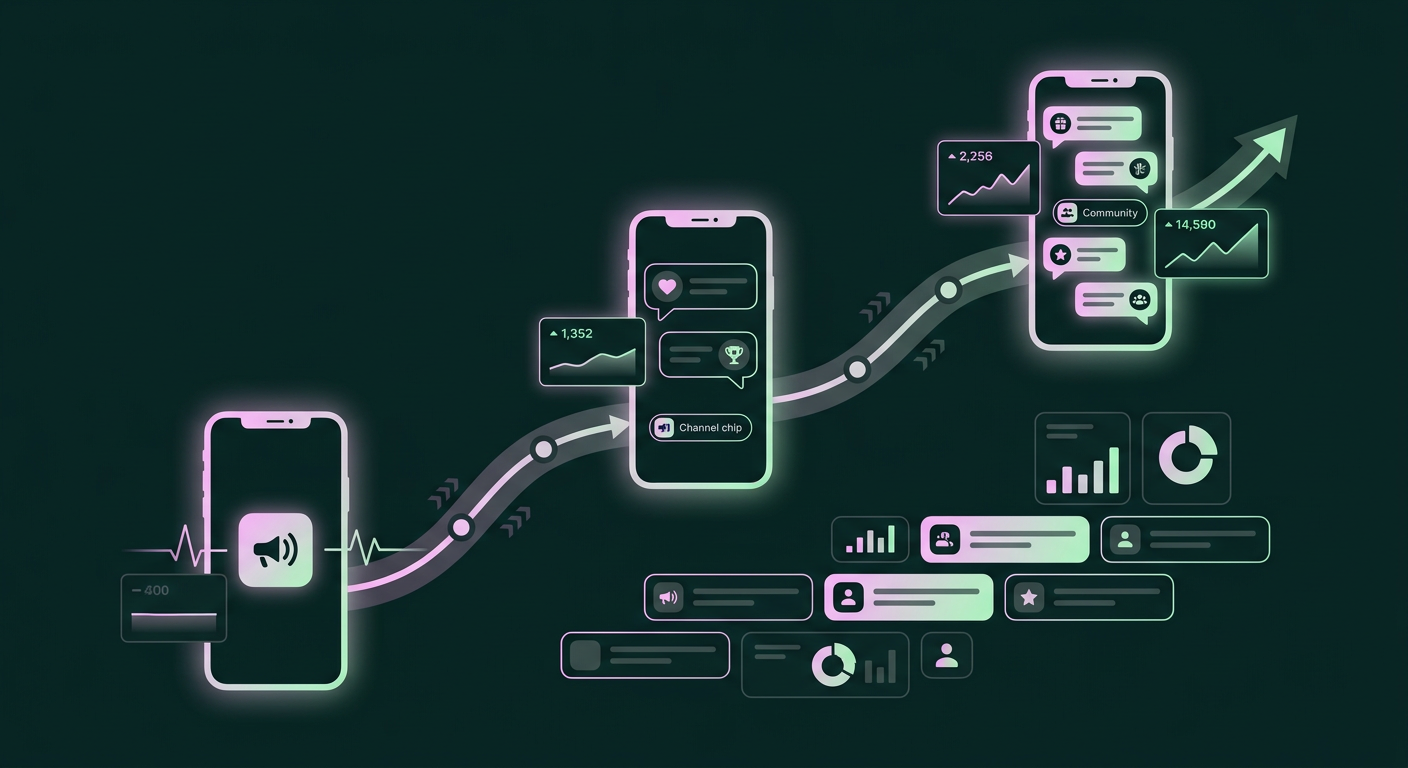
A fundamental shift is underway in the mobile gaming market, with profound implications for how studios handle growth and player engagement. While the industry continues to see impressive financial growth, projected to hit $173.4 billion by 2026, the underlying dynamics have changed. For the first time, growth isn't being driven by a rising tide of new users. A SensorTower's State of Mobile Gaming 2025 report revealed a telling paradox: while mobile in-app purchase revenue grew by 4% year-over-year, overall game downloads actually decreased by 7%.io/post/the-evolution-of-live-ops-in-mobile-gaming). In other words, the era of fueling expansion with a constant flood of new installs is over. The new economic reality for game studios is that long-term success now hinges almost entirely on retaining and re-engaging the players you already have.
The Mobile Market Is Shifting From Acquisition to Retention
The core focus of mobile (opens in a new tab) game growth has decisively pivoted from user acquisition to player retention and monetization. For years, the dominant strategy was pouring resources into acquiring new players, but with rising media costs and a saturated market, that model is no longer sustainable. With IAP spending hitting a reported [$150 billion in 2024](https://appsamurai.With (opens in a new tab) IAP spending hitting a reported $150 billion in 2024, the studios that are thriving are the ones who have mastered keeping their existing players happy, engaged, and invested in the game's ecosystem over the long term.
This shift puts game live operations directly in the spotlight. It's no longer enough to just manage events and push out updates; the new mandate for live ops teams is to become the primary engine of player retention. The challenge is that the very nature of mobile gaming makes this difficult. Players can download a game in seconds, but they can also abandon it just as quickly if the initial experience doesn't immediately capture their attention. This dynamic forces a strategic recalibration, moving away from broad, top-of-funnel acquisition tactics toward a deeper, more nuanced understanding of the full player lifecycle. The battle for market share is no longer won at the point of install, but in the days, weeks, and months that follow.
Yesterday’s Live Ops Playbook Is Losing Ground
The traditional live ops playbook, which relies heavily on generic push notifications to drive engagement, is proving ineffective against the steep drop-off rates that define the modern mobile market. For many studios, the default response to a player who has gone quiet is to send a series of scheduled, one-size-fits-all push notifications. These might offer a "come back" bonus or announce a new event, but because they are rarely tied to a player's specific in-game behavior or the reason they left, the result is a low-impact strategy that feels more like noise than a genuine attempt at re-engagement.
The core problem with this approach is that it fails to address the critical early moments of the player journey. The first few days after an install are the most volatile. Studies repeatedly show that unless they are actively engaged, most games lose between 70% and 80% of their new users within the first 72 hours (opens in a new tab). A generic push notification sent on day seven is already far too late; the player has likely forgotten the game or moved on. This old model treats all churned players the same, failing to distinguish between someone who played for five minutes and someone who was a daily active user for a month. That lack of context makes the messaging feel impersonal and irrelevant, leading to low open rates and even lower conversion rates, all while contributing to the notification fatigue that causes players to disable them entirely.
Why Your Strategy Must Go Beyond Generic Bulk sends
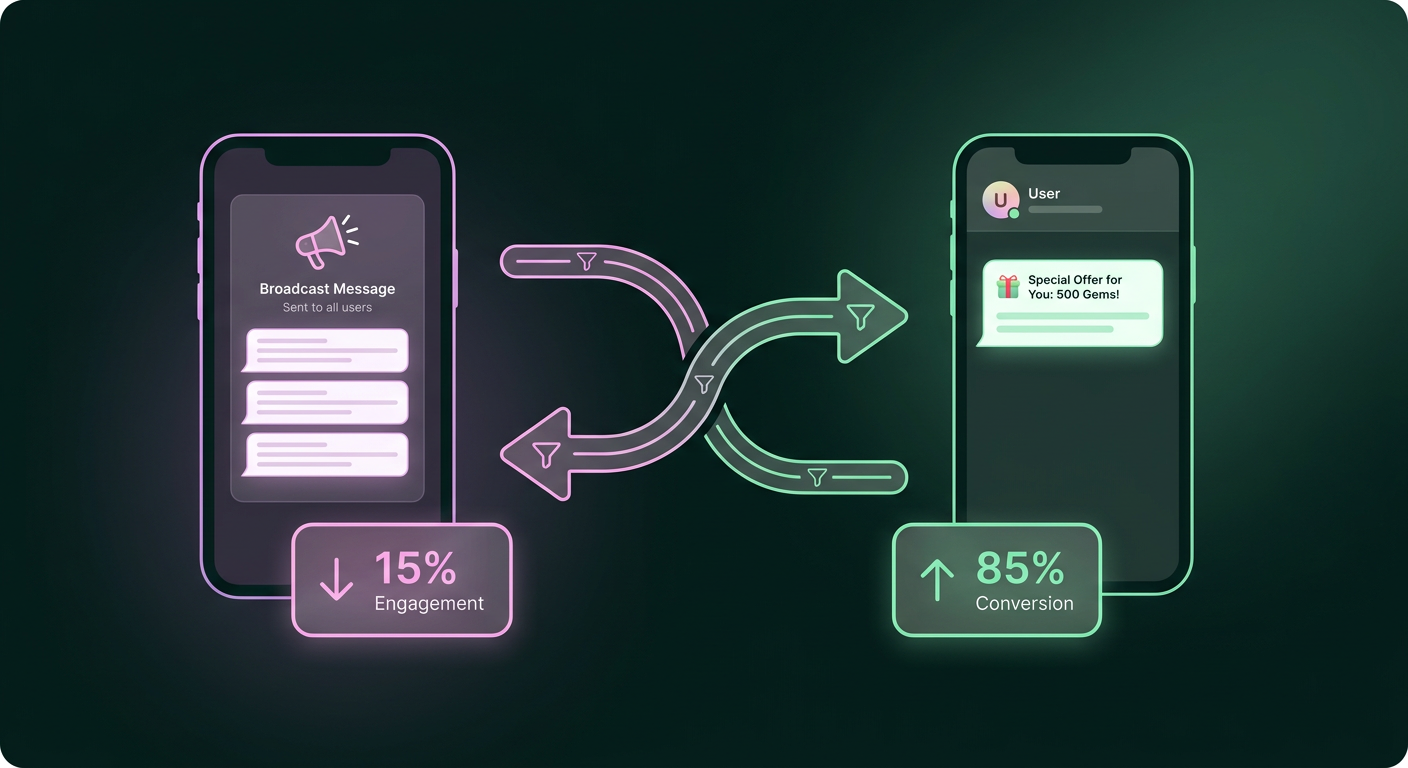
To effectively combat early churn and maximize player lifetime value, a modern live ops strategy must prioritize personalized, behavior-driven messaging. Relying on impersonal bulk sends is a losing proposition in a market where players expect experiences tailored to them. To effectively retain a player, you need to understand why they might be losing interest and intervene with the right message at the right time. This requires a deeper connection between your player data and your communication channels, allowing you to move beyond static, scheduled campaigns.
The strategic importance of getting this right cannot be overstated. A survey by Newzoo highlighted that the vast majority of developers already recognize this reality.
"According to a survey conducted by Newzoo, a leading provider of market intelligence in the gaming industry, 77% of game developers consider Live Ops to be crucial (opens in a new tab) for the commercial success of their game." , iLogos, The Essential Guide To Live Ops
The goal is to create a more dynamic and responsive system. Imagine automatically identifying a player who stalled in the tutorial and sending them a helpful tip, or reaching out to a player who just missed a daily login bonus with a personalized offer to keep their streak alive. This level of granular, individualized outreach turns a one-way broadcast channel into a powerful tool for building relationships and guiding players toward a more engaging experience. This is how you not only prevent churn but also actively increase customer lifetime value by fostering a deeper connection to the game.
Where Personalized, Event-Triggered Messaging Is Working
Studios are seeing significant success by shifting their re-engagement efforts from push notifications to event-triggered direct messages (DMs) on platforms where players are already active. The fundamental difference is the context and the channel. Instead of a generic alert on a crowded phone screen, a personalized DM lands in a player's private message inbox on a platform like WhatsApp or Instagram, feeling more like a one-to-one conversation than a broadcast. This approach cuts through the noise and delivers a message in a format that players are conditioned to open and read.
The performance difference is stark. While push notification open rates can be inconsistent and often fall into single digits, direct messages command attention, with open rates regularly exceeding 80% and channels like WhatsApp reaching into the 90-98% range. This massive increase in visibility is the first step, but the real impact comes from conversion. Because the messages are triggered by specific player behaviors and delivered in a personal, conversational format, they are far more effective at prompting action. Studios using this approach have seen conversion rates that are three to five times higher than those of traditional push notifications. This isn't a marginal improvement; it's a fundamental change in the effectiveness of player re-engagement.
How to Re-Center Your Live Ops Around the Player
To truly adapt to the new market reality, live ops teams must restructure their workflow to connect player data directly to messaging channels, enabling them to test and automate campaigns based on real-time behavior. This means moving away from a siloed approach where analytics, CRM, and communication tools operate independently. The goal is to create a unified system where an in-game event can directly trigger a personalized, external message without manual intervention.
Connect Player Data and Messaging
The foundation of any modern live ops strategy is the integration of player data with your communication tools. This involves connecting your game's backend or your existing CRM to a messaging platform that can ingest player event data. Information like last_played_date, tutorial_completed, level_achieved, or currency_balance shouldn't just live in a dashboard; it should be actionable data that can define audiences and trigger outreach. This technical integration is the crucial first step toward building a truly responsive communication system.
Use Behavior to Trigger Outreach
Once your data is connected, you can move beyond scheduling campaigns and start creating behavior-driven triggers. Instead of a generic "we miss you" campaign that goes out to everyone who hasn't logged in for seven days, you can build much more sophisticated and effective flows. For example, you could create a trigger for players who complete the tutorial but don't start the first level, or for players whose currency balance drops below a certain threshold but who don't visit the store. These are high-intent moments where a timely, helpful message can make all the difference in keeping a player on a positive trajectory. This is how you begin re-engaging inactive users in a way that feels helpful, not intrusive.
Test and Automate Campaigns
With the right infrastructure in place, you can build a system for continuous improvement through testing and automation. It becomes easy to run A/B tests on message copy, timing, and offers to see what resonates with different player segments. You might find that a simple tip works best for players stuck in the tutorial, while a small currency bonus is more effective for re-engaging a lapsed daily player. Once you identify winning patterns, you can automate these campaigns, allowing your team to focus on strategy and new experiments rather than manual execution. This approach can yield significant efficiencies, such as making warm retargeting for installs 50% cheaper by focusing on players who have already shown interest. Learning how this process works (opens in a new tab) is key to building a scalable and effective retention engine.
What to Watch: The Move Toward Conversational Engagement
After recalibrating your strategy around behavior-triggered DMs, the next frontier for game live operations is developing truly conversational, two-way relationships with players. The shift from push notifications to personalized DMs is a significant step forward, but it is still largely one-way communication. The future lies in creating experiences where players can actually respond to these messages and have meaningful, automated interactions that guide them back into the game.
Imagine a player receiving a message about a new in-game event and being able to reply with "remind me later" or "show me the rewards" and receive an instant, relevant response. Or consider a churned player who can ask "what's new?" and get a personalized summary of updates and content they've missed. This level of interaction transforms live ops from a series of outbound messages into a continuous, supportive conversation that meets players where they are. This approach deepens a player's connection to the game and the brand, fostering a sense of community and personal investment that a simple notification could never achieve. As the market continues to prioritize retention, the studios that master this conversational approach will be the ones who build the most loyal and valuable player bases.
Frequently asked questions
How can I figure out why new players are leaving my game so early?
Start by analyzing player data from the first few days, particularly around the tutorial and early gameplay loops. A significant drop-off at a specific point, like the end of the tutorial or the first time a player is asked to make a purchase, is a strong signal. Most mobile games see a massive churn of 70% to 80% within the first three days, so pinpointing the exact moments where players lose interest is critical. You can then use this data to form hypotheses, such as a confusing UI or an imbalanced difficulty curve, and begin testing solutions.
What are the most important metrics for creating useful player segments for win-back campaigns?
Focus on metrics that reveal both engagement level and intent. Key metrics include "last active date," "session count," "session length," "level reached," and "in-app purchase history." Combining these allows you to create much richer segments than a simple "inactive for 7 days" filter. For example, a "High-Value Lapsed Player" (high IAP, inactive for 14 days) should receive a very different message than a "Tutorial Drop-off" (1 session, never finished tutorial).
How can I use my player data to create and test different messages to see what works?
Connect your player analytics to a messaging platform that allows for A/B testing and control groups. Start with a specific segment, like players who have churned after reaching level 10. Divide this group into three: Group A gets one message, Group B gets a different message (e.g., with a different offer or tone), and Group C (the control group) gets no message. By measuring the reactivation rate for each group, you can scientifically determine which messages are effective and quantify their direct impact.
How can I automatically message players who are about to churn without just sending generic push notifications?
Use behavior-based triggers to send personalized direct messages (DMs) to channels like WhatsApp or Instagram Messenger. Instead of a generic push alert, you can set up a system where, for example, a player who breaks a 7-day login streak automatically receives a friendly DM. Because DMs have much higher open rates (often over 80%) and feel more personal, they are far more effective at re-engaging a player before they are completely lost.
What’s the best way to start a small, personalized campaign to bring back players who have left?
Begin with a well-defined, high-value segment and a clear goal. For instance, target players who made at least one purchase but have been inactive for 30 days. Craft a personalized DM that acknowledges their past engagement and offers a compelling reason to return, such as a special bonus or a preview of new content. This targeted "warm retargeting" approach is not only more effective but also more cost-efficient, often reducing the cost per install by 50% compared to acquiring a brand new user.