
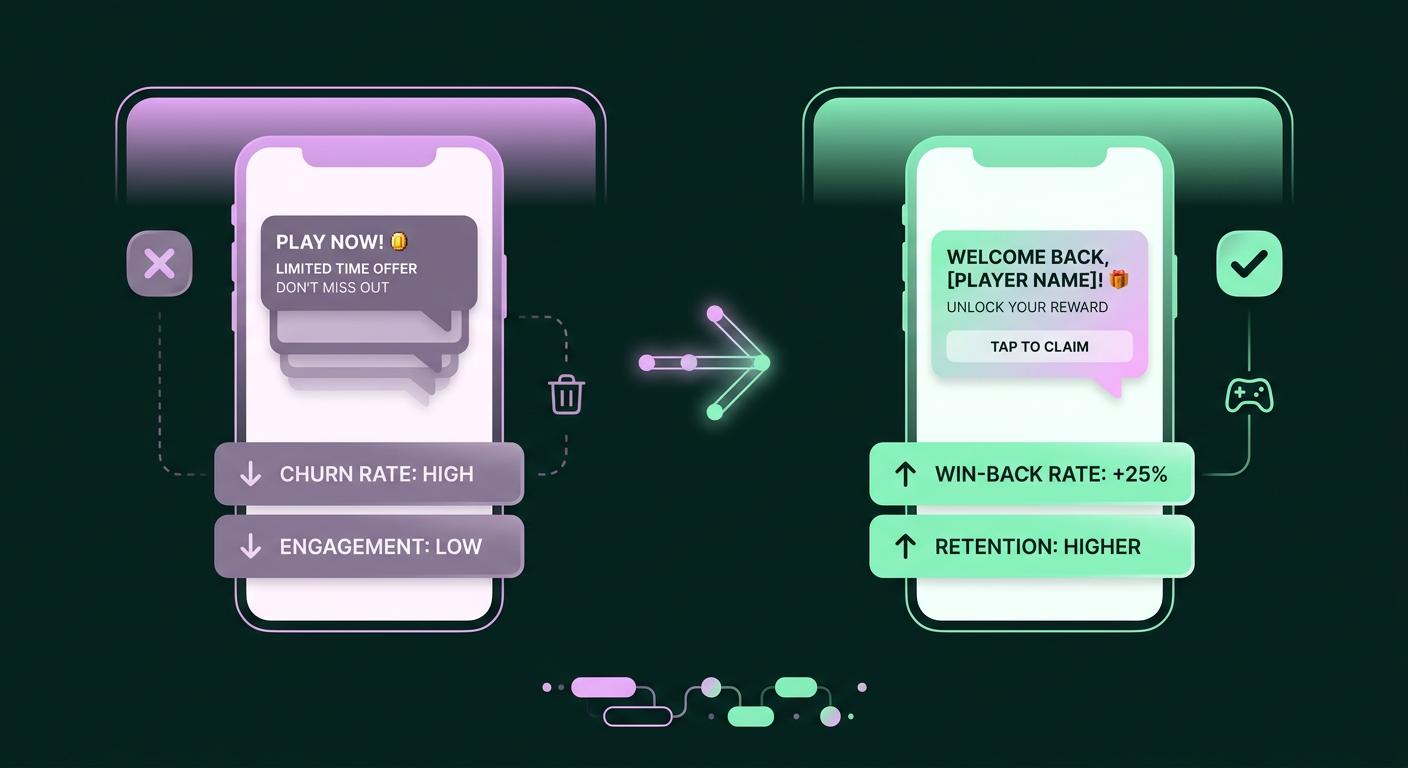
As a lifecycle or retention leader at a mobile game studio, your performance is measured by your ability to keep players engaged and increase their lifetime value. For years, the standard playbook for re-engaging lapsed players has been the broadcast push notification. It’s cheap, easy, and it feels productive, but it's a strategy of diminishing returns. In a market as competitive as mobile gaming, which was valued at $68.5 billion as far back as 2019 (opens in a new tab) and projected to grow another 12% in 2020, simply sending generic messages to everyone who has churned is no longer enough. This approach leads to notification fatigue, lower opt-in rates, and ultimately, a missed opportunity to win back a valuable player.
The fundamental issue is that (opens in a new tab) traditional mobile game push notifications are a one-way channel built on interruption, not conversation. When a player has already decided to leave your game, another generic "We miss you!" alert is more likely to be the final nudge they need to delete the app for good. To truly succeed at player win-back, studios need to move beyond the broadcast and embrace a more intelligent, personalized, and data-driven approach.
The Push Notification Trap
**Relying solely on generic push (opens in a new tab) notifications for re-engagement is a losing strategy because of low opt-in rates, message fatigue, and a fundamental disconnect from individual player behavior. This approach treats all lapsed players the same, ignoring the specific reasons they left and failing to provide a compelling, personal reason to return.**
Push notification technology was first introduced by Apple in 2009, creating a new channel for direct communication. Player behavior and expectations, however, have evolved dramatically since then. Today, users are fiercely protective of their home screens and their attention, which has led to a steady decline in the channel's effectiveness.
The first hurdle is simply getting permission to send a message in the first place. According to a 2021 benchmark report, median opt-in rates for push notifications on iOS hover around just 51%. This means that from the start, you can’t even reach nearly half of your potential audience on one of the world's biggest mobile platforms. Even on Android, where opt-in is the default, players are quick to disable notifications for apps that send too many irrelevant messages.
Even if you get past the opt-in barrier, the next challenge is relevance. Most push notification platforms are fundamentally broadcasting tools, designed to send the same message to a large segment of users simultaneously. This model is completely disconnected from the nuanced, individual journey of a player. It doesn’t know if someone left because they were frustrated with a specific level, ran out of in-game currency, or simply got distracted by another game. Without that context, the best you can do is send a generic plea. The result is that players learn to ignore your messages, or worse, are annoyed by them. This is why direct messages, which see open rates of over 80%, consistently deliver conversion rates that are 3-5x higher than push notifications. A generic push is noise; a personal DM is a signal.
What Really Matters in Player Re-Engagement?
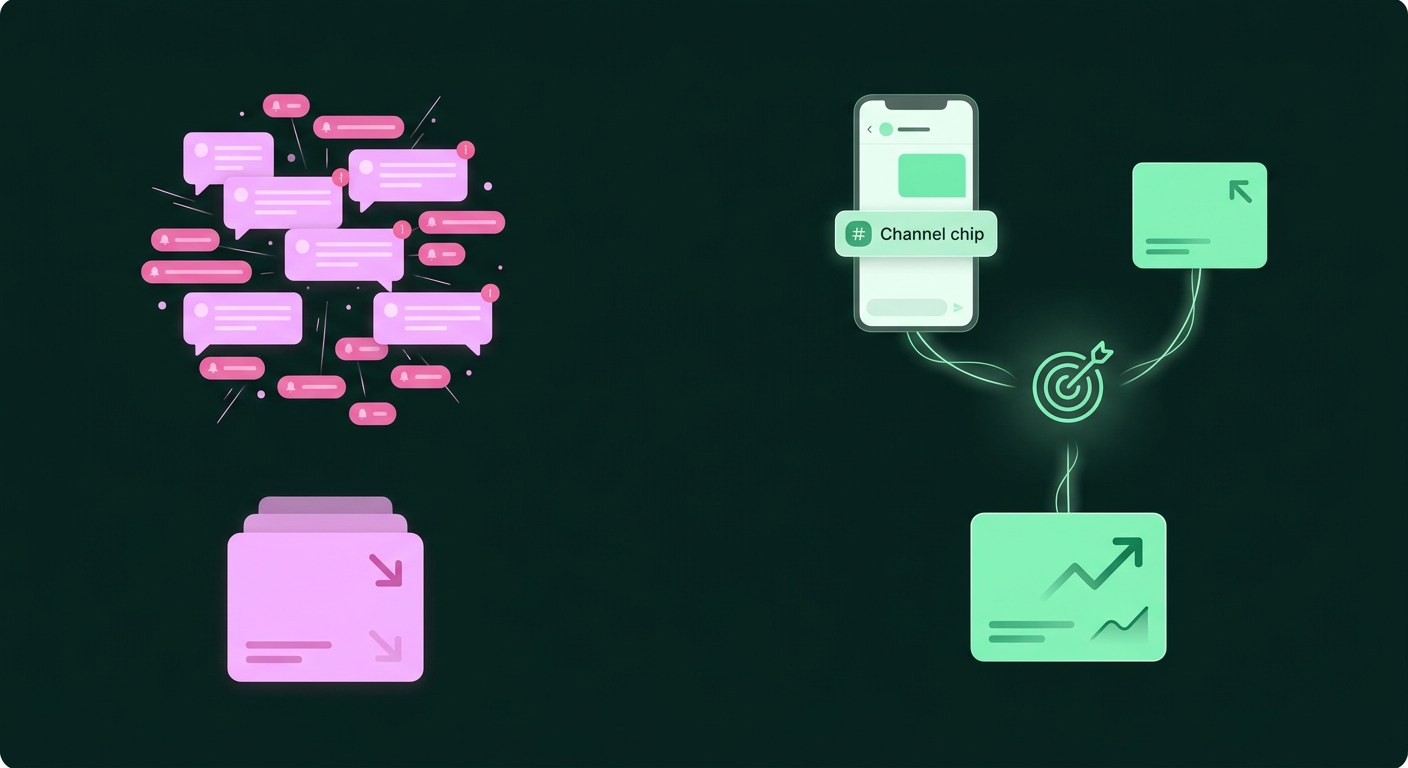
An effective re-engagement strategy requires three core components: a channel that players actually see, personalization based on individual behavior, and a clear connection to measurable business outcomes like conversion and lifetime value. Simply sending more messages isn't the answer; sending the right message to the right player on the right channel is.
Now that we've seen the limits of old tactics, we can define what a modern solution needs to deliver. When evaluating a new approach to winning back your players, the flashy features of a platform matter far less than its ability to execute on a few fundamental principles.
First, you need to communicate on channels where your players are genuinely engaged. A modern re-engagement campaign should be holistic, combining different touchpoints to create a cohesive experience. As experts note, a strong campaign blends paid retargeting with owned channel messaging (opens in a new tab) and in-game mechanics to bring players back. This means looking beyond just push notifications to include email, in-app messages, and the direct messaging apps where players spend their time. The most effective strategies layer these channels by reachability (opens in a new tab), using the most direct and personal options to re-engage players who haven't responded to broader messages.
Second, your messaging must be deeply personalized and context-aware. This goes far beyond using a player's first name. True personalization means connecting your messaging to their actual in-game behavior. Did they churn after failing a mission three times? Did their session times drop off after a recent update? Were they a high-spending player who suddenly stopped making purchases? These data points are the key to crafting a message that feels relevant and valuable. Instead of a generic "Come back!", you can send a message offering a boost for the level they were stuck on or a special bonus for their favorite game mode. This is the difference between a broadcast and a conversation.
Finally, your re-engagement efforts must be tied to clear, measurable ROI. It’s not enough to track open rates and click-throughs. A modern platform must be able to show you the direct impact of your campaigns on player reactivation, in-game spending, and long-term retention. You need to be able to answer critical business questions: How much did it cost to win back this cohort of players? What is the downstream impact on their lifetime value? Without this connection to tangible results, your re-engagement strategy is just a cost center, not a profit driver.
Comparing Your Re-Engagement Options
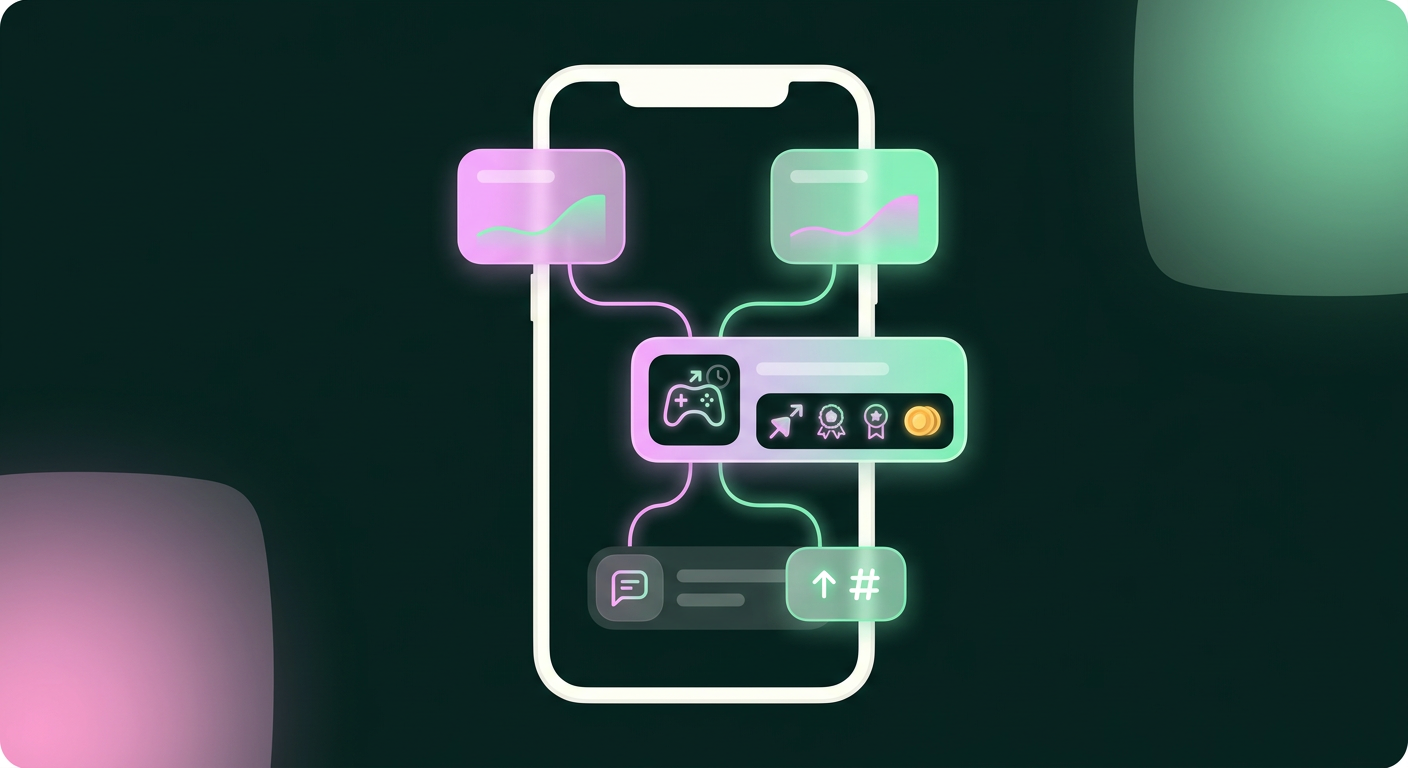
With those criteria in mind, the choice becomes clear: traditional push notification platforms are designed for mass broadcasting and fall short on personalization and ROI tracking, while modern, data-connected DM tools are built for personalized, high-conversion conversations that demonstrably win back players.
When you apply these criteria, the gap between the old way and the new way becomes impossible to ignore. Traditional push notification tools and modern, data-connected direct messaging platforms are built on fundamentally different philosophies. One is about volume; the other is about value.
Traditional platforms excel at sending a high volume of messages cheaply. However, they are siloed from the rich behavioral data inside your game, forcing you to rely on broad, simplistic segmentation. The messages are impersonal, the channel is crowded and often muted, and measuring true impact on retention or LTV is nearly impossible. You can see how many notifications you sent, but you can't easily see how many valuable players you actually recovered because of them.
A data-connected DM platform, by contrast, is built to translate player behavior into personalized 1:1 messages on high-engagement channels like Instagram DMs, WhatsApp, and Facebook Messenger. By integrating directly with your game's data, it can trigger messages based on specific events or a lack thereof. This allows for a level of personalization that traditional tools can't match, resulting in a conversation that feels personal and timely, leading to dramatically higher engagement and conversion. With this model, campaigns can achieve an 8% drip conversion, and warm retargeting can deliver installs for as little as $3.20 per install.
Summary: Platform vs. Data-Connected Approaches
| Criterion | Traditional Push Platforms | Data-Connected DM Tools |
|---|---|---|
| Channel Effectiveness | Low opt-ins, high fatigue | High open & conversion rates |
| Personalization at Scale | Generic broadcast model | Individualized 1:1 messages |
| Data Connectivity | Siloed from live game data | Connects to player events |
| Measurable ROI | Measures sends, not revenue | Directly tied to win-back & LTV |
The table above summarizes the core trade-offs. If your only goal is to send mass announcements, a traditional platform can do the job. But if your goal is to build a sophisticated, scalable, and profitable win-back program, the limitations of that model become a serious liability. The data shows that meeting players where they are with a message that understands their journey is what truly works. The 3-5x higher conversion rates seen in DMs versus push notifications aren't an anomaly; they are the natural outcome of a more intelligent strategy.
Which Approach Is Right for Your Studio?
Given the tradeoffs, the right choice depends on your team’s focus. If you only need to send simple, generic announcements and are not measured on reactivation ROI, a basic push tool may suffice. However, if your primary goal is to measurably increase player retention and lifetime value through targeted win-back campaigns, a data-connected DM platform is the necessary choice.
The best path forward is a direct function of your studio's goals and how you measure success. There isn't a single tool that fits every possible need, so the decision requires an honest assessment of your priorities.
You should stick with traditional push notification tools if: your primary need is to make broad, infrequent announcements to your active player base. For example, if you just need to alert all players about scheduled server maintenance or a major new content release, a simple push platform can handle that. This approach is suitable for teams who are not primarily focused on personalized retention marketing and who operate with very limited technical resources or budget for connecting new systems. If you aren't under pressure to prove the ROI of your messaging, the old way can still have a place.
You should choose a data-connected DM platform if: your team is measured on key retention and revenue metrics like player reactivation, D7/D30 retention, and lifetime value. If you need to re-engage inactive users in a way that directly contributes to the bottom line, you need a more powerful tool. Studios that want to run sophisticated, behavior-driven campaigns, like targeting players who churn after a specific event with a personalized offer, will find that traditional tools are simply not equipped for the job. This approach delivers campaigns with provable ROI, such as a 75% first-DM engagement rate, and can make your retargeting efforts up to 50% cheaper than standard user acquisition methods.
"A re-engagement campaign in mobile gaming is a coordinated program designed to bring lapsed players back into active play. It typically combines paid retargeting, owned channels (push, in-app messaging, email), and in-game mechanics like welcome back rewards and returning player missions."
, Helpshift
Ultimately, this choice reflects a strategic decision: are you in the business of broadcasting messages, or are you in the business of cultivating player relationships? For studios serious about long-term growth and profitability, the answer is clear.
Your Next Move: Pilot a Smarter Campaign
The most effective way to see the impact of a data-driven, personalized messaging strategy is to run a small, focused pilot campaign. Instead of overhauling your entire lifecycle marketing stack, you can start by targeting a single, high-value segment of churned players and prove the model.
Moving from a familiar process to a new one can feel daunting, but you don’t have to change everything overnight. The best way to validate the power of a data-connected, conversational approach is to test it in a controlled environment.
Start by identifying a specific, valuable player segment that has recently churned, like a cohort of players who reached a certain level and stopped playing or a group of former spenders who have gone dormant. Instead of enrolling them in your standard, generic push notification win-back flow, isolate this group and target them with a personalized DM campaign. You can set up a simple flow where your game's data triggers a message based on their last known activity, crafting a few different variations to test what resonates best. One might offer a currency bonus, while another highlights a new feature you've added since they left.
Then, track the results. Measure not just open and click rates, but the actual reactivation rate, the cost per reactivation, and the in-game behavior of the players who return. By running a targeted pilot, you can generate clear, undeniable data on the effectiveness of this modern approach. This evidence will provide the business case you need to expand the strategy and build a truly powerful and profitable player retention engine for your studio.
Frequently asked questions
How do I re-engage players without just sending more push notifications?
The key is to adopt a multi-faceted strategy that goes beyond a single channel. A comprehensive re-engagement campaign combines several elements, including paid retargeting ads, in-game mechanics like welcome-back rewards, and messaging across owned channels. This includes not just push notifications but also in-app messages, email, and high-engagement channels like Instagram DMs or WhatsApp. By layering these channels, you can reach players where they are most active and create a more compelling reason for them to return.
What tools can connect our player data to personalized retention messaging?
A growing category of tools specializes in marketing automation for direct messaging platforms. For example, some well-known platforms are used by over a million businesses to automate conversations on channels like Instagram and Facebook Messenger, and other services are also highly rated for managing brand communications within the Meta ecosystem. The most effective tools integrate with player data to enable messaging across multiple channels, which is a more effective approach for re-engaging lapsed players.
Which metrics are most important for building useful player segments for messaging?
To build effective player segments, you need to look beyond simple demographics. The most important metrics are behavioral. These include session frequency and duration, purchase history and average transaction value, progress within the game (level, quests completed), and social engagement (clan activity, friend invites). By combining these data points, you can create nuanced segments like "High-Value Players at Risk of Churn" or "Recently Lapsed Mid-Core Players." This allows you to tailor your messaging strategy using a multi-channel approach for maximum effectiveness.
How can my team use player retention data to create targeted messaging experiments?
You can start by using your retention data to identify a key churn point in your player journey, such as a significant drop-off after players complete the tutorial or reach level 10. This becomes the basis for an experiment. Create a segment of players who have just hit this churn point and gone inactive, then divide them into a control group (which receives no message) and a test group. For the test group, you can trigger a personalized DM campaign offering a specific incentive to continue, like a special item or a coin bonus. By measuring the reactivation rate of the test group against the control group, you can prove the direct impact of your targeted intervention.