
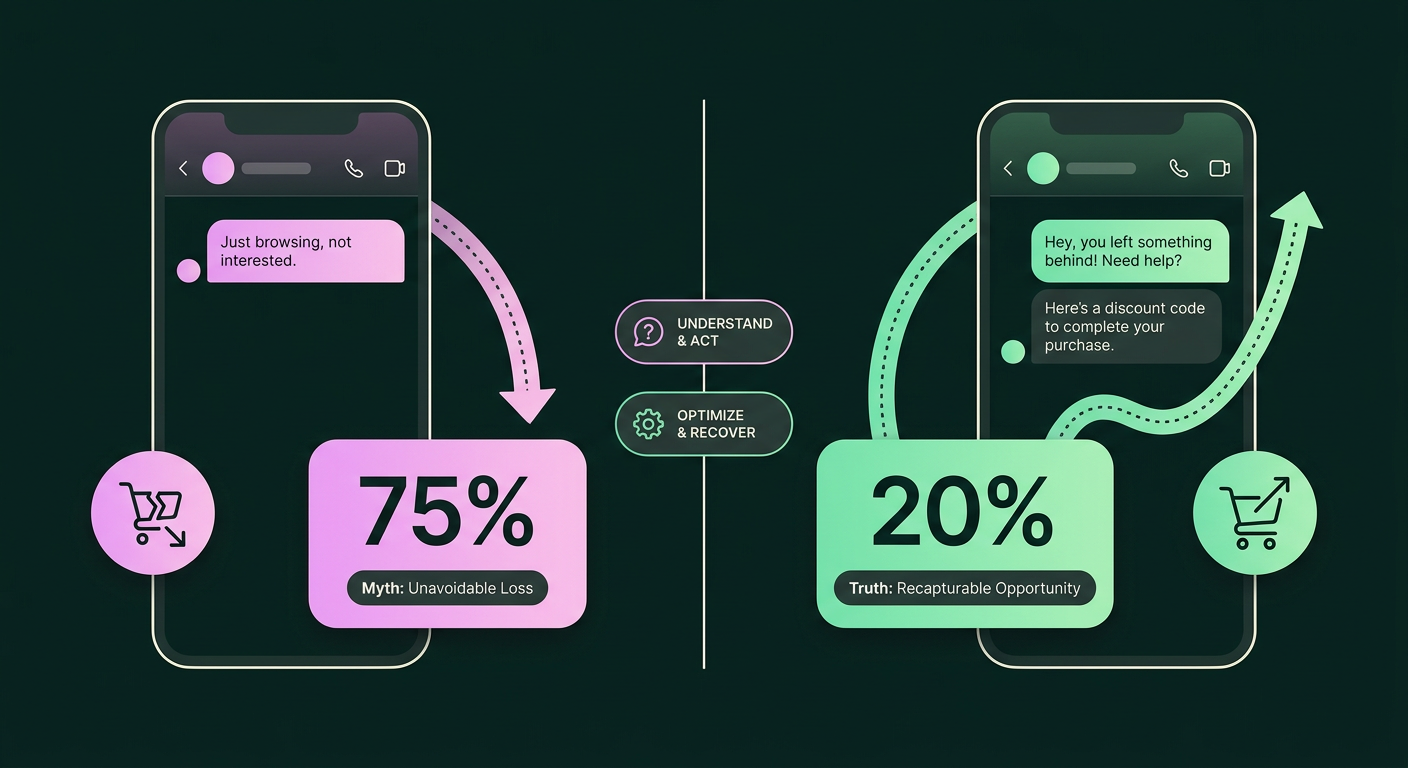
The advice given to every e-commerce manager is always the same: lower your cart abandonment rate. It's the big, alarming percentage on every dashboard, supposedly representing millions in lost revenue, and an entire industry has sprung up around chipping away at it. But this advice is a trap. Focusing on your overall cart abandonment rate is a distraction because the metric itself is fundamentally broken. It’s inflated with low-intent shoppers who were never going to buy in the first place, and chasing them just wastes your time, annoys your real customers, and pulls focus from the revenue you can actually recover.
You're Told to Lower Your Cart Abandonment Rate. Don't.
The core belief drilled into every e-commerce manager is that a high cart abandonment rate is the biggest leak in their funnel. When you see a number hovering around 70%, it’s natural to assume that fixing it should be your top priority. The problem is, this figure lumps together two completely different kinds of shoppers: those who genuinely intended to buy and those who were just window shopping.
A huge portion of people who add items to their cart are simply using it as a digital shopping list, a tool for comparing prices, or a way to save something for later. They have little to no immediate purchase intent. Research suggests that these "browsers" account for a huge portion of abandonments (opens in a new tab), which means your actual, addressable audience of would-be buyers is much smaller than you think. Trying to lower the top-line number means you're spending resources trying to convince people who were never serious to begin with. It’s like a brick-and-mortar store manager chasing every person who walks out without buying something. It’s not just ineffective; it misses the point entirely.
Why We Obsess Over a Broken Metric
So why is this broken metric so pervasive? The main reason is that the 70% average cart abandonment rate is an alluringly massive number. It feels like a treasure chest of lost sales just waiting for you to crack it open. Analytics platforms reinforce this by making it a headline metric, presenting it as the primary indicator of checkout health. When a single number appears to represent such a colossal opportunity, it naturally becomes the focus of your optimization efforts.
This obsession leads even smart, capable teams down the wrong path. They invest in generic, site-wide conversion tactics designed to nudge every visitor who abandons a cart, like aggressive exit-intent pop-ups, generic "Come Back!" email series, or sitewide banners offering last-minute discounts. These broad-stroke tools are built on the flawed idea that everyone who abandons a cart is the same. The result is a cycle of diminishing returns. You might see a tiny dip in the overall rate, but you’re likely achieving it at the cost of annoying high-intent shoppers and training your audience to wait for a discount. The real problem isn't the 70% of people who leave; it's that we’re not correctly identifying and engaging the subset of them who actually wanted to stay.
The Shoppers You Can Actually Win Back
If chasing that 70% figure is a mistake, the real question is who you should be focusing on instead. The answer lies within a much smaller, more valuable cohort: the high-intent shoppers who were on the verge of buying but hit a specific, preventable snag. This group, which represents the truly addressable abandonment rate of about 25% to 35% (opens in a new tab), is where your recovery efforts will actually pay off. These weren't casual browsers; they were motivated buyers who ran into a deal-breaking issue at the final step.
The reasons this group leaves are rarely mysterious and are almost always tied to concrete, frustrating experiences during checkout. One of the most common reasons someone abandons a purchase is being blindsided by unexpectedly high extra costs like shipping, taxes, and fees. Another major factor is slow delivery times, with many customers deciding the wait isn't worth it. And a significant number will simply give up if they are forced to create an account before they can complete their order. These aren't people who need to be convinced of your product's value, because they were already sold. They just need a clear path to purchase, and when they don't get it, they walk away. Focusing on this group transforms the problem from a vague battle against "abandonment" into a solvable mission to fix specific friction points and win back motivated customers.
Measure Recovery Rate, Not Abandonment Rate
This shift in focus from broad abandonment to high-intent shoppers requires a new metric. Instead of chasing the vanity metric of a lower overall abandonment rate, the most effective e-commerce teams measure their cart recovery rate. This metric shifts the entire goal. The question is no longer "How do we stop people from leaving?" but rather "Of the high-intent customers who do leave, how many can we successfully bring back?" This reframe moves your attention from pre-abandonment pop-ups to post-abandonment communication.
The bottleneck for most brands isn't their checkout flow; it's the channel they use to try to win back customers. Standard recovery playbooks rely heavily on automated email and SMS campaigns. While these methods are better than nothing, their effectiveness is capped. Even a sophisticated, multi-step email sequence typically only recovers between 10-15% of lost revenue, and adding SMS can push that figure up to 15-25%. This isn't a failure of messaging, but a failure of the channel itself. When your recovery attempt lands in a crowded inbox or a promotional folder, it doesn't matter how well-crafted it is. To truly improve your recovery rate, you have to stop broadcasting into a crowded room and start having a direct conversation where your customer is already listening.
Abandoned Cart Emails Fail. Go Where You Won't Be Ignored.
If recovery rate is the goal, it's clear why the standard methods are falling short. Your abandoned cart emails feel like they're not working because, for the most part, they aren't. Not anymore. The email channel is overwhelmingly saturated, and users have become adept at tuning out marketing messages. Gmail and other clients automatically sort promotional emails into separate tabs that are rarely checked, meaning your carefully timed reminder often goes completely unseen. Even when they are opened, the messages feel impersonal and automated. And while SMS can cut through the noise, it often feels too aggressive for a customer who is still just considering a purchase, bordering on intrusive.
The practical implication is clear: you need to meet your customers in a channel where a message feels less like an advertisement and more like a personal conversation. This means moving your win-back efforts to platforms like Instagram DMs and WhatsApp. These are the channels where people communicate with friends, family, and increasingly, with brands they trust. A personalized 1:1 message in a DM lands directly in a user's primary inbox, where open rates regularly exceed 80%. It's a fundamentally different experience. Instead of a generic "You left something behind!" email, you can send a helpful, context-aware message that offers assistance, answers a question, or provides a gentle nudge. By shifting the conversation to a more personal space, you change the dynamic from interruption to interaction, which is the key to an effective cart recovery. For a deeper look at this change in strategy, it's worth exploring the differences in effectiveness between DM and email.
A Simple Test to Find Your Best Recovery Channel
You can test this new approach without overhauling your entire e-commerce stack or abandoning your existing flows overnight. The smartest way to validate this strategy is to run a small, simple manual experiment. For the next week, dedicate a little time each day to finding your highest-value abandoned carts. Instead of just letting them fall into your standard email sequence, try a more direct approach.
If you can identify the shopper on Instagram, send them a friendly, manual direct message. Keep it simple and helpful, not salesy. Something like, “Hi [Name], I noticed you were checking out the [Product Name]. Just wanted to reach out and see if you had any questions about it before you decide.” Or, if you suspect shipping costs were the issue, you could offer a one-time shipping code. Track the response rates, engagement, and eventual conversion from this small, manual test group. Then, compare those results to the performance of your automated email flow for carts of a similar value. The data will give you a clear answer about which channel truly gets your customer's attention and drives a better conversion. This simple test is the first step toward building a more resilient and effective win-back strategy that's focused on real revenue, not vanity metrics.
Frequently asked questions
Why do my abandoned cart emails feel like they aren't working?
Your abandoned cart emails likely feel ineffective because they are competing in an extremely crowded channel. Most email providers automatically filter promotional content away from the primary inbox, and users have been trained to ignore marketing messages. Even a well-designed email series has a performance ceiling; studies show that multi-step campaigns typically recover around 10-15% of revenue at best. The mediocre results aren't necessarily your fault; they're a limitation of the channel itself.
How should I calculate my true cart abandonment rate?
To calculate your true, or "addressable," cart abandonment rate, you need to distinguish between casual browsers and high-intent shoppers. While there's no perfect formula without advanced analytics, a good rule of thumb is to consider that only about 25-35% of all abandonments come from users you can realistically recover. Instead of focusing on the total number of carts abandoned, concentrate on the revenue lost from carts that exceed a certain value threshold or contain multiple items, as these are stronger signals of purchase intent.
Should I still try to reduce my Shopify cart abandonment rate?
Yes, but you should refine your goal. Instead of trying to lower the overall cart abandonment percentage in your Shopify dashboard, you should focus on two things. First, reduce abandonment among high-intent shoppers by fixing clear friction points, like surprise fees or forced account creation. Second, and more importantly, prioritize increasing your recovery rate for the high-intent shoppers who do leave. The goal isn't a smaller percentage; it's more recovered sales.
What's the difference between a user who's just browsing and one who abandons a cart?
The key difference is intent. A user who is "just browsing" often uses the shopping cart as a temporary holding place, a wish list, or a way to compare items, with no firm plan to purchase during that session. A high-intent user who truly "abandons" a cart, on the other hand, has proceeded through most of the checkout process but stops due to a specific issue like high shipping costs, a technical glitch, or a required login. Browsers were never going to convert, whereas abandoners could have.
Why do shoppers with high intent still abandon their carts?
Even highly motivated shoppers will abandon a purchase if they encounter significant friction at the last minute. The most common reasons are practical and financial. According to research, the biggest culprit is surprise costs, with 39% of shoppers leaving when shipping, taxes, or fees are higher than expected. Other major deal-breakers include slow delivery times, which deter 21% of buyers, and being required to create an account to check out, which causes 19% to give up.
Can I use Instagram DMs to recover abandoned carts?
Yes, absolutely. Using Instagram DMs is an effective strategy for cart recovery because it lets you bypass the noise of traditional email marketing and connect with shoppers in a more personal, direct way. A message sent via DM lands in a space usually reserved for conversations with friends, making it far more likely to be seen and engaged with. Automating this process with personalized 1:1 messages at scale lets you turn a simple reminder into a helpful conversation, which can significantly increase your recovery rate. !A conceptual illustration capturing the core idea of the section "Frequently asked questions" within an article about cart abandonment rate - depict the idea, not the literal words.