
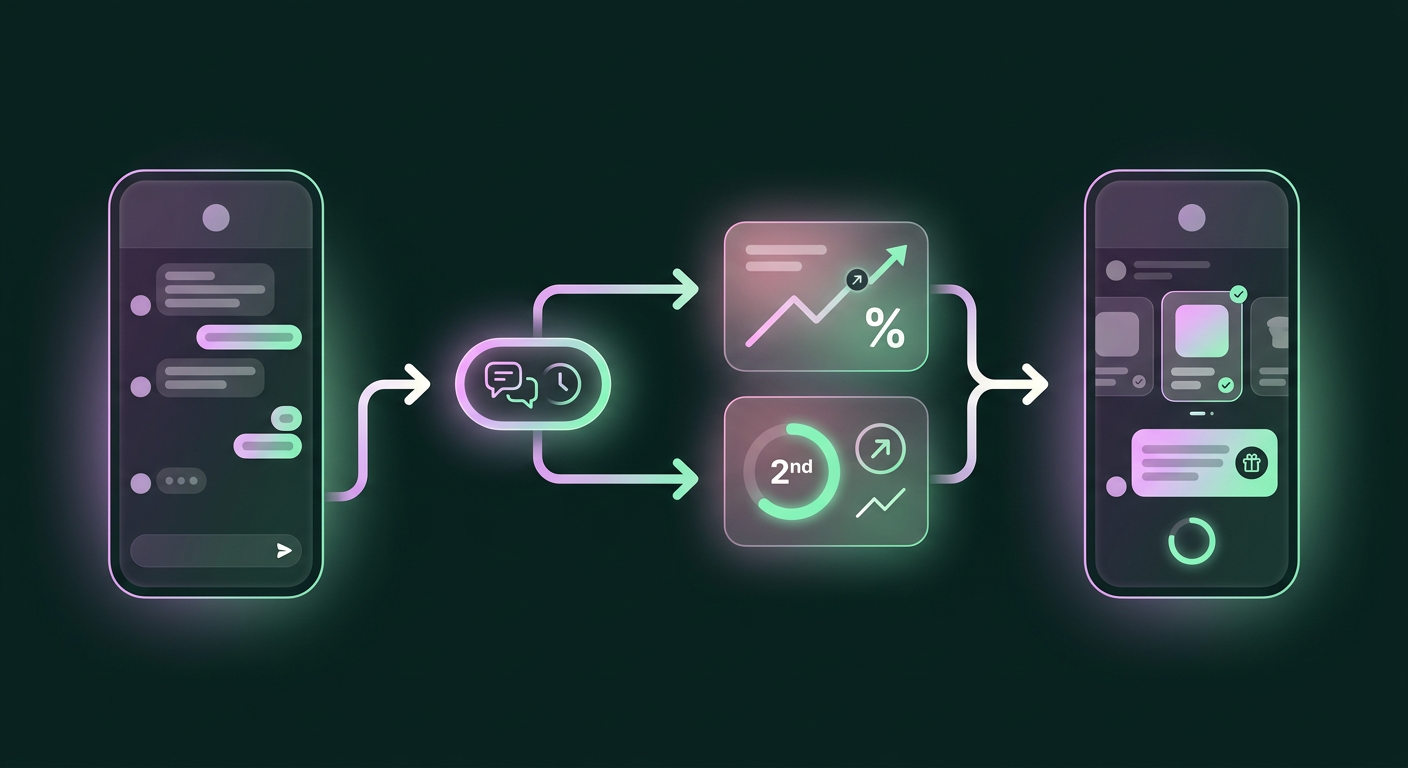
Pouring money into paid ads just to acquire customers who buy once and then vanish is a frustratingly common cycle. For many brands, this makes growth feel unsustainable, like you’re constantly refilling a leaky bucket. The fix isn't to find a cheaper way to acquire customers you've already paid for, but to shift your focus entirely. By using DM automation to build a real relationship, you can reliably drive a second Purchase and turn one-time transactions into loyal customers.
Stop Renting Your Customers, Start Owning the Relationship
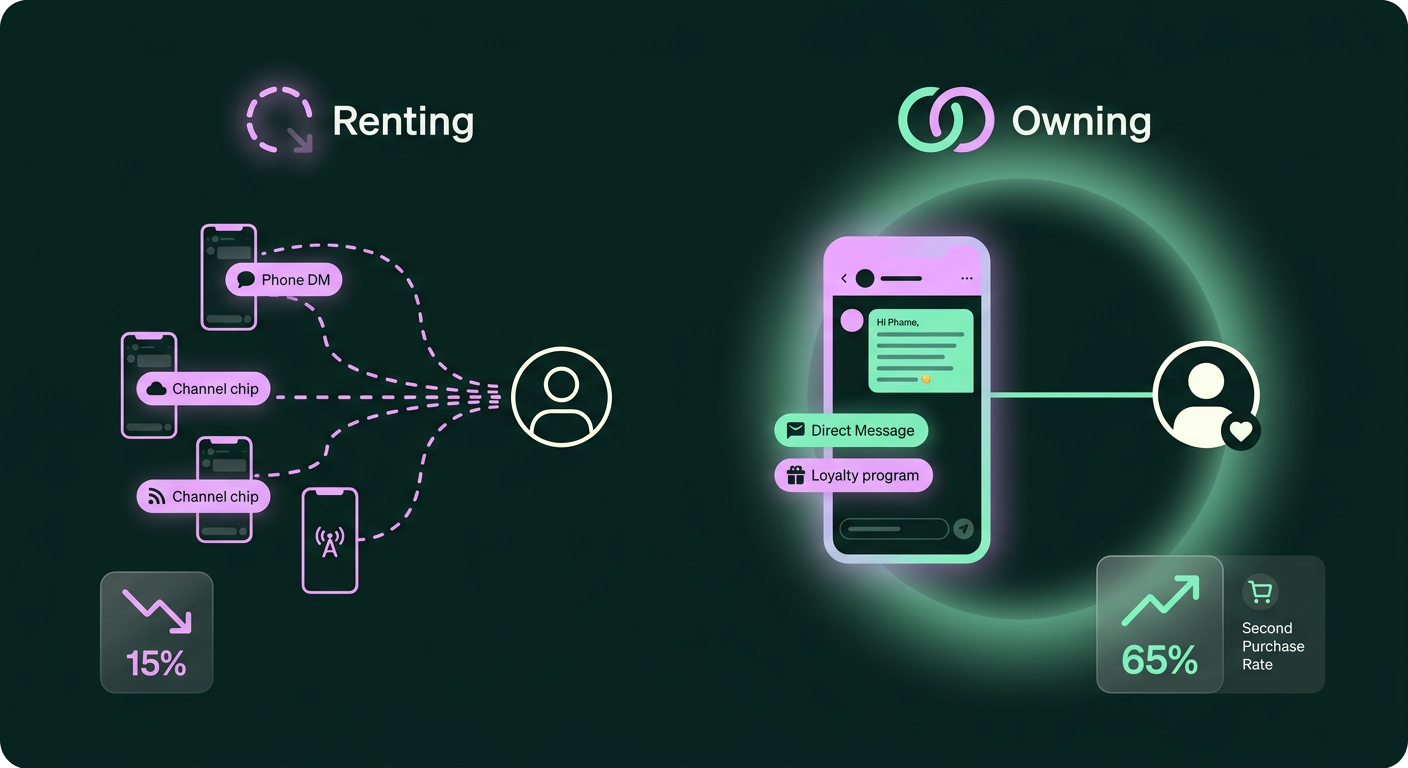
The reason your current acquisition model is becoming a dead end is simple: the very customers you pay to acquire aren't coming back. To break this cycle, you have to stop "renting" access to your customers from ad platforms and instead build an owned relationship in a channel they actually use, their DMs.
For many direct-to-consumer brands, the growth playbook has been to spend more on ads to get more customers. The problem is that this model is breaking down. You might win the first sale, but the relationship often ends there. For most Shopify stores, a sobering 72% of first-time buyers never come back for a second purchase (opens in a new tab). That means the vast majority of your ad spend is acquiring a customer for a single transaction.
Only 28 percent of first-time buyers on most Shopify stores ever place a second order. That means 72 percent never come back. , Huptech Web
When it's time to re-engage those customers, you're forced to go back to the same ad platforms and pay again just to reach them. This is the definition of a rented relationship. You don't own the connection; you're just paying for temporary access. Building a sustainable business requires converting that first transaction into a direct, owned line of communication. This is where personalized, one-to-one DM automation comes in. It helps you build a retention engine that works in the background, converting single-purchase customers into repeat buyers without you having to pay for them over and over again.
The Breaking Point: Why Your Acquisition Model Is Unprofitable
That need to own the customer relationship has become urgent. An acquisition-only strategy is now mathematically unsustainable, thanks to the one-two punch of sharply rising ad costs and the massive missed opportunity in your existing customer base. The cost to acquire a new customer has skyrocketed, while the probability of selling to an existing one is dramatically higher, making retention your most profitable growth lever.
The financial pressure to find a new approach is mounting. Over the last eight years alone, customer acquisition costs (CAC) have climbed by a startling 222% (opens in a new tab). Every dollar you spend on ads brings in less than it used to, forcing you to run faster just to stay in the same place. When you combine this with the fact that most of your newly acquired customers don't return, the unit economics start to look grim. You're paying a premium for a single sale with little long-term value to show for it.
The good news is that there's immense, untapped potential sitting in your order history. While you might have a 5-20% chance of converting a brand-new prospect, your chances of selling to an existing customer jump as high as 70% (opens in a new tab). Not only is the probability higher, but the cost is drastically lower. Depending on your industry, acquiring a new customer can cost anywhere from five to 25 times more (opens in a new tab) than simply keeping an existing one. When you do the math, it becomes clear that every dollar moved from an acquisition-focused ad budget to a retention-focused automation system generates a far greater return. Your most valuable audience isn't strangers on social media; it's the people who have already trusted you once.
How to Build a Post-Purchase DM Automation Flow
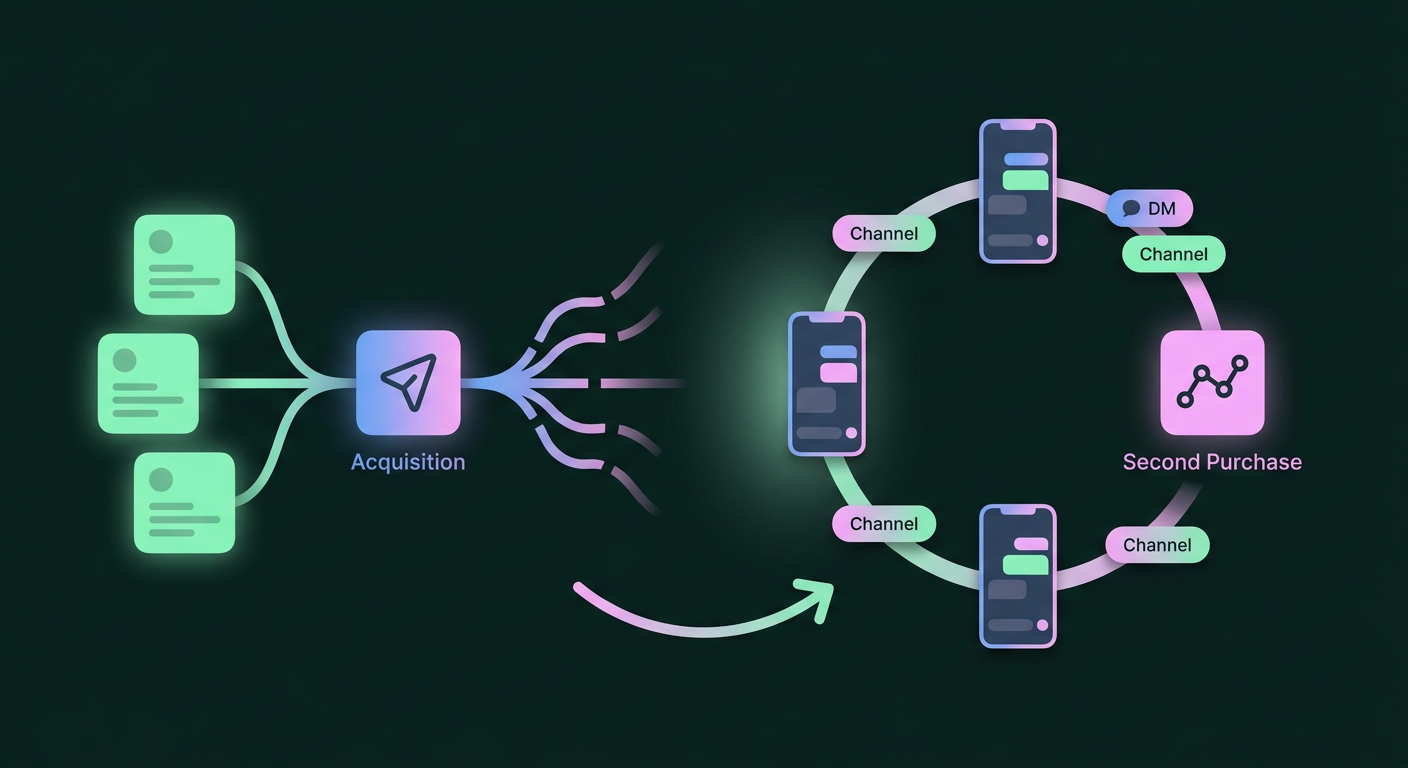
So, given the high cost of acquisition, how do you build a system that nurtures the customers you already have? You need a process that automatically sends timely, relevant, and personal messages to first-time buyers. This involves three key phases: unifying your customer data, segmenting new buyers based on their behavior, and launching a conversational DM sequence designed to guide them to their next order. This isn't about sending a generic discount code; it's about orchestrating a thoughtful post-purchase experience that makes a second purchase the natural next step.
Step 1: Unify Your Customer and Messaging Data
Before you can send a single personalized DM, your marketing and communication systems can't operate in silos. You need a unified view of your customer. The goal is to connect your customer data platform (like a CRM such as Braze or Klaviyo) with your DM automation platform. This integration is the foundation of the entire strategy, as it allows your messaging to be triggered by real-world customer actions.
When a customer makes their first purchase on your Shopify store, that event should become immediately visible to your messaging system. This connection means you're no longer sending messages to a generic list of "followers." Instead, you're communicating with "Jane, who bought the blue running shoes in size 9 yesterday." A single source of truth ensures your automated messages are based on actual purchase history, behavior, and lifecycle stage, making them infinitely more relevant than any manual broadcast.
Step 2: Segment Your First-Time Buyers
With your data unified, the next step is to segment your new customers. Not all first-time buyers are the same, and sending them all the same message is a recipe for low engagement. Effective segmentation is about understanding the context of that first purchase so you can tailor the follow-up conversation. You can create powerful segments based on a few key criteria.
Start with the product they purchased. A customer who bought a consumable like coffee or skincare has a different journey ahead than someone who bought a durable good like a backpack. The former is a candidate for a replenishment reminder, while the latter might be interested in a complementary accessory. You can also segment by order value. A high-value customer might warrant a different kind of follow-up, perhaps from a real person or with a more exclusive offer. Finally, consider adding a time-based element. A segment of "first-time buyers who have not purchased in 45 days" is a prime target for a specific win-back campaign. By creating these distinct groups, you ensure that the message you send is the most relevant one for that customer at that moment.
Step 3: Launch a Timely, Relevant DM Sequence
Now you can design and launch the automated DM sequences for each segment, transforming a one-time transaction into an ongoing conversation. A great post-purchase flow doesn't just ask for the next sale; it adds value first. This strategy is central to a number of different use cases for DM automation (opens in a new tab) that increase customer lifetime value. Consider a sequence that unfolds over days or weeks:
- The Immediate Thank You & Check-In (Day 1): Shortly after the order is confirmed, send an automated DM. This isn't a sales pitch. It's a simple message to say thank you, confirm you're there if they have questions, and build goodwill. It feels personal and reassuring.
- The Value-Add (Day 7): Once the customer has likely received their product, send a message that helps them get more out of it. This could be a quick user guide, a styling tip for apparel, or a recipe for a food product. You're being helpful, not pushy.
- The Relevant Cross-Sell or Replenishment Nudge (Day 30-45): Now that you've built a foundation of helpfulness, you can introduce the next purchase opportunity. Based on their initial purchase, offer a relevant complementary product. If they bought shampoo, introduce the matching conditioner. If they bought coffee beans, remind them that their supply might be running low. You can weave in a special offer here to incentivize action, but the context is what makes it work.
This multi-touch sequence, delivered in the intimate and high-engagement channel of Instagram or WhatsApp DMs, feels less like a marketing blast and more like a concierge service. It builds a relationship that naturally leads to a second sale and beyond.
Watch Out: Why Broadcast Blasts Don't Drive Repeat Sales
Before you build your own DM flows, it’s crucial to understand why so many re-engagement efforts fail. Sending generic, impersonal email newsletters or SMS broadcasts to your entire customer list simply doesn't work because it ignores the personal context of the relationship and gets lost in the noise.
The most common mistake brands make when trying to secure a second purchase is treating all their customers as one monolithic group. They export a list of past buyers and send them a generic 20% off coupon via email or SMS. This approach fails for two reasons. First, it's impersonal. The message doesn't acknowledge the customer's purchase history or their individual journey with your brand. It feels like junk mail because, in a way, it is, undifferentiated and irrelevant. As a result, it gets ignored along with the dozens of other promotional emails they receive daily.
Second, it uses the wrong channel for the job. Channels like email and SMS are saturated. Open rates are declining, and it's difficult to stand out. DMs on platforms like Instagram and WhatsApp, however, are conversational by nature. A message there feels like a one-to-one conversation, not a marketing broadcast from a corporation. When you combine this personal channel with the segmentation and timing discussed earlier, the message is not only seen but feels welcome and helpful. The goal is to create a dialogue, and you can't do that by shouting at a crowd. A personalized DM cuts through the noise and shows the customer you see them as an individual, which is key to earning their trust and their repeat business.
What 'Done' Looks Like: A Predictable Retention Engine
When you avoid those common pitfalls and implement this strategy correctly, you get a reliable, automated retention engine. This system predictably increases your second purchase rate and overall customer lifetime value, letting you shift your budget and focus away from the endless, expensive churn of pure acquisition.
A well-implemented post-purchase DM flow transforms your marketing from a series of disjointed, expensive campaigns into a cohesive, profitable system. Instead of guessing how to get customers back, you'll have an engine that runs 24/7, identifying first-time buyers and automatically guiding them toward their second purchase with relevant, personalized conversations. This creates a predictable lift in your repeat purchase rate, which is one of the most powerful levers for increasing customer lifetime value and reducing ad waste.
With this engine in place, the economics of your business fundamentally change. Because you know a higher percentage of new customers will make a second and third purchase, the allowable CAC for that first acquisition can go up, giving you a competitive edge. More importantly, you can begin to strategically shift budget away from the top of the funnel. You are no longer just paying to "rent" customers from ad platforms; you are investing in owned relationships. The result is a more resilient, profitable business that grows not just by finding new customers, but by expertly nurturing the ones it already has.
Frequently asked questions
Why should I prioritize customer retention over acquisition right now?
Prioritizing retention is simply more cost-effective and profitable. With ad costs continuing to rise, getting more value from the customers you already have offers a much more stable path to growth. It can cost five to 25 times more to attract a new customer than to keep an existing one, so every dollar invested in retention just goes further.
How can focusing on repeat buyers help me break through a revenue plateau?
When a business hits a revenue plateau, it's often because its acquisition funnel is leaky, new customers come in, but they don't stick around. By focusing on increasing your second purchase rate, you raise the lifetime value (LTV) of every customer you acquire. This creates a compounding effect on revenue without you having to increase your ad spend, allowing you to break through the plateau with more profitable, sustainable growth.
Why are my Facebook ads not effective at bringing back past customers?
Your Facebook retargeting ads likely feel ineffective because it's become so expensive to constantly "re-buy" access to your own customers on the platform. With CAC increasing by 222% over the last eight years, it's a costly approach. An ad is also a broadcast medium that often lacks the personal context to be compelling. A direct, one-to-one message in DMs feels more like a conversation and is far more likely to be opened and acted upon than a generic ad in a crowded feed.
How do I use customer lifetime value (CLV) to make better marketing decisions?
Customer lifetime value (CLV or LTV) is the total revenue you can expect from a single customer over time. By knowing your LTV, you can figure out how much you can afford to spend to acquire a customer (your target CAC) and still be profitable. When you implement strategies that increase your second purchase rate, you directly increase LTV. That, in turn, either justifies a higher acquisition spend or allows you to invest more in retention to further boost profitability.
Can I apply these retention strategies if I have a subscription model?
Absolutely. These strategies are highly effective for subscription models. While the goal isn't a "second purchase" in the same way, the principles of preventing churn and encouraging upgrades are identical. You can use automated DM sequences to onboard new subscribers, share tips, check in before a renewal, or offer an incentive to upgrade. The mission is the same: use personalized communication to deepen the relationship and extend the customer's lifetime value.
What's the best way to turn a one-time shopper into a loyal customer?
The best way is to build a genuine relationship right after the first sale, and the most effective channel for this is direct messaging. A shocking 72% of first-time shoppers on Shopify don't make a second purchase, often because the brand fails to engage them in a meaningful way. An automated post-purchase DM sequence that thanks them, provides value, and follows up with relevant offers makes the customer feel seen and valued, creating a strong foundation for long-term loyalty.