
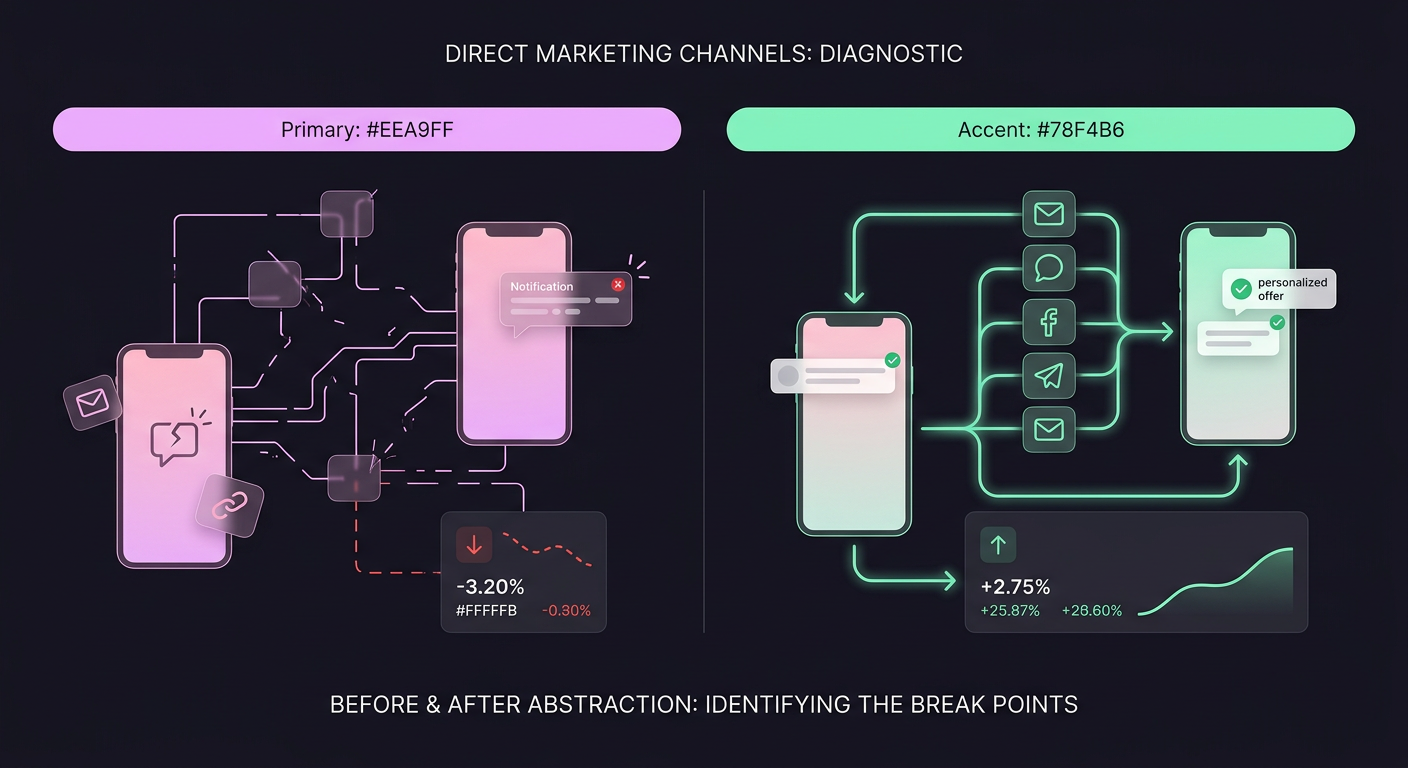
For any growth leader at a direct-to-consumer brand, it’s a frustrating and familiar story. The growth playbook you perfected, the one that likely built your business, simply isn’t working anymore. A quick look at your performance marketing dashboards tells the tale: customer acquisition costs (CAC) are climbing, return on ad spend (ROAS) is shrinking, and the daily battle for profitable growth feels unwinnable. What was once a reliable engine now feels like a treadmill where you have to run faster and spend more just to stay in the same place.
Your Go-To Growth Playbook Is Now Broken
For years, the formula for scaling a DTC brand was simple: make a great product, then pour fuel on the fire with Meta ads. This strategy was so effective that it powered an entire generation of brands from launch to household name. But that era is definitively over. The predictable returns from platforms like Facebook and Instagram have been replaced by volatility and rapidly diminishing margins. What you’re experiencing isn’t a temporary slump or a bad run of creative; it’s a systemic shift that has broken the old model for good.
The data confirms this isn't an isolated problem. Across the board, acquiring customers through these channels has become drastically more expensive. Recent analysis shows Facebook's average cost per lead shot up 21% in just one year, while Meta's own reports revealed a 14% jump in ad costs (opens in a new tab) for a meager 6% increase in impressions. You are paying significantly more to reach roughly the same number of people, a simple equation that spells disaster for profitability.
The reasons for this go deeper than just a crowded marketplace. Your ad budget is being squeezed from two directions: one that's obvious and one that's hidden deep within the platform's code.
Why Your Ad Costs Are Skyrocketing (It’s Not Just You)
To understand why your CAC is spiraling, you have to look beyond your own campaign metrics to the advertising ecosystem itself. The forces at play are both external and internal to the platforms, and together they have created a perfect storm for advertisers.
Surface Cause: More Advertisers, More Competition
The most straightforward reason for rising costs is classic supply and demand. The number of businesses competing for a user’s attention on social media has exploded. The massive shift to online shopping during the pandemic fast-forwarded digital adoption by five years (opens in a new tab), cramming a decade of e-commerce growth into just a few years. As brick-and-mortar businesses moved online, digital ad platforms were flooded. Google’s ad revenue, for instance, grew by over 42% in a single year as businesses piled into pay-per-click advertising.
This trend is just as pronounced on social media, where Meta's advertising revenue surpassed $196 billion in 2025 from brands dedicating ever-larger budgets to the platform. With millions of advertisers now competing in the same auction for a finite amount of user attention, the price of that attention naturally goes up for everyone. You aren't just competing with your direct rivals anymore; you're competing with every brand trying to reach a similar demographic.
The Real Culprit: A More Powerful, Complex Ad Algorithm
While increased competition is a big part of the story, the more fundamental driver of cost is the evolution of Meta’s own ad delivery system. The platform has become far more sophisticated, moving from simple auction dynamics to a complex, AI-driven model designed to maximize its own revenue.
The introduction of new systems like the Andromeda retrieval algorithm represents a major step forward in this capability. Powered by advanced hardware, this algorithm is reportedly 100 times faster at matching people to ads (opens in a new tab) and can process ten thousand times more ad variations at once. On the surface, this sounds like an improvement, promising better targeting and relevance. The catch is that this power comes at a price. The algorithm is now better than ever at identifying the users most likely to convert and charging a premium to reach them. Because the system no longer just sells impressions but sells outcomes, it prices its services accordingly. This means the days of finding cheap, under-monetized pockets of users are over. The platform has become ruthlessly efficient at finding and extracting the maximum value from every impression, leaving advertisers with less and less margin.
These platform-level changes leave you in an uncomfortable and unsustainable position, caught between channels that are too expensive and ones that aren't engaging enough.
Diagnosing the Impact on Your DTC Brand
The combination of fierce competition and a smarter, more expensive algorithm puts your brand in a strategic bind. On one hand, you have the paid social channels that have become the "rented land" of your marketing strategy. You know that's where your customers are, and for many brands, increased exposure remains a primary benefit of social media marketing (opens in a new tab), making it feel essential. Yet continuing to pour money into this channel feels like a gamble where the house always wins, as every dollar is subject to the whims of an algorithm you don't control.
On the other hand, you have your traditional "owned" channels, primarily email. The conventional wisdom has always been to build your email list as a hedge against rising ad costs. The problem is that for many brands, the results are underwhelming. Inbox clutter is at an all-time high, open rates are dwindling, and getting a customer to engage with a promotional email is harder than ever. It may be an asset you own, but it's not a very valuable one if nobody is paying attention. You're trapped between a channel that’s breaking your budget and another that’s failing to deliver the revenue you need.
The way out of this cycle isn't finding a "cheaper" version of Facebook ads or sending more emails. It’s fundamentally rethinking where you build your audience and how you communicate with them by embracing true direct marketing channels.
The Fix: Shift to High-Engagement Direct Marketing Channels
Escaping the ad-cost treadmill requires a strategic pivot: shifting focus from renting an audience on social media feeds to building an owned audience where they actually want to engage. This means moving beyond the crowded inbox and into the high-engagement world of direct messaging on platforms like Instagram and WhatsApp. These aren't just new channels; they represent a different kind of marketing that is personal, immediate, and conversational.
What Differentiates a 'Direct' Channel?
A true direct marketing channel is defined by the quality of the connection it creates. Unlike a social media post competing with a thousand other items in a feed, or an email that lands in a promotional tab, a direct message arrives in a personal, 1:1 space. It’s a notification people actually check, which is why channels like WhatsApp and Instagram DMs boast open rates consistently above 80%, a figure most email marketers can only dream of.
This isn't just about higher visibility; it's about the nature of the interaction. DMs are inherently conversational, allowing for a back-and-forth that feels more like a personal concierge service than a marketing broadcast. This helps you build genuine relationships, gather valuable zero-party data, and guide customers through their journey in a way that feels helpful, not intrusive.
Moving Your Audience From Rented Land to Owned Property
The strategic shift is to use paid ads not as your primary conversion tool, but as the first step in moving a user from "rented" public space to an "owned" private one. The goal of an ad click is no longer just to drive a website visit or an immediate purchase; it's to initiate a DM conversation and earn a new subscriber. Using features like Click-to-Messenger or Click-to-WhatsApp ads lets you acquire a permanent, direct line to a customer for a fraction of the cost of re-acquiring them through the ad auction again and again.
Once a user becomes a DM subscriber, you own that relationship. You are no longer subject to algorithmic gatekeepers or rising CPMs, and you can communicate with them directly to send personalized offers, recover abandoned carts, and build loyalty over time. By exploring the different use cases for direct engagement (opens in a new tab) that build long-term value, you can turn your ad spend from a temporary expense into a long-term investment in a defensible business asset: a list of highly engaged customers you can reach anytime, for free.
Making this shift means your definition of success will change, too. The metrics that once dominated your dashboard become far less important, replaced by new KPIs that more accurately reflect the health of your business.
How to Know It’s Working: Your New Metrics for Success
Adopting a strategy centered on direct marketing channels means your performance dashboard should look different. The volatile, platform-dependent metrics that once caused so much anxiety can be replaced by more stable, business-centric indicators of growth. You'll stop obsessing over daily swings in ROAS and start focusing on the long-term value you're building.
Instead of focusing on Cost Per Mille (CPM) or Cost Per Click (CPC), your primary acquisition metric becomes Cost Per Subscriber: how efficiently you convert an ad click into an owned contact in your DM list. This single metric reflects the true cost of acquiring a long-term asset, not just a fleeting website visit. From there, your focus shifts to subscriber lifetime value (LTV), which measures how much revenue the average DM subscriber generates. This becomes your north star for profitability.
Your new dashboard will feature metrics that reflect direct engagement and conversion, such as DM open rates, click-through rates, and, most importantly, the direct revenue attributed to your DM campaigns. Seeing how many abandoned carts you recover or sales you drive with a personalized offer sent via WhatsApp provides a clear, undeniable link between your direct channel and your bottom line. By tracking these new metrics for direct channel performance (opens in a new tab), you gain a much clearer picture of your business's health and can finally step off the paid acquisition treadmill for good.
Frequently asked questions
How can I grow my store without having to rely on Meta ads?
The key is to change your strategy from "renting" an audience on platforms like Meta to "owning" one through direct marketing channels. Rather than using ads only for immediate sales, use them to acquire subscribers on high-engagement platforms like WhatsApp or Instagram DMs. Once you have a direct, 1:1 connection with a customer, you can build a long-term relationship and market to them without repeatedly paying ad platforms for access. This builds a sustainable asset that isn't dependent on a volatile algorithm.
What should I do about my customer acquisition costs climbing across all platforms?
First, recognize that this is a widespread, systemic issue caused by increased competition and more sophisticated platform algorithms. To combat this, diversify your acquisition strategy by focusing on channels that provide a better long-term return. Shifting budget toward acquiring subscribers for direct channels like DM can lower your overall blended CAC over time, since you can re-engage that audience for free. The data backs this up, with costs per lead and impression steadily increasing across Meta's platforms.
Should I avoid using Facebook Ads for my business entirely?
Not necessarily. The goal isn't to abandon Meta ads, but to change their role in your strategy. Think of them as the top of your funnel for building your owned audience, not as your primary sales driver. They are still powerful tools for reaching new people. The most effective approach is to run Facebook and Instagram ad campaigns designed to convert viewers into DM subscribers rather than just one-time buyers.
What are the best alternatives to Facebook ads for my DTC brand?
The best alternatives are channels that give you a direct, owned relationship with your audience. This primarily means building out robust direct messaging capabilities on Instagram and WhatsApp, which have significantly higher engagement than traditional channels like email. Exploring other platforms like TikTok or niche-specific communities can also work, but the principle is the same: use any platform to drive people to a channel you control, where you can build a relationship without a gatekeeper.
How can I lower my CAC without sacrificing my growth targets?
The most sustainable way to lower your CAC is to increase the lifetime value (LTV) of each customer. A direct marketing channel is the most effective tool for this. When you can communicate with customers via DM, you can send personalized reorder reminders, cross-sell relevant products, and recover abandoned carts far more effectively than with email or retargeting ads. This increases the total revenue from each customer, which in turn allows you to afford a higher initial acquisition cost while still being profitable and hitting your growth targets.
What are the biggest changes to Meta's ad platform that I should be aware of?
One of the most significant changes is the rollout of more powerful AI-driven algorithms like the Andromeda retrieval system. This technology is incredibly efficient at matching users with ads they are most likely to act on, but it also means the platform has become much better at identifying and charging a premium for the highest-intent users. Because the algorithm is designed to extract the maximum possible price for valuable impressions, advertisers can no longer rely on finding inexpensive niche audiences. This makes it more critical than ever to have a strategy that doesn't depend solely on winning the ad auction.