
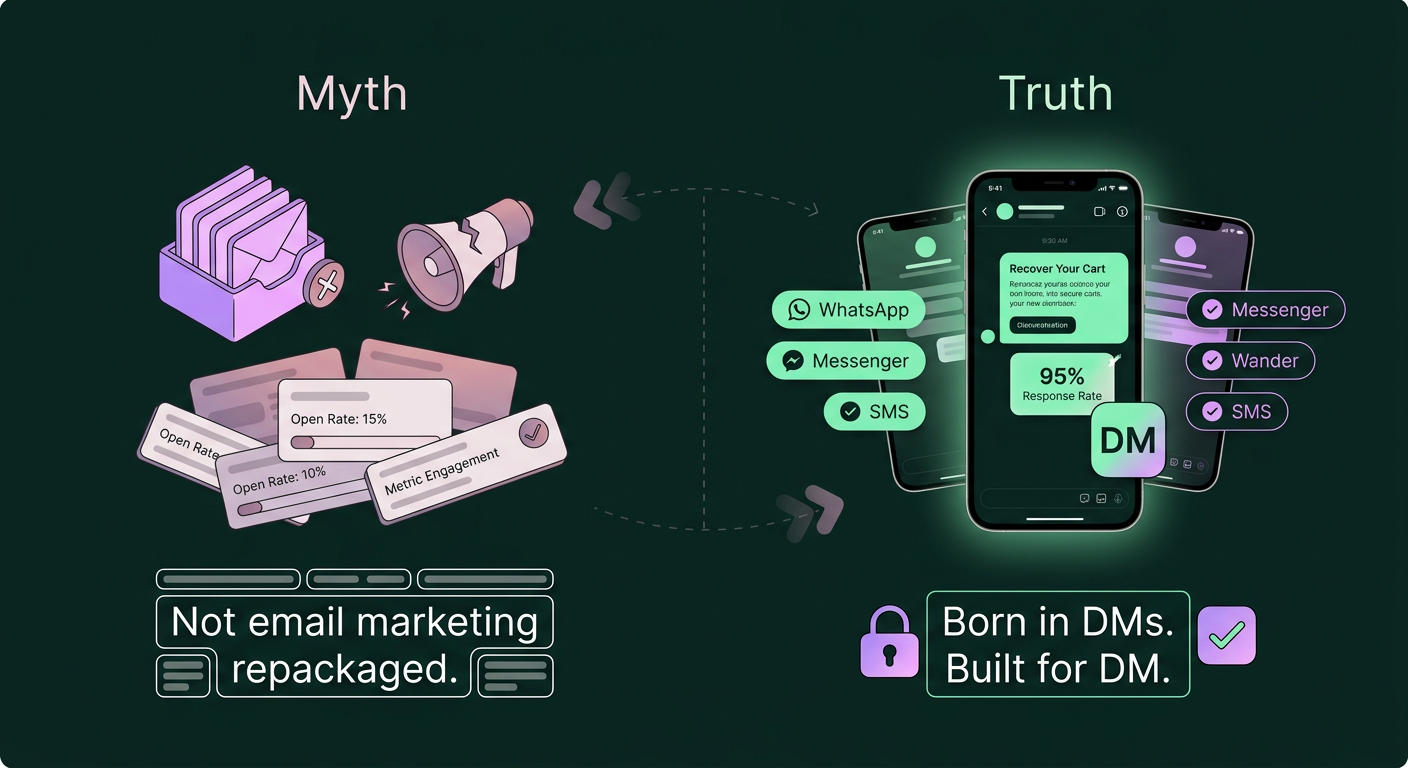
“To find the best tool, I should look for a better email platform.”
If this is your starting point for tackling abandoned carts, you're not alone, but it’s an assumption that's holding you back. For years, the default strategy for winning back would-be customers was to find the perfect email provider, craft a clever three-part email sequence, and hope for the best. The problem is that while you've been perfecting your subject lines, your customers have moved on. With nearly 70% of all e-commerce carts being abandoned (opens in a new tab), just doing what you’ve always done is no longer a viable strategy. Email’s effectiveness as a direct line to your audience is waning, and the best recovery tools today aren't about building a better email. They’re about reaching customers in the high-intent channels they actually use, like SMS and social media DMs.
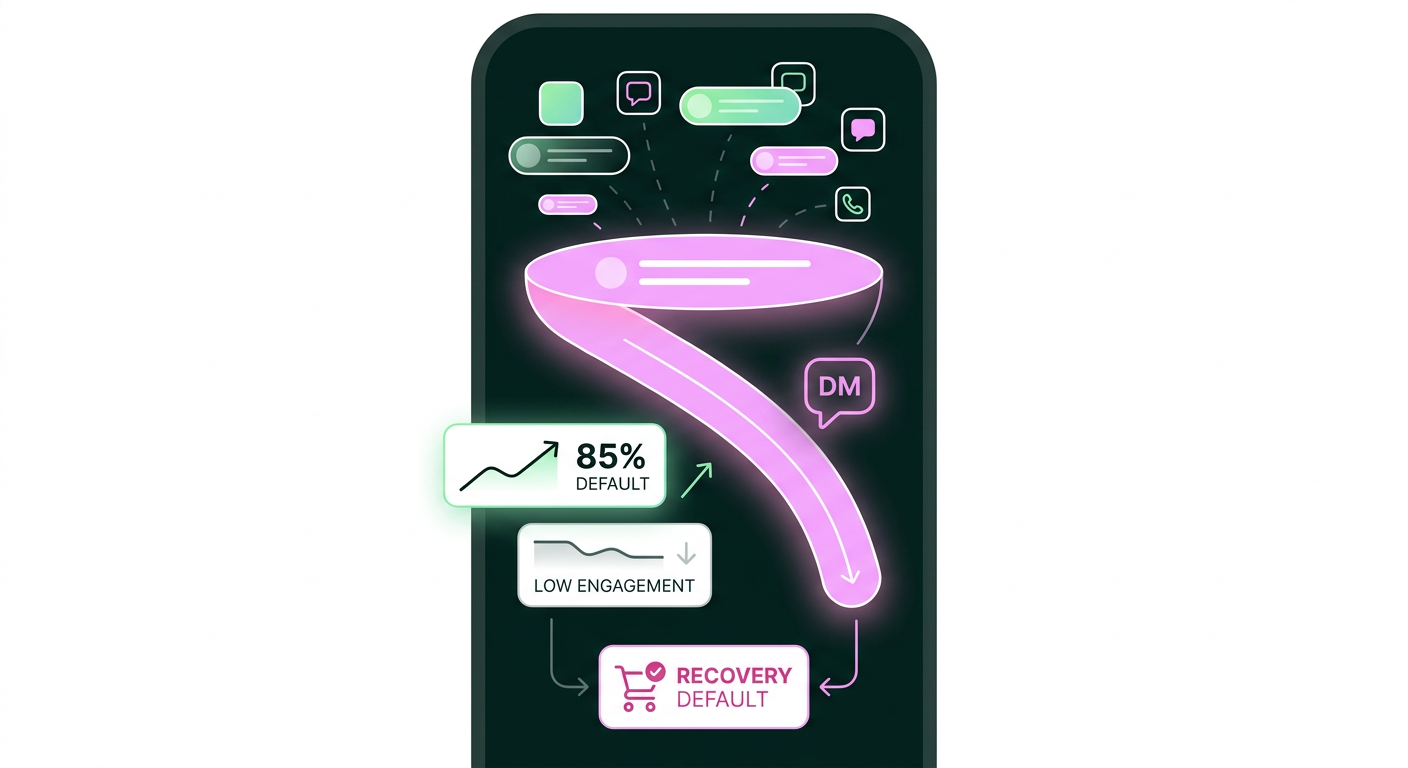
Why Email Became the Default (And Why It’s Not Enough Anymore)
It makes sense that e-commerce brands have relied on email for so long. For a while, it worked incredibly well, and in some ways, it still outperforms other types of marketing. Compared to a standard promotional newsletter's 15-30% open rate, abandoned cart email open rates can hit an impressive 39-45% (opens in a new tab). That's a significantly more engaged audience, which logically leads to focusing your efforts there. A well-executed email strategy can absolutely help recover lost sales, increase retention, and provide valuable customer insights.
To that end, the conventional wisdom evolved to support a multi-step email cadence. A single reminder was often seen as insufficient, so the standard best practice became a series. The first email would be a gentle, "Did you forget something?" nudge. A day later, a second email might introduce a sense of urgency, perhaps warning that an item is low in stock. A third could follow with a small discount or an offer of free shipping to finally close the deal. This multi-step email series allowed brands to pace the conversation and test different psychological triggers.
The strategy was logical, easy to implement with countless tools, and it produced measurable results. But the digital world has changed. Customers are so inundated with emails that even the most well-intentioned messages are often lost in a cluttered inbox or routed directly to the "Promotions" tab, never to be seen. While a 40% open rate sounds good on paper, it still means 60% of your hottest potential customers never even see your message. The foundation of the strategy is cracking, and relying solely on a better email tool is like bringing a faster horse to a car race.
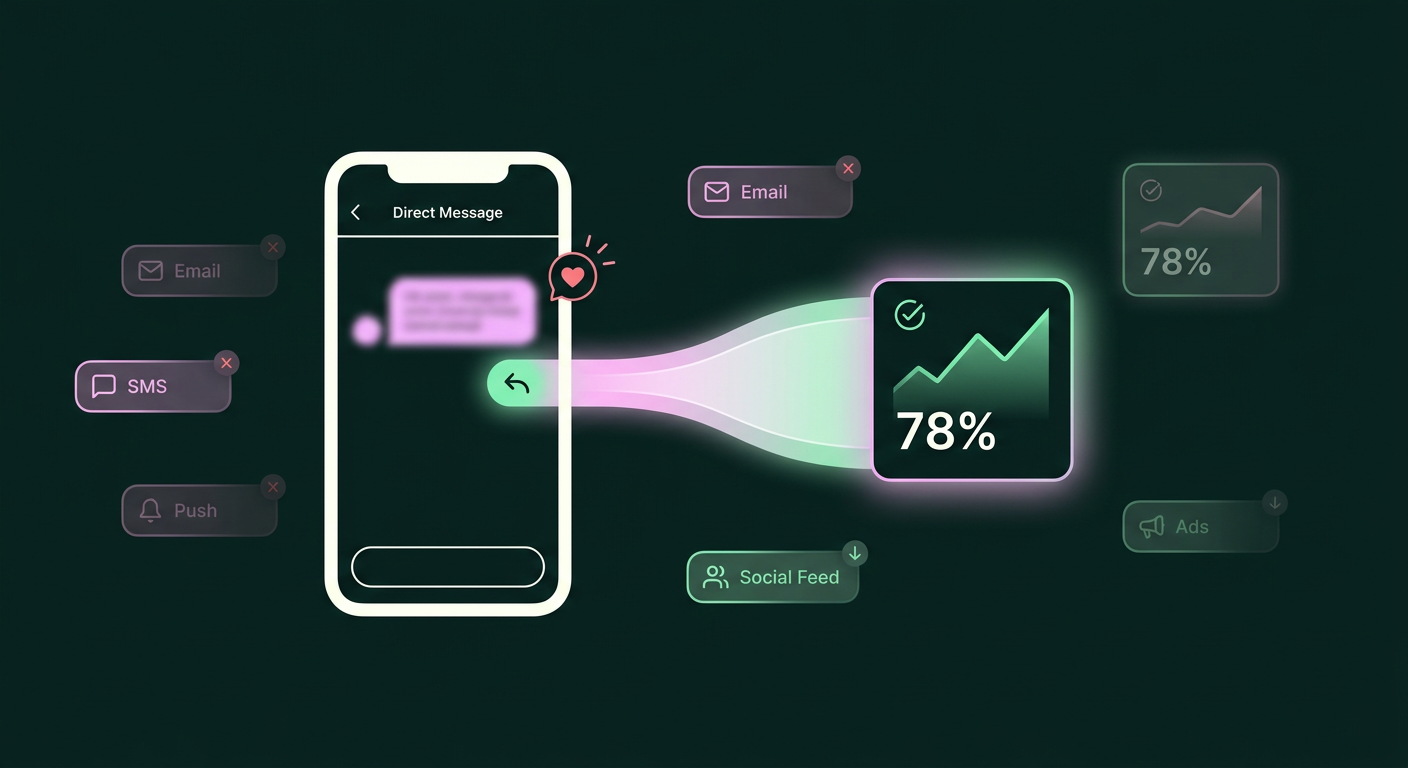
The Real Recovery Power Is Outside the Inbox
The fundamental weakness of an email-only approach is that it ignores where your customers actually spend their time and pay attention. The real opportunity for cart recovery now lies in channels that offer a more direct and personal connection, and the data on this is clear. While a great abandoned cart email might be opened by four out of ten people, SMS messages boast an incredible open rate of 98% (opens in a new tab). When you send a text, it gets read.
This isn't an argument to abandon email, but to see it as one piece of a larger, more effective puzzle. The most successful brands are adopting a multi-channel approach. Research shows that combining email, SMS, and social media can boost recovery rates by up to 45%. Imagine a flow where a customer first receives a friendly email, but if they don't open it, a social media DM follows up 24 hours later. This layered strategy meets customers where they are, dramatically increasing the odds that your message will not only be seen but acted upon.
Think about the context: an email feels like a piece of marketing from a company, while a DM on Instagram or a message on WhatsApp feels like a conversation. It's a channel people associate with friends and personal interaction, which makes a well-timed, helpful message feel less like a sales pitch and more like personal customer service. This is where the real conversion power is hiding, not in a cleverly worded subject line, but in a completely different, more intimate channel.
What's Actually True: The Best "Tool" Is a System
This brings us to a core reframing: you shouldn’t be looking for a single best tool, but rather the best system. The most effective recovery strategy isn't a standalone email platform or a simple plugin. It's an integrated system that uses your customer data to power automated, personalized outreach across multiple channels. The brain of this operation is your existing CRM or customer data platform, like Braze or Klaviyo, and the "tools" are simply the endpoints that deliver the message. You can see how this works in practice (opens in a new tab).
The goal is to move beyond generic messages and toward personalized 1:1 communication. When a customer abandons a cart, your system should know not just what they left behind, but also their purchase history and preferred communication channels, allowing for truly intelligent follow-up. Using AI-powered systems, you can even generate recovery messages automatically that are tailored to the specific customer and products. For instance, including personalized product recommendations in recovery emails has been shown to generate significant revenue, proving that deeper personalization works.
The limits of your e-commerce platform
You need this kind of system because the built-in tools offered by major e-commerce platforms are often surprisingly limited. They were designed for a world where email was the only answer.
For example, Shopify's native functionality only tracks abandoned checkouts, which means it completely misses any customer who added items to their cart but never started the checkout process. That’s a huge segment of lost opportunities. Similarly, WooCommerce has no built-in cart recovery at all; you have to find an external plugin just to get started. And while a platform like BigCommerce offers a slightly more advanced saver on some of its plans, it's still largely confined to a sequence of three emails and lacks the flexibility to easily add other channels like SMS or social DMs without an external tool. These platforms provide a starting point, but they can't deliver the kind of sophisticated, multi-channel system you need for maximum recovery.
What to Do Now: Use Your CRM Data
So what’s the practical next step? It’s time to stop shopping for more "cart abandonment tools" and start looking at the data you already have. Your CRM is the source of truth, holding the purchase history, behavioral data, and contact info you need for a modern recovery strategy. The real work isn't finding a new platform to house this data; it's connecting your CRM to tools that can send messages on your behalf across the right channels.
A modern workflow should be automated and triggered directly from your CRM's segmentation. When a user enters your "Abandoned Cart - 24 Hours" segment in Braze or Klaviyo, that event should automatically trigger a personalized message. It could be an email, an SMS with an expiring coupon to create urgency, or a friendly DM on Instagram. The possibilities expand when you see your CRM as the hub. This same logic can be applied to other parts of the customer journey, from sending automated reorder reminders to running full-funnel win-back campaigns. By using the data you already own, you can build a powerful, automated system for customer communication that goes far beyond simple cart recovery. You can explore a variety of different CRM-driven use cases (opens in a new tab) that follow this model.
Your First Move: Map Your "Abandoned Cart" Segment
While this might sound complex, getting started is surprisingly simple and doesn't require ripping out your current setup. Your first step is purely exploratory and takes less than ten minutes.
Log in to your CRM or customer data platform and find the segment, cohort, or list that your team has already built for users who have abandoned a cart. It might be called "abandoned_checkout_24h," "cart_abandoners_3_days," or something similar. Just find that list and look at the user count. This is the audience your email-only strategy is failing to fully reach.
By simply identifying this group, you've defined the exact audience that a modern, multi-channel recovery system can communicate with and taken the most important step. The next move is connecting a tool that can pull from this exact segment and start conversations on DMs, which have an 80%+ open rate (opens in a new tab), but for today, just finding the list is the real starting point.
Frequently asked questions
How can I use my CRM data to send personalized recovery messages?
Your CRM data lets you go far beyond just inserting a customer's first name. The most effective personalization uses the specific products they left in their cart to inform the message, automatically pulling the product name and image into your follow-up. You can even use their purchase history to include personalized product recommendations for other items they might like. This shows you understand their preferences and provides genuine value, turning a simple reminder into a helpful shopping assistant.
What’s the best way to start sending DMs for cart recovery?
The best way to start is by integrating a specialized tool with your existing CRM. This lets you trigger DMs based on the same segments you already use for email, such as "user abandoned cart 8 hours ago." A good tool will automatically pull the customer's social handle and send a personalized 1:1 message without requiring manual work from your team. Since channels like SMS and social DMs have open rates as high as 98%, this ensures your message is actually seen, giving you a much higher chance of winning back the sale.
Should I still use email for cart recovery?
Yes, absolutely. Email isn't dead; it's just incomplete on its own. It can still be a valuable part of a broader, multi-channel strategy. Even though its open rates are lower than DMs or SMS, abandoned cart emails perform significantly better than standard marketing emails. The ideal approach is to use email as one touchpoint in a larger sequence. You might lead with an email and then, if the customer doesn't engage, follow up with a DM or SMS a day later.
What customer information from my CRM is most useful for this?
The most useful information from your CRM includes the specific items left in the cart (product name, image, price), the customer's name for personalization, and their past purchase history to identify them as a first-time or repeat shopper. Knowing their last activity date helps you time your message correctly. If you have their social media handles or phone number stored in the CRM, that information is what enables outreach on channels outside of email.