
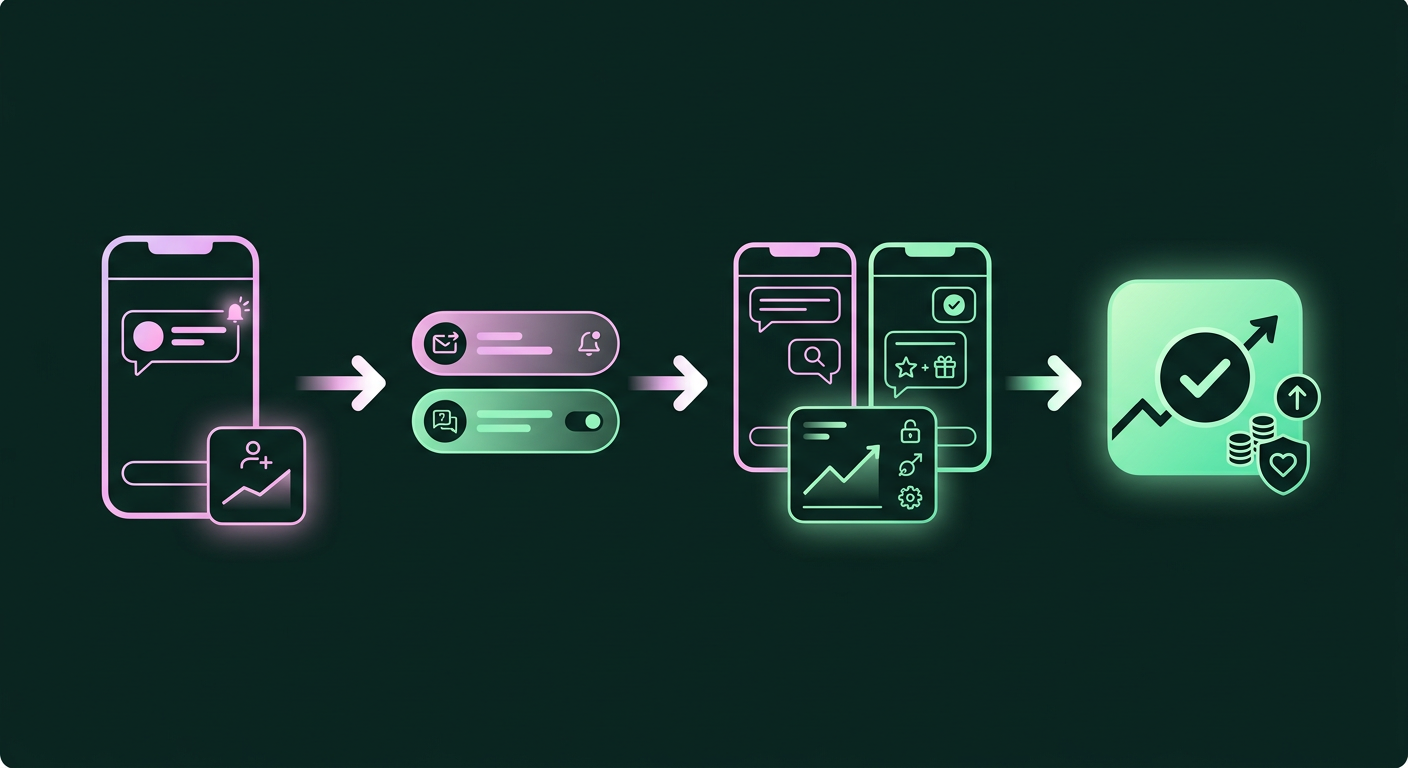
It's one of the most familiar frustrations for any mobile brand: you do the hard work of acquiring a new user, your install numbers look great, and then... nothing. A huge portion of those new installs drop off within days, vanishing before they ever complete a key action or experience the core value of your product. This leak between install and activation isn't a minor issue; it's a constant drain on your marketing budget and a major roadblock to sustainable growth. The solution isn't to pour more money into the top of the funnel, but to build a deliberate user activation strategy that guides new users from their first tap to their first "Aha!" moment.
Why Your App Sees a Drop-off After Install
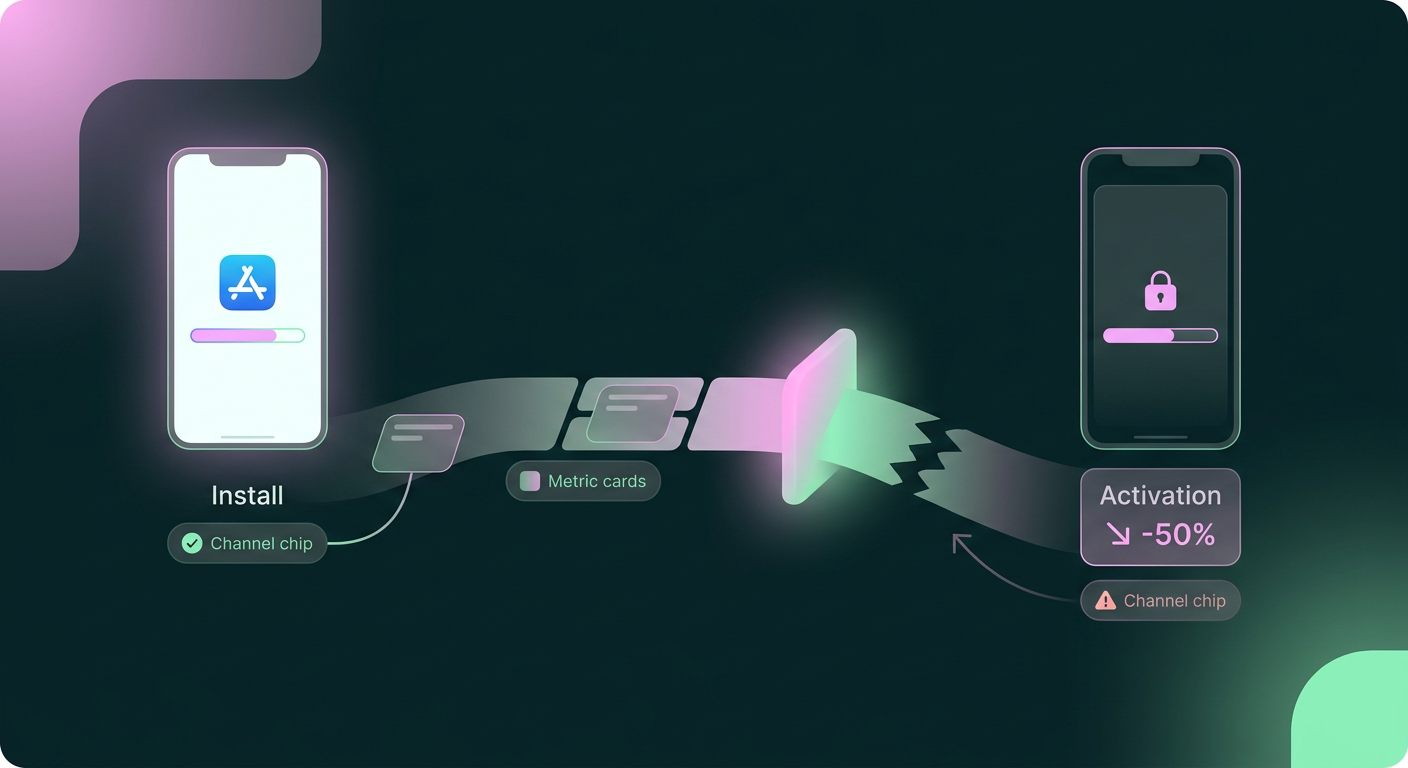
The drop-off happens because of a gap between a user's initial curiosity and their first meaningful experience of value. That initial install is driven by a promise made in an ad, but the user is often left to find their own way through an unfamiliar interface. This is especially true in the first few days, when their interest is highest but their commitment is lowest. Without a clear, guided path, their initial momentum fades, they get distracted or confused, and they churn. They might open the app once, tap around without a clear goal, and then forget about it. When early curiosity isn't channeled correctly, it rarely translates into retention. Optimizing this onboarding funnel is what transforms that curiosity into measurable growth (opens in a new tab), turning an accidental process into a predictable one.
Why User Activation Matters More Than Acquisition Alone
While user acquisition is a (opens in a new tab) necessary first step, sustainable growth comes from converting those installs into active users, not just endlessly increasing the top-of-funnel count. A business model built solely on acquisition is fundamentally inefficient and expensive. The real goal is to turn installs into an engaged user base that generates long-term value, and that transformation happens at the activation stage. Focusing on activation shifts the conversation from volume to efficiency, recognizing that simply acquiring new users is not enough for sustainable growth. An activated user is one who has experienced the core value of your app, they’ve completed their first workout, created their first playlist, or won their first game. They "get it." This experience is what bridges the gap between being a trial user and becoming a retained one. A strong strategy defines not just who you want to acquire, but also precisely which actions after the install truly matter (opens in a new tab) for the long-term health of your app. Without this focus, you're just renting users, not building a loyal customer base.
How to Build Your Activation Strategy
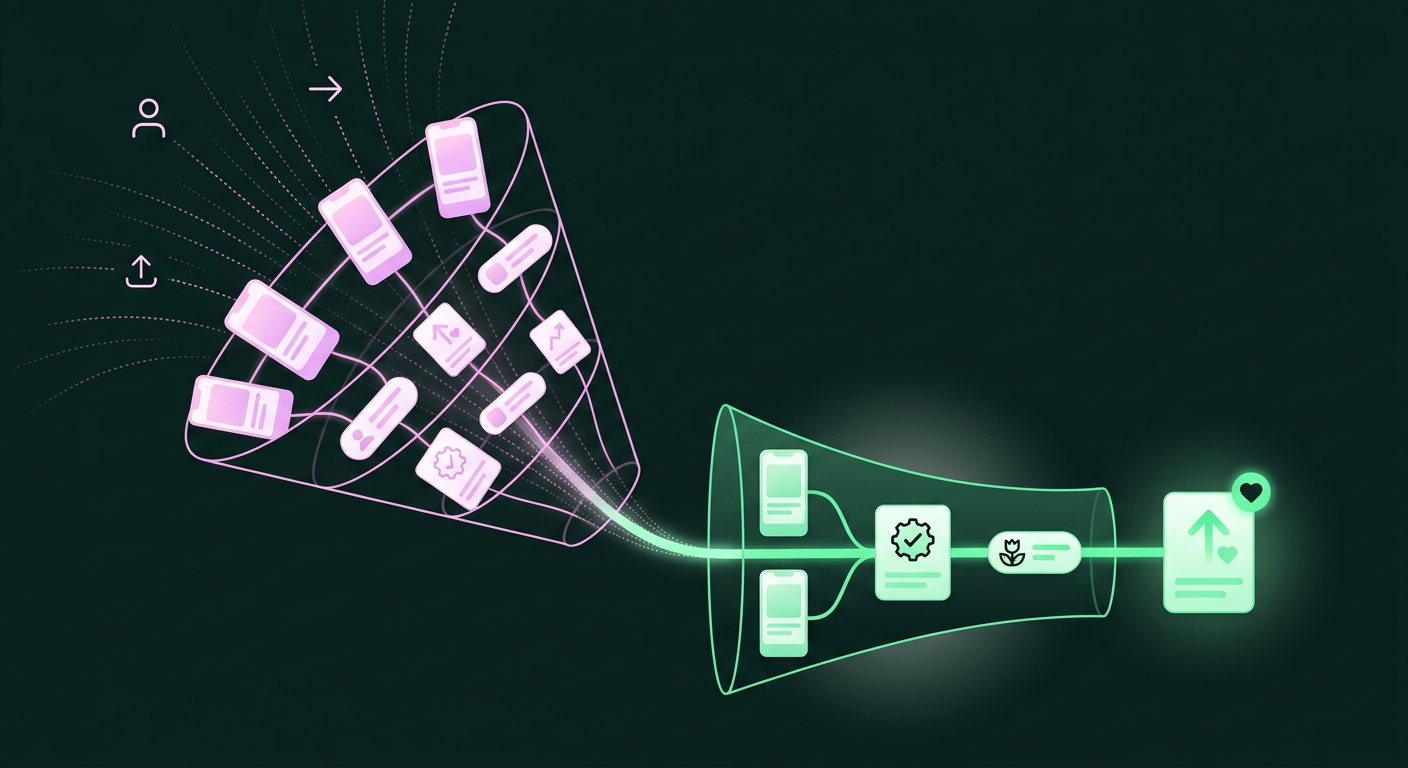
A successful activation strategy is (opens in a new tab) a systematic process of mapping the ideal user path, identifying friction points, and using personalized communication to guide users toward value. It's about moving from a passive "hope they figure it out" approach to an active, data-driven one by understanding your user's journey in detail and intervening at the precise moments they need a nudge in the right direction. The entire process rests on a few key pillars, from initial mapping to final measurement.
Map the journey from install to the first "Aha!" moment
The first step is to define the critical path a new user must take to experience your app's core value. This isn't just a list of screens; it's a sequence of key actions that lead to their first "Aha!" moment. A key best practice is to help users experience a meaningful product benefit as fast as possible (opens in a new tab). This might be completing their profile, playing their first level, or connecting with their first friend.
This process of customer journey mapping involves visualizing every interaction, from the ad they clicked to the specific in-app actions that signal they are becoming an engaged user. For each desired outcome, you should have a unique map that outlines the ideal sequence of events. This map becomes the blueprint for your entire activation strategy, defining the milestones you'll measure and the behaviors you'll want to encourage.
Analyze the funnel to find the biggest leaks
With your journey map in hand, you can use analytics to see where users are actually going. By building a funnel report that mirrors your ideal path, you can pinpoint the exact steps where users are dropping off in the highest numbers. Is there a massive dip after the sign-up screen? Do users stall after being asked for permissions? Are they failing to discover a critical feature?
This analysis turns a vague problem ("people are churning") into a specific, actionable insight ("we're losing 60% of users between Step 3 and Step 4"). This data-driven approach is essential for focusing your efforts. Instead of guessing, you now know precisely which part of the onboarding experience needs attention, which is the first step toward making activation predictable. Every improvement can be guided by data (opens in a new tab) and validated through experimentation.
Personalize messaging based on user behavior
Once you've identified a leak, the solution isn't to send a generic "come back!" push notification to everyone. The most effective interventions are personalized and triggered by specific user behaviors (or a lack thereof). If a user completes Step 3 but doesn't start Step 4 within a day, that's the perfect moment for a targeted, helpful message. This is a significant shift away from one-size-fits-all campaigns.
Research shows that automated, personalized customer journeys are far more effective (opens in a new tab) because they deliver relevant information at the moment of need. Instead of a generic push that gets ignored, a timely DM on a platform like Instagram or WhatsApp that says, "Looks like you're set up! Ready to find your first game?" can make all the difference. This approach carries the context of the user's journey into the message itself, making it feel less like marketing and more like a helpful concierge service guiding them to success. These kinds of tailored communications are a central component of a modern direct to consumer marketing strategy.
Measure the impact on activation and retention
The final step is to close the loop by measuring whether your interventions are actually working. It’s not enough to send messages; you have to know if they are driving the desired behavior. The goal is to use analytics to measure product performance and monitor user behavior throughout their journey.
This means tracking not just message open rates, but the direct impact on activation and retention rates. A key way to do this is with control groups. By sending a personalized messaging sequence to one group of users while withholding it from a similar control group, you can scientifically measure the lift your strategy provides. Are the users who received the messages activating at a higher rate? Are they retained longer? This data-driven approach allows you to prove the value of your efforts and continuously refine your strategy based on what actually moves the needle.
Common Mistakes: Where Activation Strategies Go Wrong
Many activation strategies fail because they rely on the wrong channels, ignore user context, or create security risks that erode trust. Even with a well-mapped journey, these common pitfalls can undermine your efforts. One of the most frequent is defaulting to generic push notifications or emails, channels that are often muted, ignored, or sent directly to unwanted messages. An activation message that is never seen cannot be effective, while DMs have open rates of 80%+, offering a direct and personal line to your user that cuts through the noise.
Another critical mistake is failing to connect acquisition data with onboarding behavior; the message a user receives should be informed by how they were acquired and what they've done in the app so far. A generic message misses this opportunity for relevance. Finally, security and privacy are paramount. As data breaches become more common, users are increasingly wary of how their information is handled. As one mobile security report noted in February 2024:
For instance, such an app could update to a version that tracks and shares the user’s location without their knowledge. Moreover, an app with this functionality could selectively target specific users with updates, leaving others unaware of the changes made. The growing percentage of cyber attacks poses an extensive threat to data security and consumer privacy in mobile apps. , Mobile Security Statistics, Deepstrike
With research showing that as many as 70% of analyzed mobile apps have the in-app functionality to leak personal data, any strategy that feels intrusive or insecure will backfire, leading to uninstalls and a loss of user trust. Ensuring your tools and tactics are secure is not just a technical requirement but a core part of maintaining a healthy user relationship.
What "Done" Looks Like: From Leaky Funnel to Predictable Growth
A successful user activation strategy transforms your onboarding from a leaky funnel into a predictable engine for growth. The post-install experience is no longer a black box; you have a clear view of the user journey, you know exactly where the friction points are, and you have automated, personalized systems in place to address them. The frustration of watching paid installs churn is replaced by the confidence of seeing new users consistently guided to their first "Aha!" moment.
This system turns early user curiosity into measurable engagement. Instead of random drop-offs, you see a smooth progression through your onboarding funnel. Your team is no longer guessing what works, but is making data-guided improvements and running experiments to further optimize the flow. This creates a virtuous cycle: better activation leads to higher retention, which increases lifetime value and allows you to invest more confidently in acquisition. Ultimately, fixing the leak in your funnel doesn't just save money; it builds the foundation for scalable, sustainable growth. For many brands, a key part of this is learning how to re-engage inactive users and bring them back into the fold.
Frequently asked questions
How do I connect app events to my automated customer journeys?
Connecting app events to automated journeys involves using a customer engagement platform that can receive data from your app's backend or an SDK. When a user performs a key action (like signup) or fails to perform one (like level_2_not_started), your app sends that event data. The engagement platform then uses this event as a trigger to start, advance, or branch a pre-built customer journey, allowing you to send a personalized message based on that specific user's behavior.
How can I use acquisition source and onboarding events in one lifecycle journey?
To combine these data points, your messaging platform needs to be able to ingest data from both your attribution provider (like AppsFlyer or Adjust) and your app's event stream. This allows you to create a single, unified user profile. With this combined data, you can build a journey that segments users from the very beginning. For example, you could create a rule that says, "For users who came from this specific ad campaign AND who have not completed the profile_setup event after 24 hours, send this specific reminder DM." This visualizes the complete user journey, from ad to in-app action.
What metrics should I track for user activation and retention?
For activation, focus on the percentage of new users who complete your core "Aha!" moment within a set timeframe (e.g., 7 days). Track the step-by-step funnel conversion rate for your key onboarding tasks to identify drop-offs. For retention, track Day 1, Day 7, and Day 30 retention rates. Also, monitor feature adoption rates to see if users are engaging with the sticky parts of your app. Ultimately, you need to use analytics to measure performance and monitor user behavior to make informed decisions.
How can I guide new users from signup to their first value moment?
The key is to reduce the time to value. First, clearly define the shortest possible path to that "Aha!" moment. Then, use a combination of in-app UI/UX cues (like tooltips and progress bars) and behavior-triggered external messages (like DMs or emails) to guide them along that path. A critical best practice is to focus obsessively on helping users experience a meaningful product benefit as fast as possible to build immediate momentum.
What kind of message should I send when a user leaves before the first key action?
The message should be helpful, low-pressure, and focused on restating the value proposition. Avoid generic pleas like "Come back!" Instead, remind them of the goal they were trying to achieve. For example, if a user signed up for a fitness app but didn't start a workout, a good message would be: "Ready to kick off your fitness journey? Your first 10-minute workout is waiting for you and is a great way to get started." It reminds them of the benefit and gives them a clear, easy next step.
How can my team measure if our messages are actually causing activation?
The gold standard for measuring causality is to use control groups. When you launch a new messaging journey, deploy it to a percentage of your eligible new users (e.g., 90%) and withhold it from a small, statistically significant control group (e.g., 10%). After a period of time, you can compare the activation rate, retention rate, and other key metrics between the two groups. If the group that received the messages shows a clear lift in performance, you can confidently attribute that improvement to your strategy.