
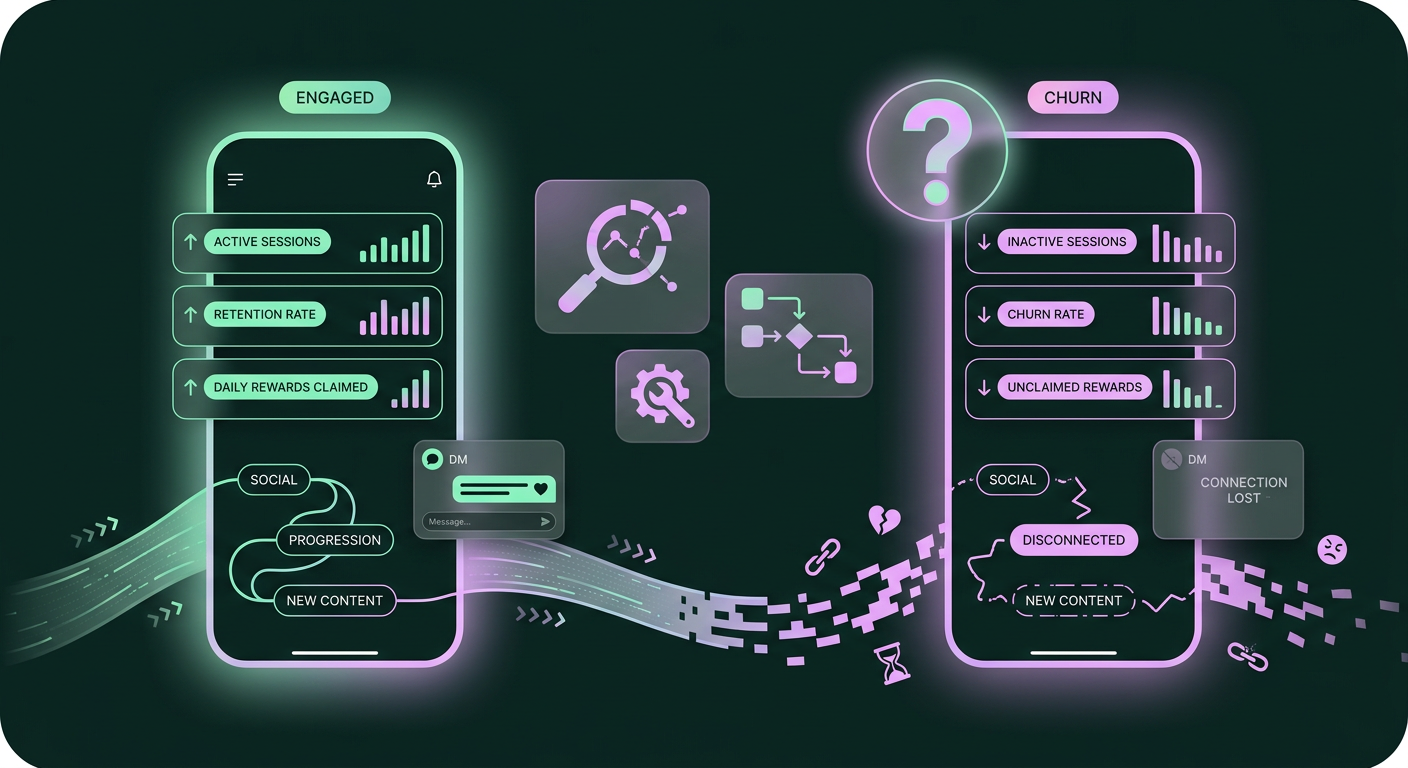
For mobile game studios, it’s a frustratingly familiar pattern. You launch a new title or a major update, and Day 1 retention looks fantastic. But when you check the metrics a week later, the bottom has fallen out. That promising cohort has vanished, your D7 retention is a fraction of what you’d hoped, and you’re left wondering where it all went wrong. This isn't an isolated incident; it’s a systemic challenge in the mobile gaming world. In fact, less than 15% of mobile games retain 35% of players after day 1, and the drop-off from there can be steep.io/blog/maximize-mobile-game-retention-by-solving-technical-churn), and the drop-off from there can be steep. If you're pouring resources into acquisition only to see players disappear within a week, you're not just losing users, you're burning your budget on a leaky bucket.
That Disappearing Act: Where Do Your Players Go?
The primary issue isn't that players aren't finding your game, but that they lack a compelling, personalized reason to stay beyond the initial novelty. While it's tempting to blame the core game loop or a competitor's flashy new release, the reality is that most churn happens quietly and quickly. This isn't a slow bleed; it's a sudden departure that often leaves analytics dashboards full of questions.
Industry-wide data bears this out. More than 95% of mobile game users will churn within the first 30 days if they aren't given a strong reason to build a habit around your game. The initial excitement of a new install is fleeting because your game is competing for attention not just with other games, but with every other app on a player's phone. That D1 retention bump often reflects a successful user acquisition campaign and an intriguing premise, but D7 retention is the true test of engagement. When there's a huge gap between the two, it signals a critical failure to build a connection in that crucial first week.
Surface Fixes vs. Real Churn Drivers
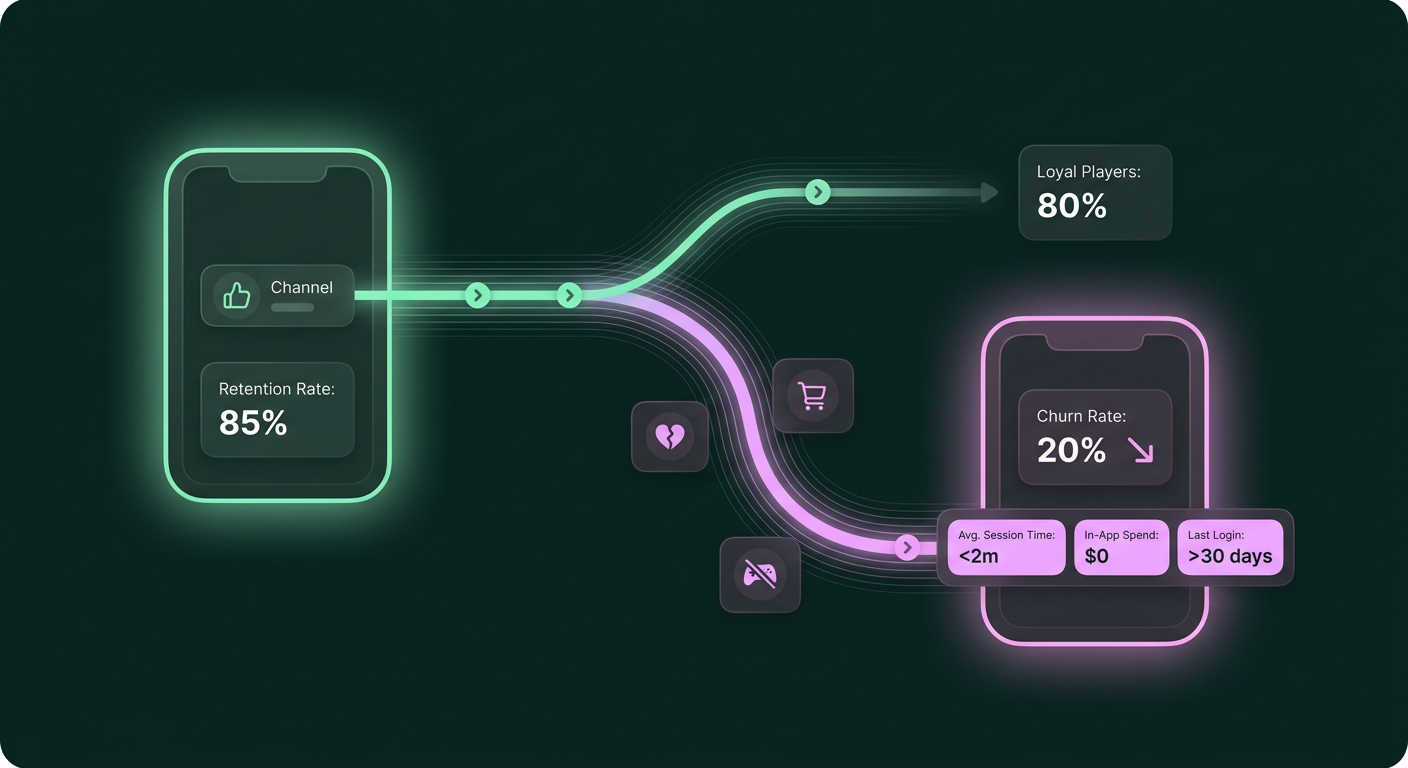
In response to this rapid churn, many studios double down on generic outreach like mass push notifications, but these often fail because they don't address the specific, underlying reasons a player is losing interest. The impulse is understandable: if players are leaving, send them a message to come back. The problem is that a generic "We miss you!" notification is just more noise, as it doesn't acknowledge why the player left in the first place, whether it was a technical snag, a confusing quest, or simply a lack of new content.
The real drivers of churn are often more practical and less abstract than "the game wasn't fun.In a hyper-competitive market, the cost of acquiring users is already high, a factor that has intensified churn rates according to a 2021 study which noted that in the mobile games industry, the churn rate is often pronounced due to the high competition and cost in customer acquisition.acm.org/doi/fullHtml/10.1145/3468891.3468895). You can't afford to lose players to preventable issues. For instance, technical problems are a massive, often underestimated, cause of churn. One analysis found that 79% of users will only give an app one or two more tries (opens in a new tab) if it fails to work correctly the first time. Another significant factor is content fatigue. Even loyal players will eventually leave if the experience grows stale; one report noted that 9% of both new and loyal gamers have churned (opens in a new tab) from their favorite games simply due to a lack of fresh things to do. These issues can't be fixed with a generic push notification campaign.
Are You Losing Them at Hello or Goodbye?
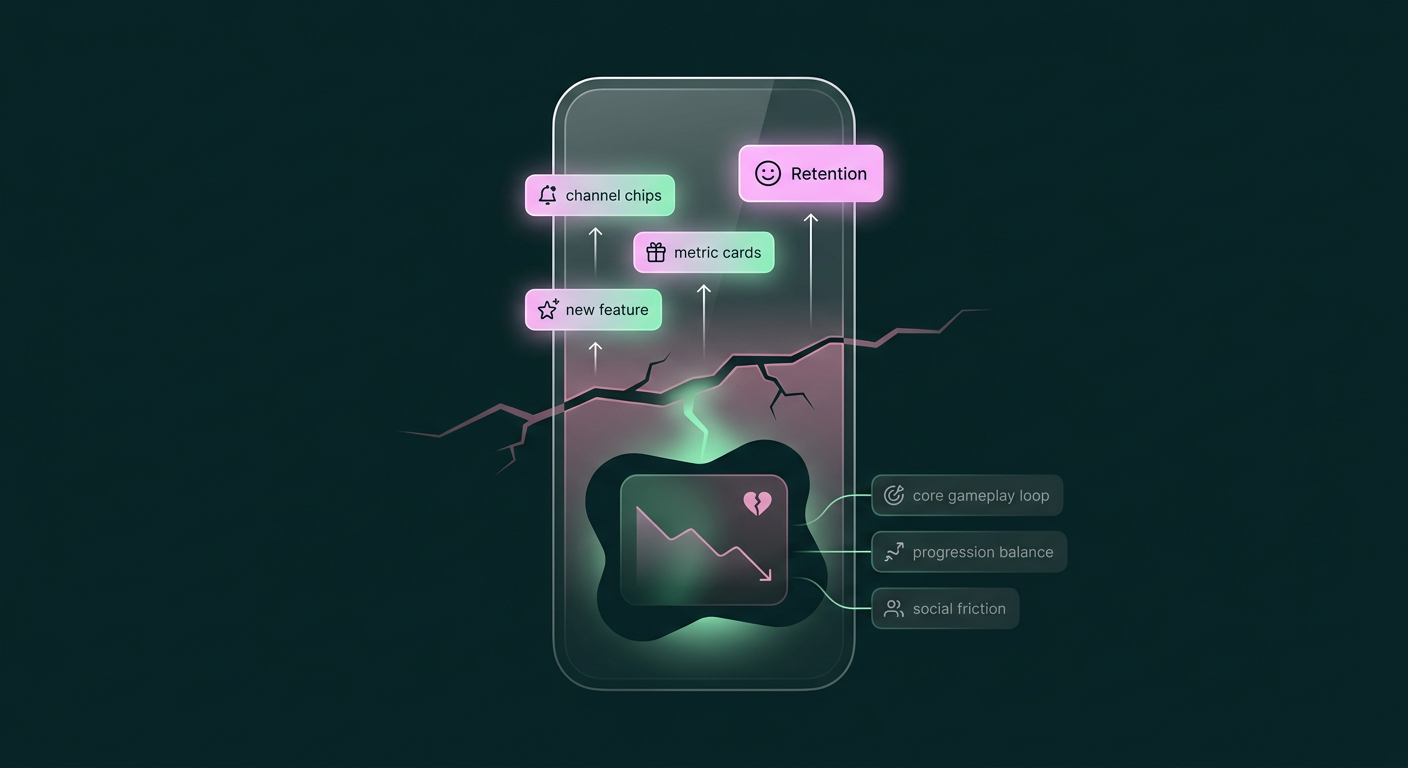
To effectively combat churn, you have to diagnose when and why you are losing players by segmenting them based on their initial behavior. A player who uninstalls after 30 seconds is leaving for a very different reason than one who plays daily for a week and then stops. By separating these groups, you can move from guessing to a data-driven intervention.
Early Churn: The First Five Minutes
If you're seeing a significant drop-off before players even complete the tutorial, your problem is likely technical or related to the earliest moments of onboarding. This isn't about game mechanics; it's about the fundamental user experience. A player who downloads your game is giving you a very brief window to make a good impression. If that initial experience is frustrating, they won't stick around to see how great your mid-game content is.
The data here is unforgiving. For example, a staggering 71% of all app uninstalls are the direct result of app crashes (opens in a new tab). Even a minor delay can be fatal, as one study found that 18% of users will delete an app immediately if it freezes for just five seconds. Dig into your crash reports and performance analytics. Are players churning on a specific device type? Is there a spike in drop-offs during a particular loading screen? These are not signs of a boring game, but of a technical barrier that is preventing players from ever getting started.
Mid-Lifecycle Drift: The Seven-Day Itch
This is the churn that creates the D1-to-D7 gap. It comes from players who successfully navigated onboarding and liked the game enough to play for a day or two, but something stopped them from forming a long-term habit. This is where the core loop, content cadence, and social features come into play. Perhaps they hit a paywall that felt too aggressive, ran out of compelling quests, or didn't find a guild or community to connect with.
This is where generic win-back campaigns fail most spectacularly. A player who is confused about the crafting system doesn't need a "20% off gems" offer; they need a nudge explaining what to do next. A player who has completed all available content doesn't need a reminder to log in; they need to be the first to know when the next update drops. Identifying these drop-off points requires connecting in-game player behavior (like level completion or resource balances) to your lifecycle messaging strategy, which allows you to start re-engaging inactive users with contextually relevant messages.
From Signal to Strategy: Intervening Before They Leave
Once you've diagnosed the 'when' and 'why,' you can act. The most effective way to reduce mobile game churn is to shift from reactive, generic outreach to proactive, personalized interventions triggered by specific player behaviors. This means using the data signals from your game to send the right message to the right player at the right time, on a channel they actually see.
Instead of waiting for a player to be gone for seven days before sending a generic push notification that gets lost on a crowded lock screen, consider a different approach. A player hasn't logged in for 48 hours after reaching level 10, which your system recognizes as a common drop-off point. Instead of a push, it sends a personalized DM on WhatsApp or Instagram: "Hey [PlayerName], saw you hit level 10! The Dragon's Peak is tough. Here’s a free stamina potion to help you conquer it." This message is timely, relevant, and helpful, not a desperate plea to come back, but a concierge-like nudge from a game that understands their journey.
This strategy works because it meets players where they are. Direct messages have a visibility that push notifications and emails can't match, with open rates often exceeding 80%+ and conversions that are 3 to 5 times higher than push. By connecting player data to a system that can generate and send individualized DMs, you can automate these helpful, personalized interventions across dozens of different lifecycle marketing use cases (opens in a new tab), turning churn signals into retention opportunities.
From Churn to Return: What Success Looks Like
But how do you know if these interventions are working? Success isn't just a handful of players coming back; it's a sustainable improvement in your core retention metrics, driven by a clear understanding of what messages resonate with which player segments. You'll see the D7 retention curve start to flatten, bringing it closer to your strong D1 numbers.
When this approach is working, your dashboards will reflect it. You won't just see a lower churn rate; you'll be able to attribute that improvement directly to specific, triggered campaigns. You'll know that your "Stuck on Level 10" message has a 40% re-engagement rate, or that your "New Content Drop" alert brought back 25% of lapsed spenders. This creates a powerful feedback loop where you can continuously refine your messaging based on what actually drives behavior.
Ultimately, this all leads to a higher player lifetime value (LTV). Retaining a player is almost always more cost-effective than acquiring a new one, especially in gaming, where a small fraction of your player base often drives a disproportionate amount of revenue. A 2021 academic analysis showed that the top 1% of game user-accounts produce 20% of total revenue, while the top 10% generate half of all revenue.acm.org/doi/fullHtml/10.1145/3468891.3468895), while the top 10% generate half of all revenue. By focusing on retaining these valuable cohorts with personalized, high-impact messaging, you can significantly increase customer lifetime value and build a more resilient, profitable game.
Frequently asked questions
How do I even start with a personalized win-back campaign?
The best way to start is to pick one specific, high-impact churn point instead of trying to solve everything at once. Look at your data and find the first major drop-off point after the tutorial. Is it after 48 hours? Is it when players run out of the starting currency? Identify that single moment, define the player segment who hits it, and craft one personalized, helpful message designed to get them past that specific hurdle.
What's the best way to test if my audience, timing, or message is working?
You should approach this with methodical A/B testing. For a given churn signal, test different messages against each other to see which copy gets the highest re-engagement. Test different timings: does a message sent after 24 hours of inactivity work better than one sent after 48? Finally, test different offers. Does a free in-game item work better than a simple helpful tip? Track open rates, click-through rates, and, most importantly, whether the player returned and completed a meaningful action in the game.
What player data do I actually need to build useful segments for this?
To build effective segments for churn intervention, you need a few key data points. Start with last_seen (to identify inactivity), session count, and tutorial completion status. Then layer in game-specific progression data like level_reached, current_balance of virtual currency, and major milestones achieved. Finally, in-app purchase history is crucial for identifying your VIP players who need a different level of attention.
Why does my D1 retention look good but my D7 retention is so weak?
This common pattern usually indicates a disconnect between a strong initial hook and a weak mid-game engagement loop. Your game's theme and onboarding are successfully attracting players, which is why D1 is high. However, the weak D7 retention suggests that players aren't finding a compelling reason to stick around for the long term. This could be due to running out of content, hitting a frustrating difficulty spike, or the game failing to build a sense of community or long-term goals in that crucial first week. While many games struggle with retention, data shows that less than 15% of mobile games retain 35% of players after day 1, highlighting how critical that first week is.io/blog/maximize-mobile-game-retention-by-solving-technical-churn), highlighting how critical that first week is.
How can I tell if players are churning because of the game itself or because of technical problems?
You can diagnose this by checking different data sources, as technical churn often leaves clear fingerprints. Look in your analytics for high drop-off rates on specific loading screens or during asset downloads, which could indicate slow performance that causes players to abandon the app, as 70% of users will abandon an app because it takes too long to load.io/blog/maximize-mobile-game-retention-by-solving-technical-churn). Dive into your crash reporting tools to see if uninstalls correlate with app freezes or crashes, which account for an estimated 71% of uninstalls. If these technical metrics are clean, the churn is more likely related to the game's design, economy, or content.
How can I send messages to prevent churn without just annoying my players with more notifications?
The key is to replace generic, low-value notifications with personalized, high-value direct messages (DMs). Instead of sending a "Come back and play!" push notification to everyone, use behavioral triggers to send a specific, helpful DM to a player facing a specific problem. A message that offers a hint for a level they're stuck on feels like a concierge service, not an advertisement. This approach is not only less annoying but far more effective, often achieving conversion rates that are 3 to 5 times higher than traditional push notifications.fyi/metrics).