
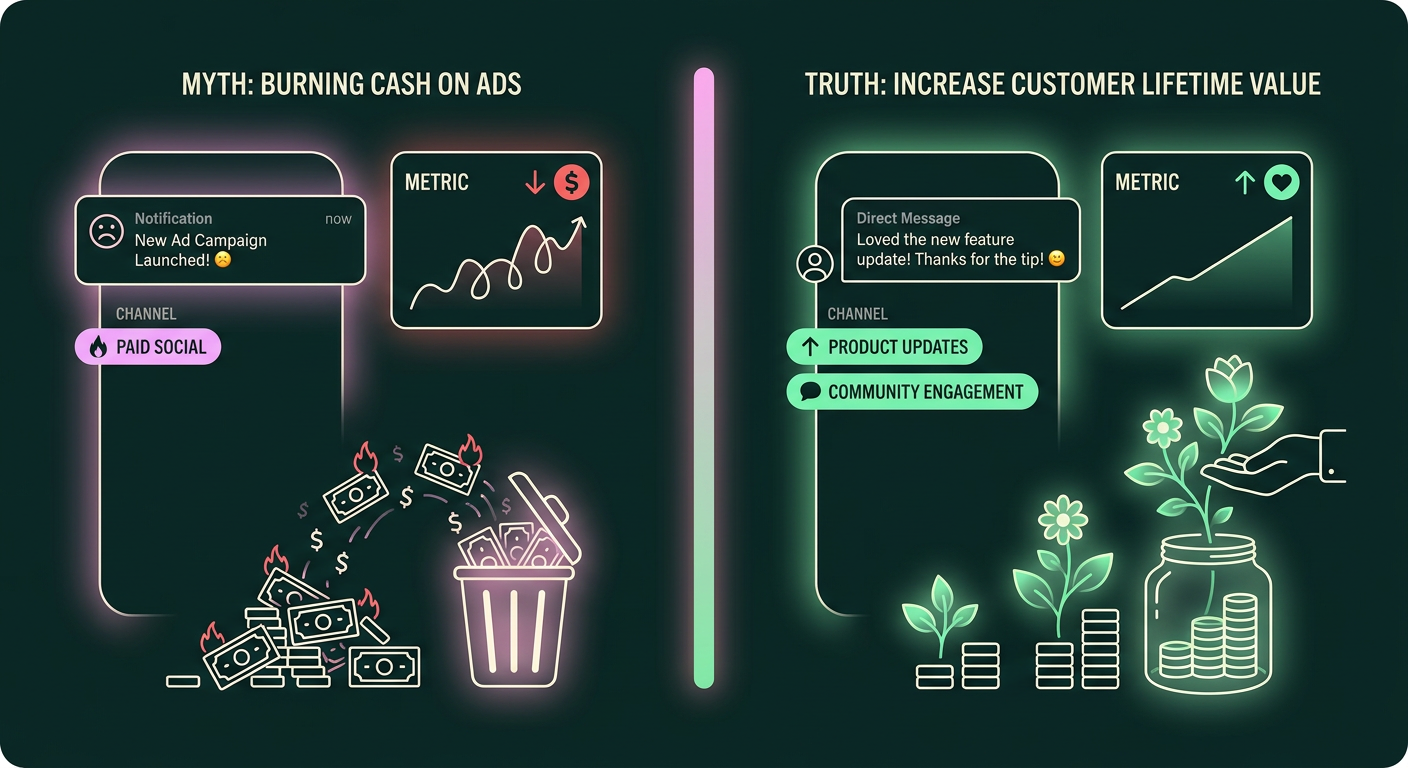
It can feel like a fundamental law of ecommerce: if you want to grow your brand, you have to keep pouring more money into paid ads. But this belief is a trap. For most brands, constantly chasing new customers leads directly to an unprofitable acquisition treadmill, where rising ad costs eat away at your margins and you end up paying to acquire the same people over and over. The real path to sustainable, profitable growth isn't about getting more new customers; it's about getting more value from the ones you already have.
The Growth Trap: Why More Ad Spend Isn’t the Answer
Believing growth is directly proportional to ad spend creates a dangerous cycle for direct-to-consumer brands. This approach forces you to spend ever-increasing amounts of money just to maintain momentum, a strategy that becomes less effective and more expensive over time. It’s what we call the growth trap: you're running faster and faster on the acquisition hamster wheel, but your business's profitability isn't actually moving forward as you become dependent on channels with volatile costs and diminishing returns.
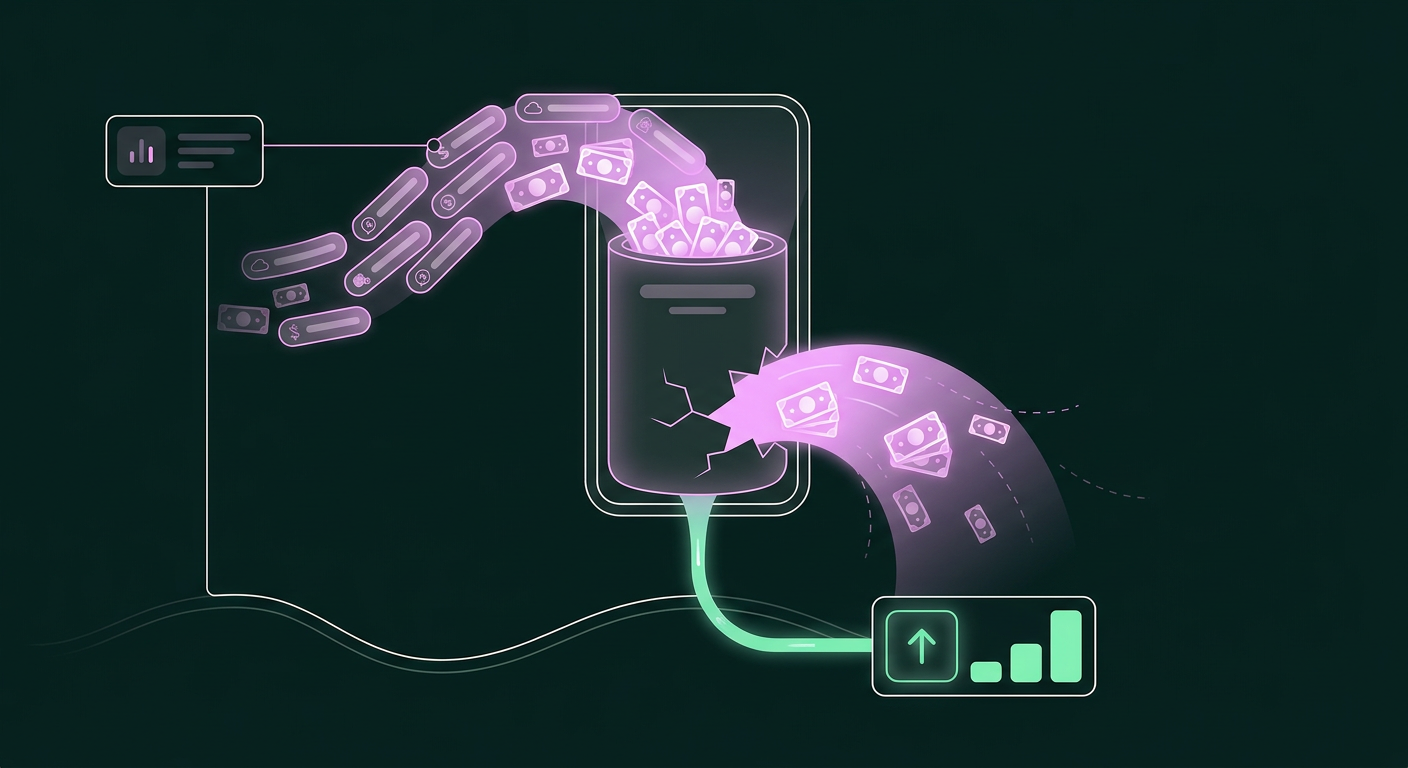
This isn't a hypothetical problem; it’s a widespread reality documented in marketing budgets everywhere. The average company dedicates a staggering 80% of its marketing budget to acquisition (opens in a new tab), even as the evidence mounts that this is the least efficient part of the entire flywheel. You see the immediate feedback of a click or a first-time purchase and assume it's working, but you're often just buying revenue at a cost that negates any real profit. This intense focus on the top of the funnel leaves the rest of the customer journey neglected, resulting in a stream of one-time buyers who never come back. It's a leaky bucket that forces you right back to the ad platforms, wallet in hand, to buy your next customer.
Why We're Addicted to Acquiring New Customers
Even smart marketers fall into the acquisition trap because it’s the industry's default playbook, reinforced by clear and immediate (though misleading) metrics. For decades, the marketing world has been conditioned to see new customer acquisition as the ultimate benchmark for success, which means most tools, strategies, and agency models are built around attracting strangers rather than cultivating relationships. It feels like the "right" thing to do because it’s what everyone else is doing.
This allure is strengthened by the dashboards we all watch every day. Clicks, cost-per-acquisition (CPA), and conversion volume are tangible, easy-to-measure metrics that create a powerful illusion of progress. It’s much simpler to report a 10% increase in new customers from a campaign than it is to measure the nuanced, long-term impact of a strong retention effort. This focus is so ingrained that a global survey found just 14% of companies actually prioritize and excel at customer retention (opens in a new tab), despite its known benefits. The entire industry is geared toward celebrating the hunt, making acquisition the path of least resistance for busy marketing teams, even when a more profitable one is right there.
The Hard Math: Retention Is More Profitable Than Acquisition
Once you look at the economics, the argument for shifting your focus from acquisition to retention becomes undeniable. The data clearly shows that keeping an existing customer is dramatically more cost-effective and profitable than constantly chasing a new one. While acquisition metrics might look good on a spreadsheet, they often hide the true cost of doing business and mask underlying issues with customer loyalty.
The numbers are stark. According to research from Bain & Company, just a 5% increase in customer retention can boost profits by a staggering 25% to 95% (opens in a new tab), because repeat customers tend to spend more over time and require far less marketing investment to convert. Compare that to the cost of acquisition, which is fundamentally more expensive.
"According to Amy Gallo from Harvard Business Review, a new customer is between five and 25 times more expensive than an existing one. The variation of the cost depends on the industry." , Glue Loyalty
When you internalize this simple fact, spending 80% of your budget to acquire customers at 5 to 25 times the cost of keeping them begins to look financially irresponsible. The math points to one conclusion: the most effective way to grow your profits isn't to pour more money into ads, but to invest in the customers you've already won.
The Reframe: From One-Time Buyers to Lifetime Value
Accepting that math fundamentally changes your goal from securing a single transaction to cultivating a long-term, profitable relationship. Your new primary metric isn't the first purchase but the total value a customer brings over their entire lifecycle. This reframes every interaction as an opportunity not just to sell, but to build the kind of loyalty that ensures they come back again and again, which is the key to increasing customer lifetime value.
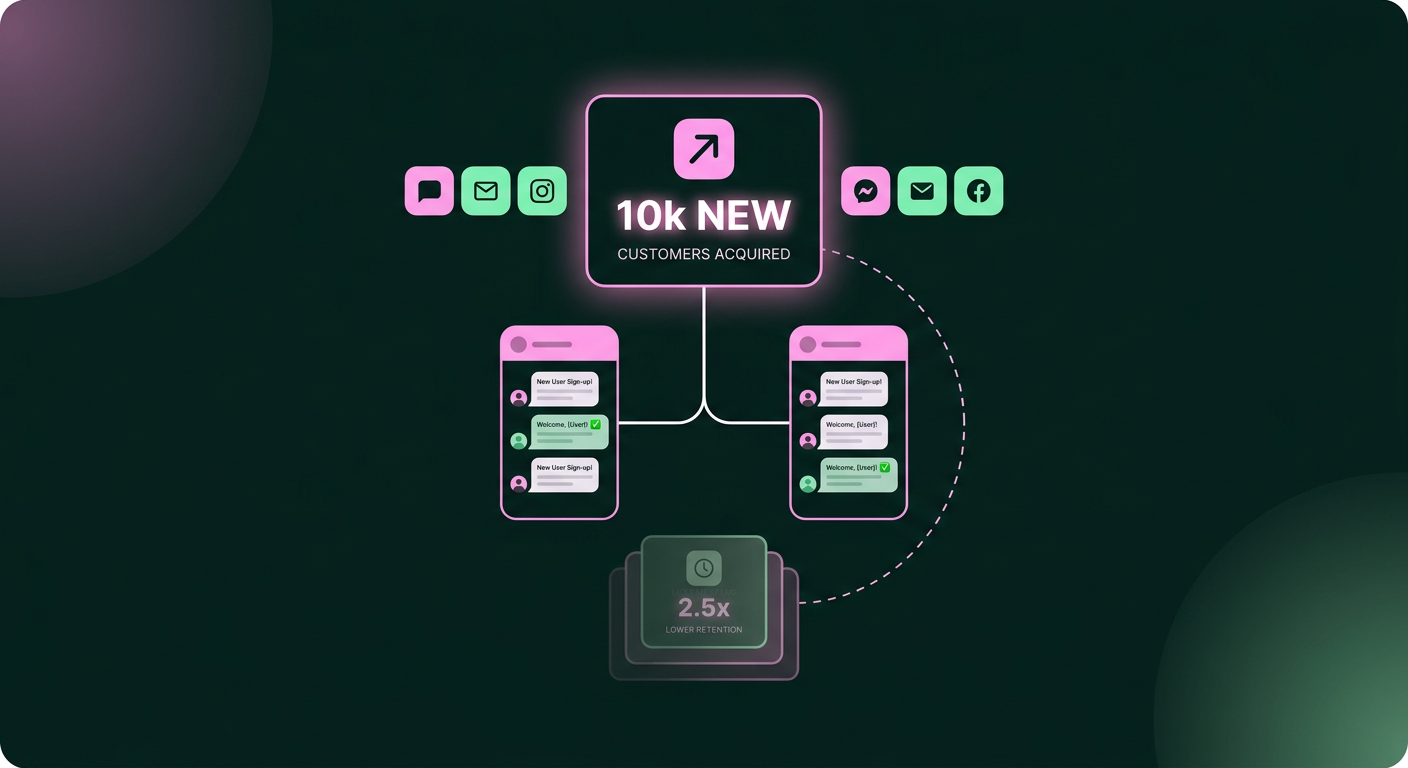
This shift requires moving away from generic marketing and toward genuine, personalized engagement. A great experience is what separates a one-time buyer from a lifelong fan, and a 2024 study showed that more than half (60% of consumers globally are likely to become repeat buyers (opens in a new tab)) after a personalized shopping trip. Adding a personal touch is no longer a nice-to-have; it's a core driver of profitability. When customers feel understood, they don't just buy more; they also become more forgiving of mistakes and more vocal advocates. This is directly reflected in metrics like Net Promoter Score (NPS). By 2026, the global average NPS is projected to be 32, but companies with world-class scores above 70 experience 2.5 times lower churn. Stopping that churn and improving your ecommerce repeat purchase rate is the first step toward lasting value.
What to Do Now: Shift Focus to Retention Marketing
This new mindset requires a practical shift in both budget and strategy, moving resources from broad acquisition campaigns to personalized, automated retention channels. Instead of shouting at everyone through paid ads, the goal is to whisper to the right person at the right time in a place they actually pay attention. This means reallocating a portion of that massive acquisition budget toward building a retention engine that runs in the background, creating value automatically.
Map your customer lifecycle segments
First, you need to understand the journey your customers take with your brand, which isn't one monolithic path but a series of distinct phases. Key segments often include new customers who just made their first purchase, loyal VIPs who buy frequently, and "at-risk" customers who haven't bought in a while. By mapping these segments, you can move from generic messages to targeted, relevant communication that speaks directly to where each customer is in their lifecycle.
Engage customers in high-intent channels (like DMs)
Once you know who you're talking to, you need to reach them where they're most likely to listen, which for most people is not a cluttered email inbox. Channels like Instagram and WhatsApp DMs are where real conversations happen. An automated, personalized message in a DM feels like a one-to-one interaction, not a mass advertisement. This is critical when traditional channels like email see declining open rates and are often ignored. Shifting engagement to these high-intent environments dramatically increases the chances your message will be seen, read, and acted upon.
Automate personalized, 1:1 messages
The key to scaling retention marketing is to automate these personalized interactions, because you can't manually send a unique message to every single customer. By connecting your customer data to a DM automation tool, you can trigger full-funnel messages based on their behavior. For example, a customer who abandons their cart can receive a helpful DM an hour later, while a loyal customer gets an exclusive offer and a one-time buyer gets a follow-up asking about their experience. This allows you to scale personalized, 1:1 conversations across the entire customer lifecycle without hiring a massive team, creating a system that nurtures loyalty and drives repeat purchases automatically. You can explore a variety of use cases for this type of automation (opens in a new tab) to see how it might fit your own lifecycle stages.
Your First Step to Higher LTV This Week
Thinking about overhauling your entire marketing strategy can be paralyzing, so the best way to start is to pick one high-impact segment and run a simple, measurable test. Focus on taking one concrete action that moves you from theory to practice, which will give you immediate feedback and build momentum for a broader shift.
Here’s your action item for this week: Identify your "one-time buyer" segment, specifically customers who made a single purchase 60-90 days ago and haven't been back. This group represents a huge, untapped opportunity. Instead of retargeting them with another expensive ad, create a simple, automated DM campaign that checks in on their first purchase, offers a small incentive to come back, or shows them a related product. Then, measure the engagement and repurchase rate from this small test. The results will give you the data and the confidence you need to start shifting more of your focus from burning cash on acquisition to building true customer lifetime value.
Frequently asked questions
Should I prioritize acquisition or retention right now?
You should prioritize retention. While both are necessary for growth, the data overwhelmingly shows that retention is far more profitable. Since it can be 5 to 25 times cheaper to keep an existing customer than to acquire a new one, shifting focus and funds toward your existing customers will deliver a much higher return on investment, especially if your budget is tight.
Why do so many DTC brands struggle with Facebook Ads?
Many DTC brands struggle with platforms like Facebook Ads because of rising costs, increased competition, and signal loss from privacy changes like iOS 14, which makes it harder and more expensive to target the right audiences. Over-reliance on a single acquisition channel creates fragility; when that channel becomes less effective, the brand's growth stalls, forcing a search for more sustainable, owned channels.
How can I calculate customer lifetime value for my subscription business?
A basic way to calculate LTV for a subscription business is to multiply the average monthly revenue per customer by the average customer lifetime in months. For example, if your average customer pays $30 per month and stays for an average of 18 months, your LTV would be $540 ($30 x 18). More complex formulas can also account for gross margin and churn rate for a more precise figure.
What does it mean to increase customer lifetime value?
Increasing customer lifetime value (LTV or CLV) means increasing the total net profit your business makes from a single customer over their entire relationship with your brand. This is achieved by encouraging them to buy more frequently, increasing their average order value, and keeping them as a paying customer for a longer period of time.
Do I need to use customer lifetime value (CLV)?
Yes, you absolutely should use CLV as a core metric because it shifts your focus from short-term gains (like a single sale) to long-term profitability. Understanding your CLV helps you make smarter decisions about how much to spend on acquiring new customers and where to invest in retention, especially since a small 5% improvement in retention can increase profits by 25-95%.
How can I turn one-time buyers into repeat customers?
The key is creating a personalized post-purchase experience. Follow up after their initial purchase with styling tips or usage guides, and provide an incentive for a second purchase. A 2024 study found that 60% of consumers are likely to buy again after a personalized experience, and using high-intent channels like DMs helps ensure these messages are seen and acted upon.