
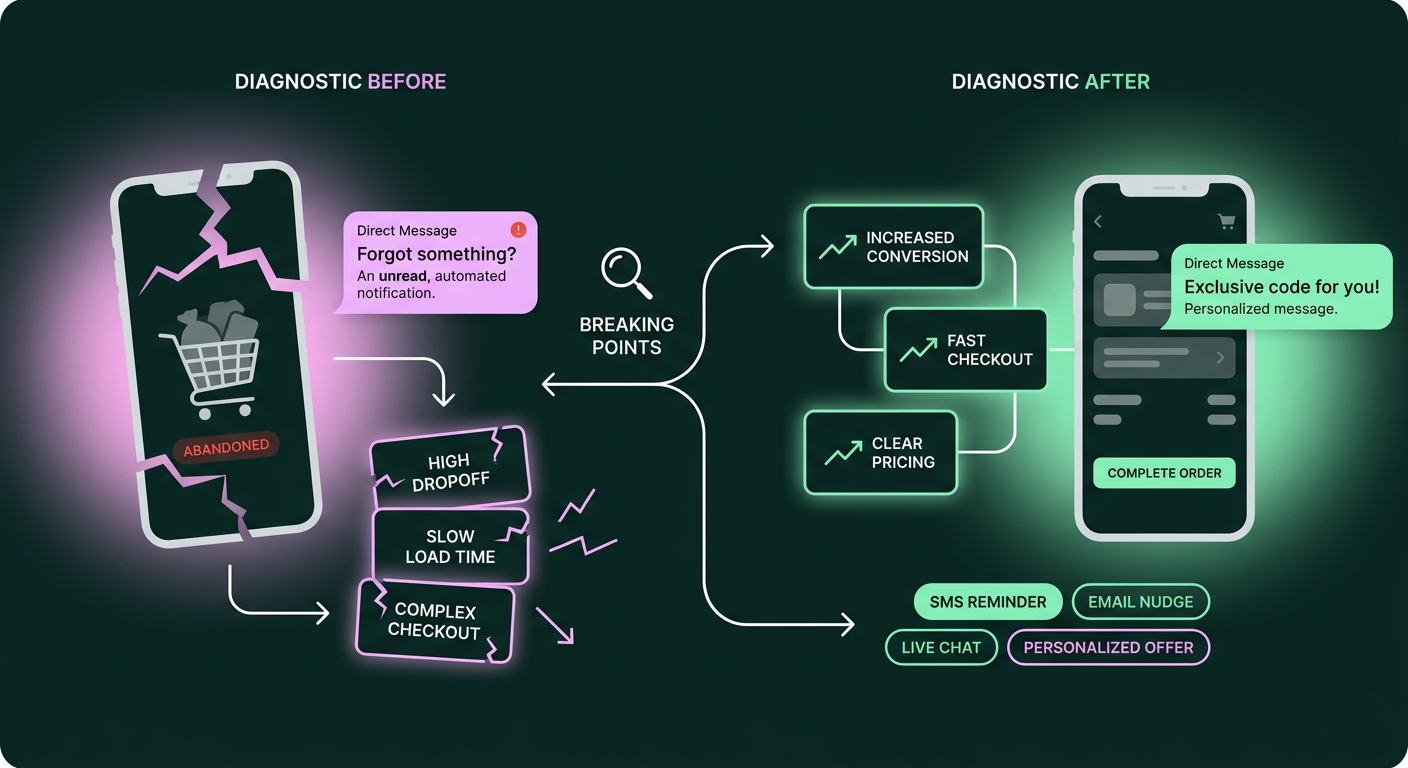
It’s a familiar story for many mobile brands. You identified abandoned carts as a major leak in your sales funnel and set up the standard, best-practice recovery strategy: a sequence of two or three automated emails with a gentle reminder, maybe a small discount, and a link back to checkout. But despite following the playbook, your recovery revenue is flat. You keep watching high-value carts disappear, and the reports just confirm your fear, the messages are sent, but nobody’s responding. It feels less like a strategy and more like sending messages into a void. This isn't just frustrating; it's a significant financial drain, with some estimates suggesting that just over 70% of all online shopping carts are abandoned, adding up to trillions in lost revenue each year.com/resources/articles/abandoned-cart-email), adding up to trillions in lost revenue each year.
Your Recovery Emails Are Fading into the Noise
The core problem is that your well-intentioned recovery strategy is failing at the most fundamental level: it isn't being seen. While you’ve correctly diagnosed the symptom of lost sales, your team is likely operating on a flawed assumption about the cause. When a customer leaves, the standard e-commerce playbook tells you to send an email, and if that fails, maybe an SMS message. The catch is that both of these channels are completely saturated. Your carefully crafted email lands in an inbox already overflowing with promotions, newsletters, and other abandoned cart messages. Your SMS arrives in a feed that people now associate more with one-time passwords than personal shopping (opens in a new tab) assistance. You're trying to have a conversation in a crowded, noisy room where no one is listening.
This is a case where "best practice" has become such common practice that its effectiveness has been diluted. You can spend all your time optimizing email copy, testing subject lines, and tweaking discount offers, but the underlying issue remains: you're trying to re-engage a customer through a channel they have already learned to filter out. The messages aren't just being ignored; they're often not even consciously registered. For many e-commerce leaders, this is the frustrating reality of seeing high-intent shoppers vanish at the final step, completely unresponsive to the very mechanisms designed to bring them back.
Surface Fixes vs. The Real Funnel Leak
The standard advice for cart abandonment often misses this point entirely, focusing instead on on-site optimizations. A quick search will point to culprits like unexpected shipping costs, taxes, and fees (opens in a new tab) as the top reason shoppers leave. Other common suggestions involve removing the need to create an account, which can deter a quarter of all shoppers, or simplifying a long, complicated checkout process. These are absolutely valid points, and optimizing your checkout flow is a critical part of improving conversions.
But these surface fixes don’t address the deeper, more costly leak in your funnel: the failure of your recovery strategy. Optimizing the checkout might prevent some carts from being abandoned, but it does nothing to rescue the ones that inevitably still get left behind. The real breakdown happens after the shopper has left your site. Your system fires off an email as planned, but it disappears into an inbox where it competes with hundreds of other messages for attention. The problem isn't the 10% discount you offered; it's the fact that your message was never seriously considered because the channel itself is the point of failure.
Relying so heavily on a single channel is a major strategic flaw. Data clearly shows that e-commerce brands using three or more recovery channels recover 2.7 times more revenue than those relying on email alone (opens in a new tab). This isn't just about sending more messages; it's about matching your approach to modern communication habits. The three-email sequence might have worked years ago, but in today's mobile-first world where attention is fragmented across a dozen apps, it’s simply not enough. The checkout process is often clunkier on mobile devices to begin with, leading to higher abandonment rates, and your email is even less likely to command attention on a small screen crowded with notifications.
Diagnosis: Is Your Channel the Problem?
So how can you be sure the channel is your problem? The diagnosis starts with an honest look at your current recovery metrics. The conventional wisdom isn't entirely wrong; a healthy email sequence should produce decent results. For instance, sending three abandoned cart emails instead of one has been shown to increase recovered revenue by 153-231%.io/abandoned-cart-recovery). A well-executed multi-email sequence can typically recover between 10-15% of gross revenue that would have otherwise been lost.
This gives you a clear benchmark. Are you seeing recovery rates in that 10-15% range? If so, your channel is likely performing well enough, and your efforts might be better spent on checkout optimization or A/B testing your offers. If, however, your recovery rate is stuck in the low single digits and your email open rates are poor, you have a clear symptom of channel failure. Your messages simply aren't cutting through.
You can take the diagnosis a step further by comparing your performance to top-performing stores. The most successful brands often achieve recovery rates between 15-25% by adding SMS to their flow and segmenting carts by value to give high-value shoppers a more personal touch. But even this advanced strategy still hinges on the assumption that the message will be read. If your email open rates are below industry averages and your SMS unsubscribe rate is climbing, it’s a strong signal that you're pushing on a channel your customers have already tuned out. The diagnosis is clear: the problem isn't your offer, it's the inert channel you're using to deliver it.
The Fix: Recover Carts on Their Native Channels
If the diagnosis is a failed channel, the fix is to find one that actually works. The answer is to stop trying to pull customers back to a channel they ignore and instead meet them on the channels where they already spend their time and attention. Instead of sending another email to an unread inbox, you can engage them in a real conversation in their Instagram or WhatsApp DMs. This isn't just a change of medium; it's a change in the entire dynamic, shifting from a one-way broadcast to a personalized, 1:1 interaction. This approach aligns with how people actually communicate, making your brand feel less like a faceless corporation and more like a helpful person.
The difference in engagement is staggering. While email open rates often struggle to cross 20%, direct messages on platforms like Instagram and WhatsApp boast open rates of over 80%, with WhatsApp often approaching a near-perfect 90-98% open rate (opens in a new tab). People are hardwired to open their DMs. This is where they talk to friends, family, and, increasingly, brands they trust. By showing up here with a helpful, context-aware message, you not only ensure your message is seen but also place it in a context of personal connection rather than mass marketing.
This increase in engagement directly translates into better business outcomes. We see that conversions from personalized DMs are consistently 3 to 5 times higher than from traditional push notifications because you are reaching the right person at the right time in the right place. By using a platform that can automate these personalized conversations (opens in a new tab), you can manage this process at scale without losing the human touch. We have helped nearly 100 brands facilitate billions of these 1:1 direct messages, proving this conversational approach isn't just a niche tactic but a powerful strategy for full-funnel marketing. The fundamental difference is so stark that we break down the effectiveness of DM vs. email for cart recovery in full detail here.
What Success Looks Like: How to Know It's Working
When you switch to a channel that commands this kind of attention, the results are immediate and measurable. The first and most obvious signal that your new strategy is working will be a direct increase in your cart recovery rate. You will start to see those high-value, high-intent shoppers who previously ghosted your email campaigns actually returning to complete their purchases. Because conversion rates from DMs are so much higher, the impact on your bottom line should be both swift and significant. You're no longer losing willing customers at the last second; you're successfully guiding them across the finish line.
Beyond the immediate revenue lift, you’ll notice a qualitative shift in your customer relationships. You are moving from an impersonal, automated message toward a genuine, two-way conversation. This builds rapport and trust in a way an email template simply cannot. Each interaction becomes an opportunity to reinforce your brand's personality and commitment to service, and these positive touchpoints accumulate over time to foster loyalty and increase customer lifetime value.
Finally, you will see greater efficiency in your marketing spend. Engaging warm audiences on their native channels is not only more effective but also more economical. For instance, our retargeting campaigns for audiences who are already engaged are 50% cheaper than traditional user acquisition efforts. Success means your recovery program transforms from an ineffective but necessary chore into a powerful revenue driver and relationship-building tool. You'll know it's working when you're not just recovering carts; you're building a more resilient and profitable business.
Frequently asked questions
Why does my cart recovery strategy feel like it's failing?
If your cart recovery strategy feels ineffective, it's likely because you are relying too heavily on a single, overcrowded channel like email. While timing and offers matter, the biggest point of failure for most brands is the delivery channel itself. Research shows that merchants who use three or more channels to recover carts generate 2.7 times more revenue than those who use email exclusively, demonstrating that a multi-channel approach is necessary to cut through the noise.
How do I know if my abandoned cart emails are even worth it anymore?
You can determine if your emails are still effective by evaluating your performance against industry benchmarks. A well-structured series of three abandoned cart emails can recover 153-231% more revenue than a single email, and a healthy sequence should be recovering around 10-15% of your gross revenue from abandoned carts. If your rates are significantly lower than this and your open rates are poor, it's a strong sign that the email channel is no longer working for your audience and it's time to explore other options.
What's the best way to actually recover abandoned carts?
The most effective way to recover abandoned carts is to engage customers on high-engagement, conversational channels where your message is guaranteed to be seen. Instead of email, consider using direct messages on platforms like WhatsApp or Instagram. These channels have exceptionally high open rates, with WhatsApp reaching 90-98%, which ensures your reminder gets noticed. Furthermore, the conversational nature of DMs leads to conversion rates that are 3 to 5 times higher than those from push notifications.
How can I reduce my Shopify store's cart abandonment rate specifically?
While on-site optimizations like simplifying checkout are important, a powerful way to reduce the net impact of cart abandonment is by strengthening your recovery strategy. For Shopify stores, this means moving beyond the basic email app. By integrating channels like SMS and, more effectively, automated direct messages on social platforms, you can reach shoppers more directly. Top-performing stores that use SMS and segment carts by value can reach recovery rates of 15-25%, and using DMs can push this even higher.
Why do my customers seem to ignore my cart recovery emails?
Your customers are likely ignoring your emails because their inboxes are incredibly crowded, and your message is simply getting lost. This problem is magnified on mobile devices, which already have higher cart abandonment rates and where long-form emails are less effective. In stark contrast, channels designed for personal communication, like WhatsApp and Instagram DMs, command attention. With open rates exceeding 80%+, a message sent to a DM inbox is almost certain to be read, unlike an email that may be filtered, ignored, or never opened at all.