
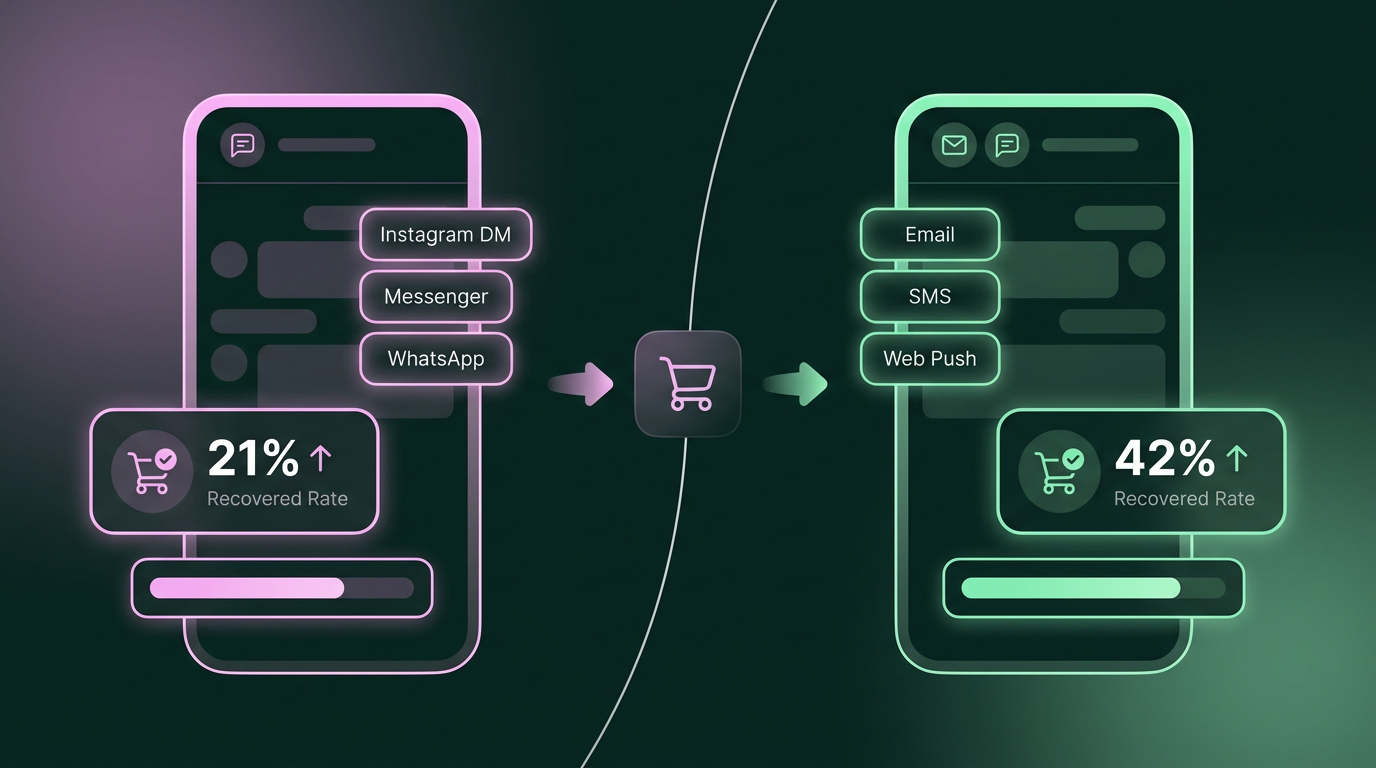
Every e-commerce brand knows the pain of cart abandonment, it's a massive leak in the revenue pipeline. With a staggering 70.22% (opens in a new tab) of carts being left behind, the missed opportunity is colossal. The problem is that traditional solutions like email and SMS reminders are failing, as they get lost in channels customers have learned to ignore. This isn't a small problem: in the US and EU alone, an estimated $260 billion in lost orders are considered recoverable (opens in a new tab) with the right approach. That reality leaves growing brands at a crossroads: do you stick with general-purpose tools, or adopt a specialized strategy designed to recover that revenue where customers are actually listening?
Why Your Abandoned Cart Emails Are Being Ignored
The core problem is a channel mismatch: traditional abandoned cart emails and SMS fail to re-engage shoppers because they get lost in crowded, low-attention environments. While these automated messages can show some ROI, they pale in comparison to the conversational channels where customers spend their time, like Instagram and WhatsApp. As a result, brands are missing their best chance to convert high-intent buyers at the final step.
For years, automated emails were the gold standard for cart recovery because they were cheap and easy to set up. They still punch above their weight, accounting for 30% of total revenue from just 2% of email sends (opens in a new tab) according to 2025 data. But their overall effectiveness is fading. Email inboxes have become so noisy and promotional that even an opened cart reminder rarely leads to immediate action.
To get around email's limitations, many brands turned to SMS, which boasts a nearly 98% open rate compared to email's 30.7%.co/blog/email-vs-sms-for-abandoned-cart-recovery-what-works). But while an SMS is almost certain to be seen, a generic, one-way message can feel intrusive and overly transactional. It interrupts a user’s personal space without offering a valuable interaction, often leading to a quick dismissal and a sour brand perception.
The fundamental issue is that both email and SMS are one-way broadcast channels, ill-equipped to solve the actual reasons for abandonment, like distraction or confusion about shipping. A generic message simply can't address those specific problems. In contrast, your high-intent customers are already active on conversational platforms like Instagram DMs and WhatsApp. That is where they are most receptive to a helpful, 1:1 message, and by failing to meet them there, brands are conceding the sale.
How to Choose Your Next Cart Recovery Tool
To effectively recover lost sales, you must evaluate tools based on their ability to deliver results in the channels where your customers actually are, not just on a list of features. The best cart recovery tool should be judged on its channel effectiveness, its capacity for true personalization at scale, its focus on recovering revenue, its ease of use, and the direct ROI it produces.
When evaluating a new platform, it’s easy to get lost in feature lists. Instead, shift your focus from what a tool can do to what it accomplishes for your bottom line. A long list of integrations doesn't guarantee recovered revenue.
Here are the five critical criteria for choosing your next cart recovery tool:
-
Primary Use Case: Is the tool a generalist marketing platform or purpose-built for revenue recovery? Specialized tools almost always outperform generalist ones for a critical function like cart recovery, as their entire feature set is optimized for that one goal.
-
Channel Effectiveness: Where does the tool reach customers? It must initiate natural, 1:1 conversations in channels like Instagram or WhatsApp, not just broadcast generic messages. Look for a focus on DMs, where you can achieve open rates of 80% or higher.
-
Personalization at Scale: Can the tool create genuinely personal messages? Basic name insertion isn't enough. True personalization uses cart contents and browsing history to craft unique messages that address the reason for abandonment, which requires an engine that can generate context-aware messages at scale.
-
Ease of Use & Implementation: How much work is required from your team? Some DIY platforms have a steep learning curve for building effective flows. Others offer managed services where experts handle setup and optimization, delivering results without requiring your team to become automation specialists.
-
Return on Investment (ROI): How does the tool contribute to your bottom line? A good recovery tool should be a profit center with a clear, measurable ROI linking its activity to recovered revenue. General engagement metrics are not enough.
Using these criteria will help you select a solution that truly solves cart abandonment and delivers a measurable financial impact. You can find more detail on this evaluation process in this guide to the new rules of abandoned cart recovery software (opens in a new tab).
Manychat vs. Dynamo: A Head-to-Head Comparison
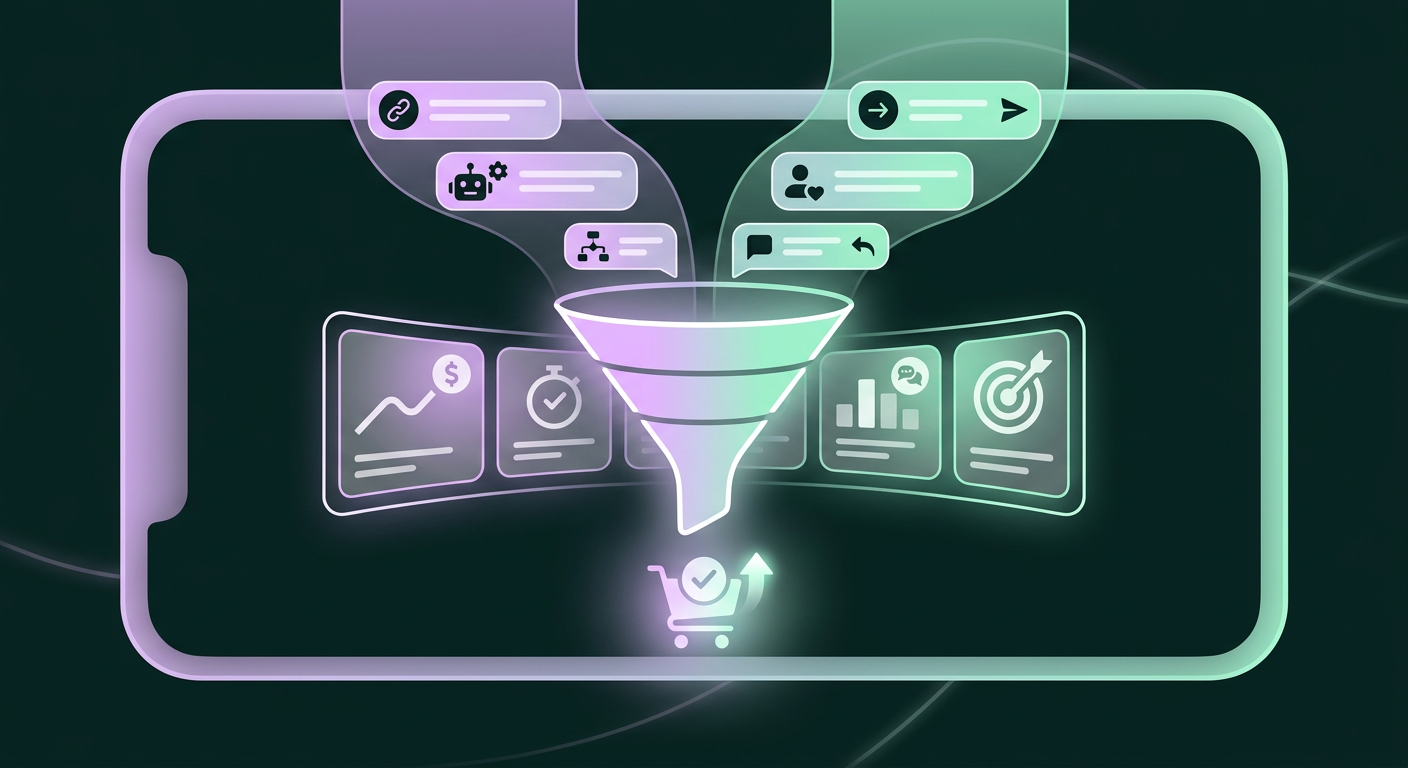
The choice between Manychat and Dynamo comes down to a trade-off between a broad marketing automation toolkit and a specialized revenue recovery engine. Manychat offers a versatile, do-it-yourself platform for general DM automation, while Dynamo provides a focused, AI-powered service dedicated to maximizing cart recovery with personalized 1:1 DMs. This fundamental difference in philosophy dictates their performance, ease of use, and ultimate ROI.
Applying our five-point framework, their distinct approaches become clear. Both platforms use messaging automation, but they use it to solve different problems. Manychat, which was founded in 2015 (opens in a new tab) as a Facebook Messenger bot builder, has since evolved into a broad platform for automating conversations across Instagram, Messenger, WhatsApp, and SMS/email. In contrast, Dynamo is laser-focused on one thing: using AI-driven 1:1 DMs to recover abandoned carts and drive sales.
The Verdicts on Cart Recovery Performance
The following table summarizes how each platform stacks up against the critical decision criteria for a head of e-commerce focused on stopping revenue leakage.
| Criterion | Manychat | Dynamo |
|---|---|---|
| Primary Use Case | Broad marketing & lead gen | Specialized cart & revenue recovery |
| Channel Effectiveness | Good for comment-to-DM triggers | Optimized for 1:1 high-intent DMs |
| Personalization at Scale | Template-based; rule-driven flows | AI-generated personal messages |
| Ease of Use & Implementation | DIY visual builder; requires setup | Fully managed; expert setup |
| ROI for Cart Recovery | Indirect via engagement | Direct, measurable revenue lift |
Interpreting the Trade-Offs
The table reveals a clear divide. Manychat is a powerful tool for marketers who want to build their own automated flows from scratch. Its visual drag-and-drop interface is accessible and excels at top-of-funnel activities, especially its "comment-to-DM" feature for lead generation. As one review notes:
ManyChat’s most powerful operational asset is its native comment automation. You can configure a trigger so that whenever a user comments a specific keyword... on an Instagram Reel or post, ManyChat instantly sends them a personalized direct message... This dramatically boosts organic engagement algorithms while simultaneously generating leads. , Filip Konecny, 2026
While this rules-based approach is excellent for lead capture, it falls short for cart recovery. The personalization is template-based, making it difficult to craft the genuinely unique messages needed to persuade a hesitant buyer. And although Manychat supports a wide array of channels, the burden of designing, building, and optimizing those flows falls entirely on your team. That's a significant time investment that can easily result in generic, robotic messages if not managed perfectly.
Dynamo takes a different approach. It is a specialized revenue recovery engine, not a DIY toolkit. Its purpose is to re-engage shoppers with personalized, human-feeling DMs that actually work. Instead of templates, Dynamo uses AI to generate unique messages that reference a user's cart and browsing behavior. This delivers a level of personalization that's impossible with manual flow-builders and is a key driver of AI personalized abandoned cart messages that work (opens in a new tab).
The result is a far more effective interaction. A well-crafted DM on Instagram or WhatsApp doesn't just get opened at rates of 80% or higher; it creates a real connection. By combining this high-performance channel with deep, AI-driven personalization, Dynamo achieves a conversion rate 3-5x higher than traditional push notifications. For leaders focused on stopping revenue leaks, this direct path to measurable financial results (opens in a new tab) is a compelling advantage, delivered reliably at scale for billions of DMs.
Recommendation: Which Tool Is Right for Your Team?
Your choice depends entirely on your primary goal. If you need a versatile, hands-on tool for general marketing automation and lead generation, Manychat is a solid option. However, if your main objective is to maximize recovered revenue from abandoned carts with minimal effort from your team, Dynamo is the far superior choice.
The right tool depends on your primary business goal, there isn't a single "best" platform, only the best fit for what you need to accomplish.
Choose Manychat if:
- Your primary need is top-of-funnel lead generation and audience engagement.
- You have a team with the time and skill to design, build, and optimize complex automation flows.
- Your goal is broad marketing automation where cart recovery is just one of many tasks.
- You prefer a hands-on, DIY approach to managing campaigns.
Choose Dynamo if:
- Your most pressing problem is lost revenue from abandoned carts.
- You want to use AI to send truly personalized, 1:1 messages that don't sound robotic.
- You prefer a managed service where experts handle the setup and optimization, freeing up your team to focus on strategy.
- Your key metric is measurable ROI, and you need a profit center, not just a tool.
For most growing e-commerce brands, the cost of abandoned carts is too high to address with a general-purpose tool. While Manychat is capable for many marketing tasks, recovering high-intent shoppers requires a specialist's touch. Dynamo’s singular focus, advanced personalization, and high-performance channels make it the more direct and effective solution for turning abandoned carts into completed sales.
How to Start Recovering More Carts Today
The most direct way to stop bleeding revenue from abandoned carts is to implement a strategy that reaches customers where they are most engaged. This means moving beyond ignored emails and generic SMS to embrace personalized, 1:1 conversations on platforms like Instagram and WhatsApp. A specialized tool designed for this purpose can be activated quickly and start delivering measurable ROI almost immediately.
Once you've decided on this path, the move is to adopt a solution built specifically for the job. A platform that combines the high open rates of DMs with true AI personalization starts turning those missed opportunities into sales right away. You don't have to accept a 70% abandonment rate as the cost of doing business.
Instead of spending weeks building complex flows, you can partner with a specialist that handles the heavy lifting. This gives you access to proven strategies and advanced technology without a steep learning curve, allowing your team to see a direct impact on the bottom line much faster. The result is that a persistent pain point becomes a new, reliable revenue stream.
Frequently asked questions
Are abandoned cart emails still worth the effort?
Abandoned cart emails can still generate some revenue, but their effectiveness is definitely declining. While 2025 data shows they can drive significant revenue, their overall impact is shrinking as inboxes get more crowded and engagement falls. They're best used as one small part of a bigger strategy; relying on them as your main recovery method means leaving serious money on the table.
What's the right way to recover abandoned carts now?
The best modern approach is to engage customers with personalized, 1:1 messages in the channels they actually use for conversation, like Instagram DMs and WhatsApp. These channels have far higher open and engagement rates than email or SMS. When you combine them with automated, context-aware messages (like referencing specific cart items), you create a genuinely helpful interaction that brings shoppers back. Even though SMS has a 98% open rate, a personalized DM feels much less intrusive and more like a real conversation.
Why is my cart abandonment rate so high? Is it my fault?
A high cart abandonment rate isn't necessarily your fault; it's a standard part of e-commerce behavior. The industry-wide average sits around 70.22%, driven by everything from unexpected shipping costs and required account creation to simple distractions. While you can optimize your checkout process to reduce some friction, a significant portion of abandonment will always happen. The key isn't preventing all abandonment, but having an effective system to recover those sales after the fact.
What's the difference between abandoned cart and abandoned browse recovery?
Abandoned cart recovery targets users who have added at least one item to their cart but left before purchasing. This indicates very high purchase intent. Abandoned browse recovery, on the other hand, targets users who viewed specific products or categories but left the site without adding anything to their cart. While their intent is lower than a cart abandoner, they have still shown interest, and a gentle, helpful nudge can often bring them back into the buying journey.
How do I use Instagram automation without sounding like a spam bot?
The key to avoiding a "spammy" feel is personalization and context. Instead of sending generic, one-size-fits-all messages, use automation that can reference the user's specific actions, like the items in their cart or the post they commented on. A great trigger, like Manychat's comment-to-DM feature, can initiate a conversation that feels natural because it's a direct response to a user's action. The message should be helpful and conversational, not just a hard sell, guiding them toward the next step rather than pushing them.