
For the better part of a decade, the growth playbook for direct-to-consumer brands was simple: pour money into Instagram and Facebook ads to get new customers. That strategy is now running on fumes. The economics that fueled the golden age of social advertising have inverted, with the average customer acquisition cost jumping 222% (opens in a new tab) between 2013 and 2022. For brands built on Klaviyo’s powerful marketing engine, this isn't just inefficient; it's a direct path to unprofitability. The ad-focused strategy that built your brand may now be the very thing holding it back.
The End of the Golden Age of Social Ads
The era of cheap, scalable customer acquisition on social media is over. What was once a wide-open frontier of potential buyers is now a hyper-competitive and costly battleground. You're no longer just competing against direct rivals; you're bidding for attention against every other brand trying to reach the same audience. The result is an acquisition treadmill that forces you to run faster and spend more just to stand still.
This financial pressure is made worse by a simple reality of customer behavior. It can cost anywhere from five to 25 times more to acquire a new customer than it does to keep an existing one, yet the dominant strategy for most brands remains fixated on that first, most expensive sale. You spend heavily to get a customer in the door, but what happens next? If they don't make a second purchase, you're forced to go back to the ad auction and pay all over again, either to win them back or acquire someone new at an equally inflated price. This cycle of acquiring single-purchase customers creates a slow-burn crisis for your bottom line.
From Rented Eyeballs to Owned Relationships
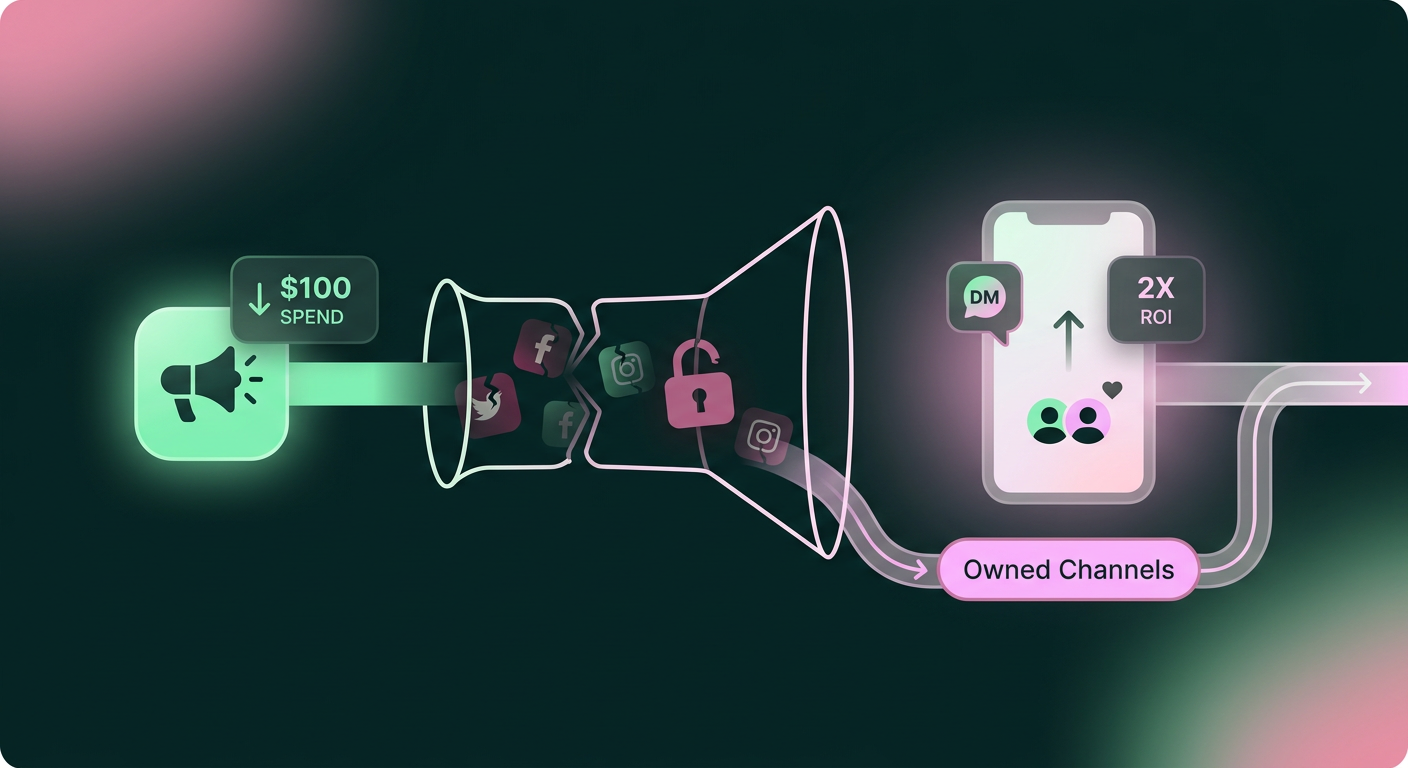
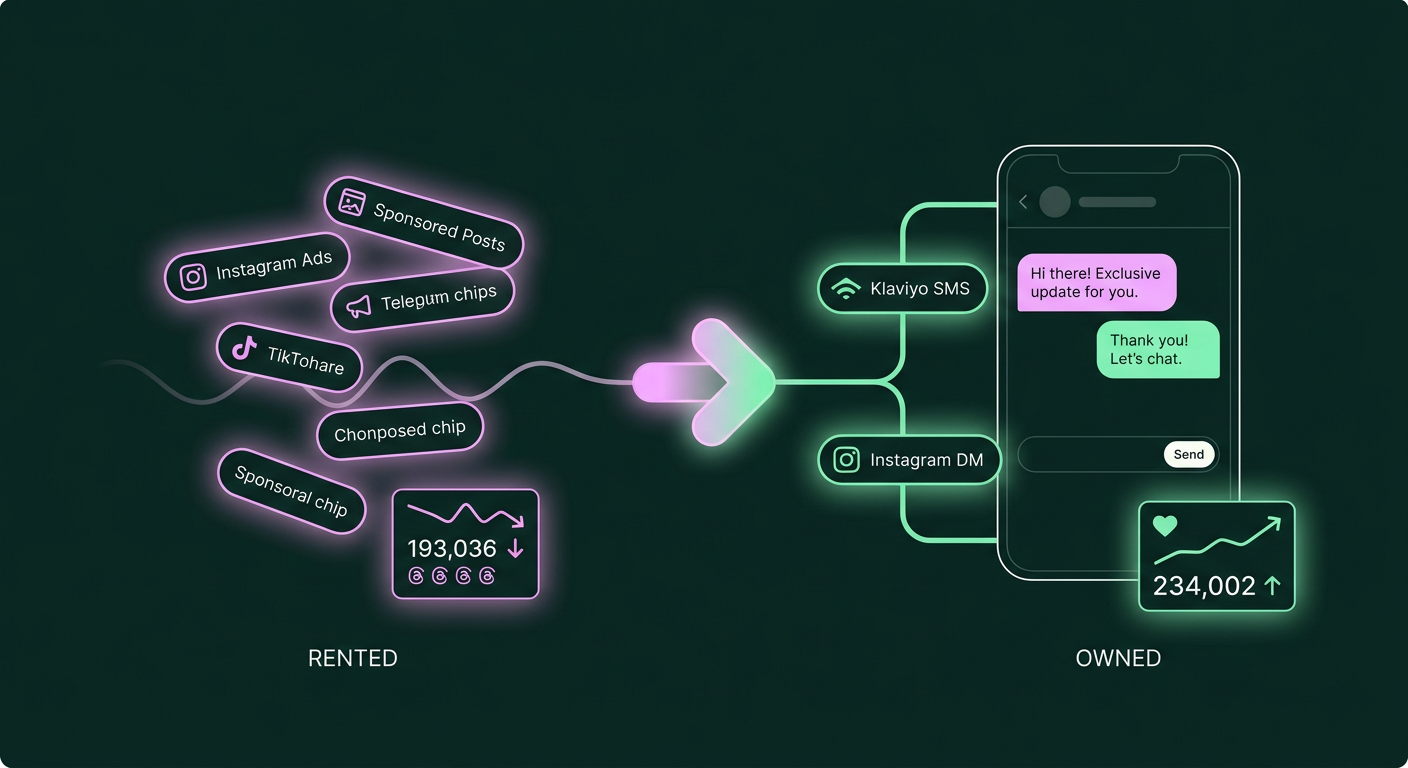
Given those rising costs, the only sustainable path forward is to rethink your relationship with your Instagram audience. For years, the model has been based on renting eyeballs. Every time you wanted to get a message in front of your audience, even your own followers or past customers, you had to pay Meta a toll. With Instagram's share of Meta's advertising revenue (opens in a new tab) projected to climb, it's clear the platform is built around you paying to borrow attention, not to build a lasting connection.
The alternative is to shift from renting attention to owning the relationship. This doesn't mean leaving social media, but using it differently. Instead of relying on the public feed, the focus has to move to a persistent, one-to-one channel: the direct message inbox. Unlike a temporary ad impression, a DM conversation is an owned asset that creates a direct line to your customer, one that isn't mediated by an algorithm or an ad auction. The value of this shift becomes clear when you look at repeat business. A customer only has a 27% chance of returning for a second purchase on their own (opens in a new tab). But if you can get them back for that second sale, their likelihood of making a third purchase jumps to 49%. Cultivating this loyalty is nearly impossible through ads, but it's the natural result of a well-managed relationship in the DMs.
What This Means for Your Klaviyo-Powered Growth
This strategic shift has direct consequences for your marketing stack. If you're running a modern DTC brand, Klaviyo is probably the heart of your operations. You’ve built customer segments, tracked purchase history, and synced your data for email and SMS. You might also be using Klaviyo's audience syncing, which offers real-time syncing with Meta (opens in a new tab), to run more targeted ads. But this is precisely where the strategy misses the point.
Most brands are using Klaviyo's deep customer intelligence to fuel a more efficient version of the old, broken ad model. You identify a segment of one-time buyers, then pay Meta to show them retargeting ads in the hopes of luring them back. You are using a sophisticated data tool to participate in an increasingly expensive system. The real, untapped potential of your Klaviyo integration is in bypassing the ad auction entirely. While some tools can convert social interactions into subscribers, the bigger opportunity is to use your existing Klaviyo segments to trigger automated, personalized lifecycle marketing campaigns directly inside Instagram DMs. Right now, your most valuable customer data is powering a system that hemorrhages money, all while the real reason why your ecommerce repeat purchase rate is stuck goes unaddressed.
How Top Brands Turn DMs into a Profit Center
In practice, this means using the rich, behavioral data in your Klaviyo account to orchestrate full-funnel conversations within Instagram DMs. This isn't about having your social media manager manually reply to messages all day. It’s about building an automated retention engine that works 24/7, turning a channel often seen as a customer support cost center into a significant profit center.
For example, when a customer abandons a cart, you can automatically trigger a personalized DM instead of just an email that might get lost in a crowded inbox. This message lands where the customer is already active, leading to DM open rates that consistently top 80%. When a new person follows your brand, an automated welcome DM can start a conversation, maybe with a small incentive or some useful content, driving an average first-DM engagement rate of 75%.
The applications extend across the entire customer lifecycle. You can create flows for post-purchase check-ins, product education, review requests, and, most importantly, win-back campaigns for lapsed customers. By using the same segments you’ve already built in Klaviyo, you can ensure these messages are relevant and timely. This approach transforms the DM inbox from a passive channel into an active one, delivering conversion rates that are consistently three to five times higher than traditional push notifications.
Your New Playbook: Integrate, Automate, Retain
Adapting this strategy for your own brand means moving away from the acquisition-at-all-costs mindset and adopting a new, three-part playbook focused on owned relationships and long-term value.
First, integrate your systems. This means creating a deep, two-way connection between Klaviyo and Instagram that allows your CRM’s customer data to trigger and personalize automated DM conversations. This foundational step is what makes the entire strategy work.
Second, automate. The real power here comes from scaling your efforts without increasing headcount. You can take the logic from your best email and SMS journeys, like abandoned cart flows and welcome series, and replicate them as automated DM campaigns. By triggering these personalized 1:1 messages based on the Klaviyo segments you already trust, you can re-engage customers at the moments that matter most, all without manual effort. The approach combines the low cost of automation, with a cost per click around just $0.90, with the high-touch feel of a personal message.
Finally, retain. It's time to shift your focus from vanity metrics like clicks and impressions to the numbers that actually drive profitability: repeat purchase rate and customer lifetime value (LTV). In a world where social commerce on Instagram is a multi-billion dollar industry, the goal isn't just to win a click; it's to win a customer for life. By implementing these automated retention use cases (opens in a new tab), you build a system that consistently turns one-time buyers into loyal, high-value repeat customers.
What's Next: The Future of Conversational Commerce
This deep integration of CRM data with 1:1 social messaging channels isn't a fleeting trend. It’s the beginning of a fundamental shift in how brands and customers interact. This move toward conversational commerce is about meeting customers where they are and communicating with them in a way that feels natural, personal, and valuable.
This is especially true for younger demographics. With 89% of Gen Z reporting that Instagram is their favorite social platform, the expectation for in-app experiences will only grow. These users don't want to be redirected to a clunky website or told to check their email for an update; they want to complete their journey inside the app they already use every day. User attention is clearly focused on Instagram, but most brands are failing to convert this attention into a lasting relationship.
The future of customer communication lies in using rich data from platforms like Klaviyo not just to target ads, but to power intelligent, automated, full-funnel conversations. This is more than just retargeting; it's relationship-building at scale. The brands that master this new form of direct, conversational commerce will be the ones who break free from the expensive acquisition treadmill and build the profitable customer relationships that define the next decade of growth.
Frequently asked questions
Should I focus my budget on acquiring new customers or retaining the ones I have?
While a healthy business needs both, the current market makes a strong case for shifting more budget toward retention. With acquisition costs soaring, the return on investment from keeping an existing customer is often far greater. A balanced approach involves maintaining necessary acquisition efforts while building a robust, automated retention system to maximize the value of every customer you bring in.
Why is everyone saying it's cheaper to keep a customer than to find a new one?
That common wisdom is backed by hard data. It can cost anywhere from five to 25 times more to acquire a new customer than it does to sell to an existing one. That's because you have to spend on marketing and ads to attract and convert a new person, whereas an existing customer already knows your brand and has shown they're willing to buy.
What's the best way to increase customer lifetime value (CLV) for my brand?
The most effective way to increase CLV is to increase your repeat purchase rate, particularly by getting customers to make that critical second and third purchase. After one purchase, a customer has just a 27% chance of buying from you again, but that probability jumps to 49% after their second purchase. You can encourage this by using automated, personalized DMs to stay engaged post-purchase, offer relevant products, and build a genuine relationship.
How can I use Instagram DMs to get first-time buyers to come back without paying for more ads?
By integrating your Klaviyo account with an Instagram DM automation platform, you can create automated post-purchase sequences. A few days after a first-time buyer receives their order, you can trigger a DM to check in, ask for feedback, or provide tips. A few weeks later, you can follow up with a personalized offer for their next purchase based on their order history. This creates a valuable, non-intrusive touchpoint that encourages repeat business without any ad spend.
Why are my Meta retargeting ads failing to bring back past customers?
Your retargeting ads may be underperforming for a few reasons. One is "ad blindness," where users are so used to ads they automatically ignore them. Another is the simple fact of rising costs, which shrinks your return on ad spend (ROAS). Ads are an impersonal, one-to-many medium, whereas a personalized DM cuts through the noise, lands in a more private space, and feels like a real conversation, leading to much higher engagement and conversion.
Can I really replace some of my paid ad budget with automated Instagram campaigns?
Yes, absolutely. By shifting your focus from pure acquisition to a strategy that prioritizes retention through automated DM campaigns, you can re-allocate a portion of your budget. The ROI on keeping a customer through a high-impact, low-cost channel like DMs is often significantly higher than acquiring a new one through expensive ads. This creates a more efficient growth model and frees up capital to be used more strategically.