
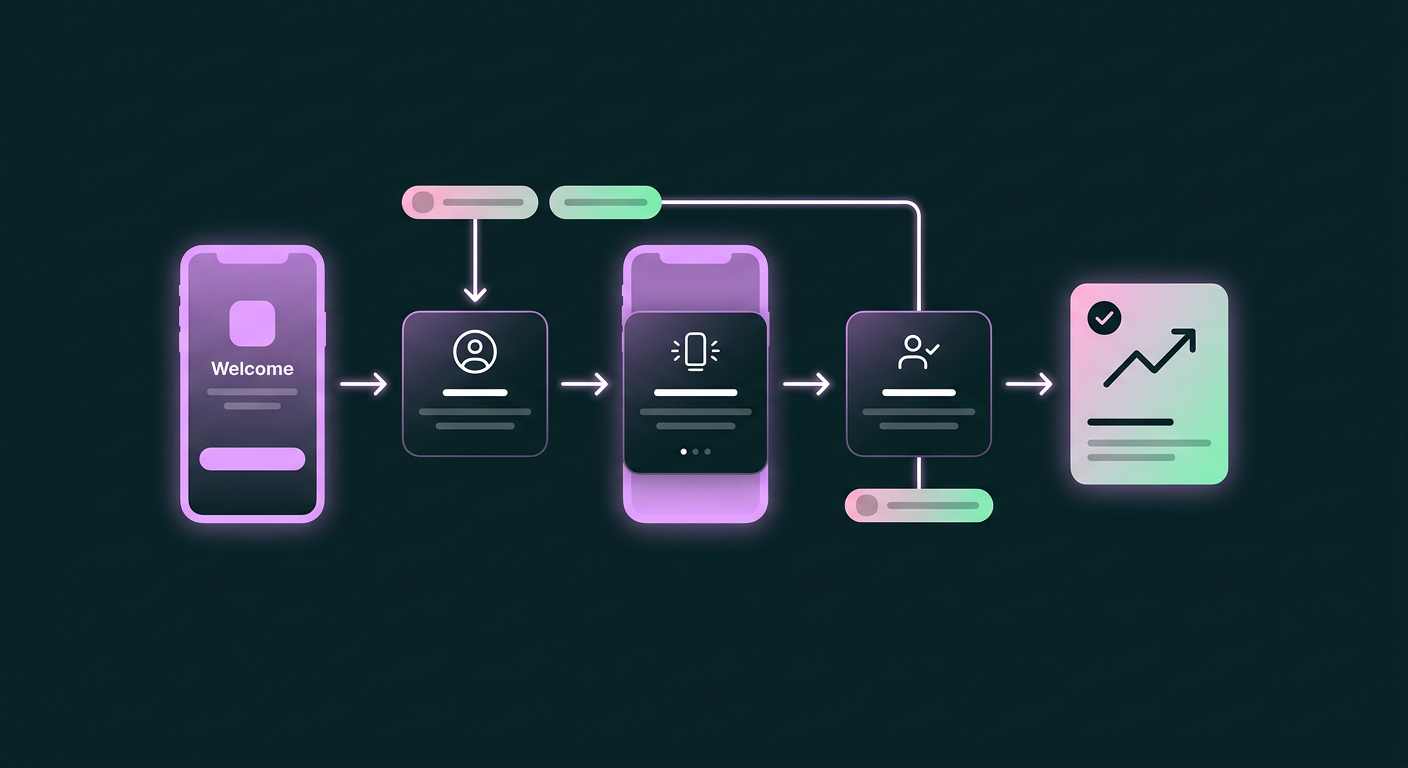
Effective mobile app onboarding is about one thing: guiding new users to their first critical value moment as quickly and smoothly as possible. The goal is to show them why they downloaded your app and give them a reason to come back. Yet for most mobile brands, onboarding is a massive leak at the start of the funnel. Generic product tours and a lack of personalization cause most new users to churn before they ever experience that 'aha' moment, meaning you pay to acquire them only to watch them go silent within days, or even minutes.
Why Your Onboarding Is Leaking Users Before Day One
If your onboarding process is losing users, the reason is almost always the same: it’s a one-size-fits-all experience that creates friction instead of guiding them to value. A generic feature tour can't acknowledge why a specific user signed up, show them a clear path to their first win, or meet their expectation for a fast, intuitive introduction.
While a great onboarding flow should guide new users through your app's core functionality (opens in a new tab) and help them achieve their goals, most sequences are built from the app's perspective, not the user's. They just point out buttons and menus without connecting those features to the outcome the user actually wants. This mismatch is a huge source of friction, and users today have very little patience for it.
This isn't a new problem, but it's getting worse. Users expect a swift, painless entry into any app. Data has long shown that most users want to complete an onboarding process in under a minute (opens in a new tab), and every extra step, unnecessary screen, or piece of irrelevant information is another reason for them to drop off. When the first few moments feel like a chore, you aren't just making a bad first impression, you're actively pushing away the very users you just paid to acquire.
The Stakes: What Leaky Onboarding Really Costs You
That friction doesn't just create a bad first impression; it has a massive financial cost. A leaky onboarding funnel goes far beyond just a few lost users. It represents wasted acquisition spend, a crippled path to profitability, and a fundamental barrier to sustainable growth. When users churn before activation, you lose nearly all of your investment in them without any chance of seeing a return.
The numbers paint a stark picture. In 2024, the [global app activation rate stood at a mere 8.4%](https://businessofapps.In (opens in a new tab) 2024, the global app activation rate stood at a mere 8.4%, which means that for every 100 users who install an app, more than 91 of them fail to become active. Think about what that means for your customer acquisition cost (CAC). You are spending money to bring people in the door, only to have the vast majority walk right back out. This inefficiency makes it incredibly difficult to achieve a positive return on ad spend.
The window to make an impact is incredibly small. If a new user doesn't experience a key value milestone, an action that delivers on the app's core promise, their churn is almost a certainty. According to benchmark data, over 98% of new users will churn within just two weeks (opens in a new tab) if they never reach that first meaningful moment. Even if they complete a signup form or tap through a tutorial, it means nothing if they don't actually use the app in a way that benefits them. This is the central failure of most traditional onboarding strategies: they focus on education instead of activation, and the cost is the near-total loss of your new user base.
A Better Way: Connect Onboarding to User Behavior
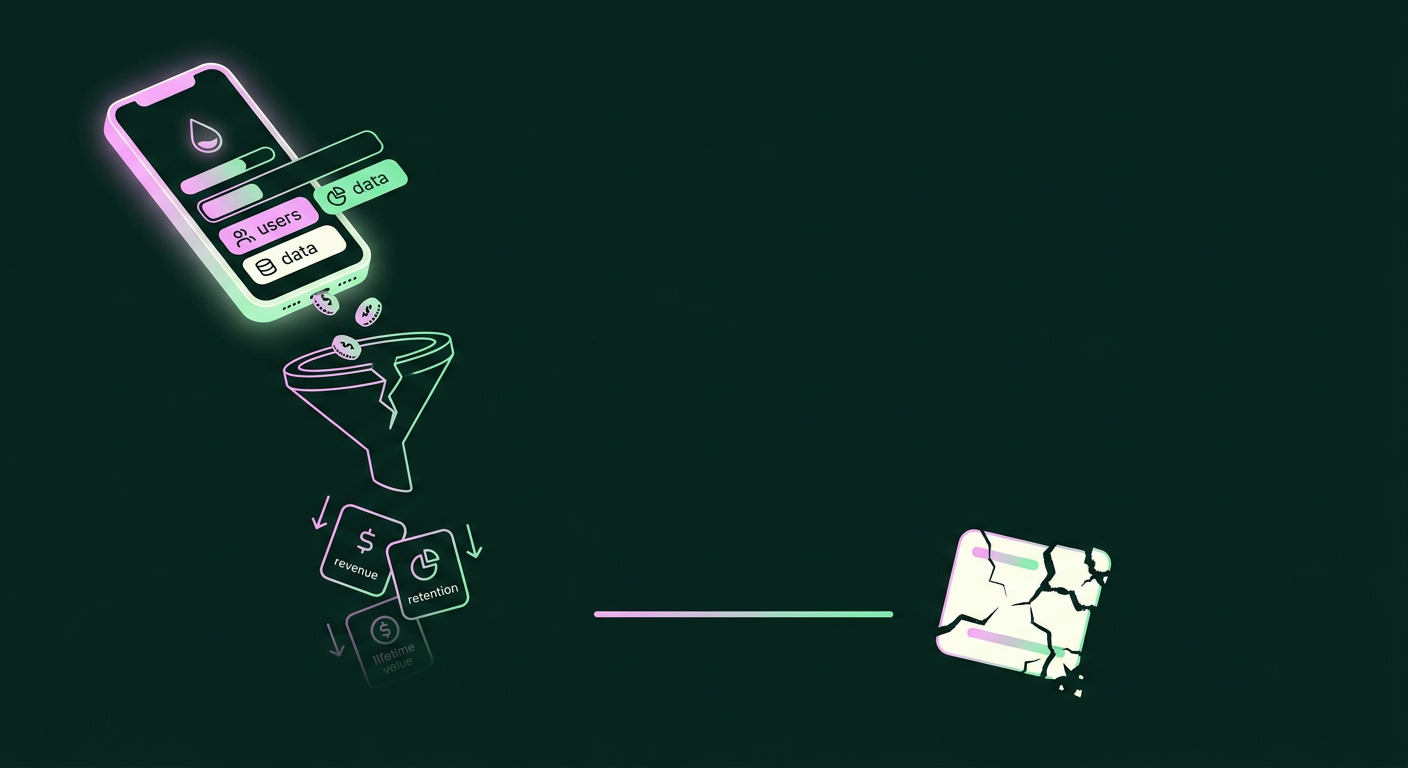
The fix, then, is to shift focus from education to activation. This means you must stop treating onboarding as a static product tour and start seeing it as a dynamic, personalized lifecycle stage. By connecting real-time behavioral data to automated, individualized messages, you can create a full-funnel journey that guides each user from their first interaction to their first value moment and beyond, all built around specific behavioral triggers.
The core principle is to let the user's actions, or inaction, dictate the conversation. An automated customer journey is powered by behavioral triggers (opens in a new tab): the specific things a user does or doesn't do inside your app. Instead of sending everyone the same welcome sequence, you send a personalized message based on what they just did. This transforms onboarding from a monologue into a dialogue.
"An automated customer journey is incomplete without behavioral triggers: specific customer behaviors or actions that trigger a series of automated events." , Profitable Media
This behavior-driven model can be broken down into a few key phases.
Carry acquisition context into the first session
Personalization should begin before the user even opens the app for the first time. The ad they clicked, the social media post they came from, or the search term they used all provide valuable context about their intent. By passing this data, often through UTM parameters, into your app and connecting it to your messaging platform, you can tailor the welcome experience from the very first screen. Someone who installed your gaming app from an ad highlighting a specific character should be greeted with content about that character, not a generic tour of the main menu. This immediately validates their decision and shows them you understand what they're looking for.
Trigger messages based on in-app milestones (or lack thereof)
This is where you connect your onboarding to the app's core value. First, identify the key actions that correlate with long-term retention. For a game, this might be completing the tutorial, joining a guild, or making a small purchase. For a productivity app, it might be creating their first project or inviting a team member. You can then use a system like Dynamo to send automated, personalized 1:1 messages (opens in a new tab) when a user hits one of these milestones, congratulating them and suggesting the next step.
Even more powerful is triggering messages based on a lack of action. If a user signs up but doesn't start the tutorial within an hour, an automated DM could check in with a helpful tip. If they complete level one but don't start level two within a day, a message could nudge them back with a small incentive. This proactive outreach is crucial for preventing the drop-off that happens when users get stuck or distracted.
Personalize outreach on channels users actually see
Finally, this guidance must happen on channels where users are actually paying attention. While in-app messages and push notifications have their place, their effectiveness is limited. Users are inundated with push alerts and often swipe them away without a second thought. To truly cut through the noise, you need to reach them on more personal and direct channels.
This is where messaging platforms like Instagram DM, WhatsApp, and Messenger become so valuable for the user lifecycle. These are conversational environments where a personalized 1:1 message feels less like a marketing campaign and more like a helpful conversation. The engagement rates reflect this; while email open rates decline, DM open rates often exceed 80%. By moving the conversation to these channels, you create a direct line to your user that can be used to guide them through the entire onboarding process and help them see value beyond just ads.
Watch Out: Common Onboarding Mistakes to Avoid
Building this kind of behavior-driven system isn't complicated, but it's easy to get wrong. The most common mistakes include sending messages without clear user consent, relying only on low-engagement channels, and measuring superficial metrics instead of actual activation lift. It's not about simply adding more messages; it's about sending the right message to the right user at the right time, and avoiding these pitfalls is key.
Ignoring channel consent and eligibility
You cannot simply start sending DMs or text messages to every user who installs your app. Each channel has its own rules for consent. For example, to message a user on WhatsApp, they typically need to initiate the conversation or explicitly opt in. For Instagram, a user must follow your page and have message requests open. Ignoring these rules not only creates a poor user experience but can also get your account flagged or blocked. A proper strategy involves creating clear pathways for users to opt into these channels, often by presenting it as a way to get exclusive content, support, or rewards.
Relying only on push notifications
Many app marketers live and die by the push notification. While it's a direct channel to the user's device, its effectiveness has waned significantly due to overuse. It's become a noisy channel that's easy to ignore or disable entirely. A modern strategy must be multi-channel, incorporating higher-engagement formats. The significant growth in channels like SMS, where revenue was projected to grow 52% in 2025, demonstrates a clear shift toward more direct, text-based communication. DMs on social platforms offer similar benefits, with engagement rates that are often 3-5x higher than push notifications, making them a powerful tool for re-engaging inactive users who have gone silent.
Measuring journey completion instead of activation lift
A common vanity metric is "journey completion," which tracks how many users received all the messages in your onboarding sequence. This tells you nothing about whether the journey was effective. The only metric that truly matters is lift. To measure it, you need to use a control group. A portion of your new users should receive no messages, while the test group receives your automated onboarding sequence. The goal is to see a statistically significant increase in the activation rate for the messaged group. If your onboarding journey doesn't produce a measurable lift in activation compared to doing nothing, it isn't working.
What Done Looks Like: From Install to Retained Activation
When you avoid those mistakes, you can build a truly effective, modern onboarding system. It's an automated, personalized 1:1 path that guides a user from the moment of install to their first value moment and encourages their next valuable action. Success isn't measured by opens or clicks, but by a clear, measurable increase in retained activation, turning a leaky funnel into a powerful engine for long-term growth.
When this system is working, the user experience feels fluid and personal. A user installs your app after seeing an ad for a specific feature. The first screen they see acknowledges that interest and directs them toward it. If they get stuck, a helpful DM appears on Instagram or WhatsApp, offering a tip to get them moving again. When they complete a key milestone, they receive a congratulatory message that encourages them to take the next step.
From the marketer's perspective, this entire process is automated. It connects acquisition source, in-app events, and messaging channels into a single, coherent lifecycle journey. You are no longer sending generic push notifications that get ignored. Instead, you're having thousands of personalized 1:1 conversations simultaneously, each one nudging a user closer to activation and retention. This is how you stop wasting your acquisition budget and start building a base of loyal, active users who contribute to long-term revenue and growth.
Frequently asked questions
How can I connect my app events to automated customer journeys?
To connect app events to customer journeys, you need a system that can ingest behavioral data from your app and use it to trigger messages. This typically involves integrating an SDK into your app that tracks key user actions (like level_complete or item_purchased). These events are then sent to a marketing automation platform, which uses them as behavioral triggers to start or advance a user in a journey. For example, a tutorial_skipped event could trigger a DM offering help.
What's the best way to guide new users from signup to their first value moment?
The best approach is to create a personalized, goal-oriented onboarding experience. Instead of a generic tour, identify the single most important action a user can take to see your app's value (the "aha" moment). Then, use a combination of in-app guidance and automated external messages (like DMs or emails) to create a clear, simple path to that action. The key is to guide them through the features that help them achieve their goals, not just show them every button.
What metrics should I track to measure app activation and early retention?
For activation, the primary metric is your activation rate: the percentage of users who complete a predefined key action within a specific timeframe (e.g., 7 days). You should also track Time to Value (TTV), which is how long it takes a new user to reach that first "aha" moment. For early retention, track Day 1, Day 3, and Day 7 retention rates. A key data point to remember is that the global app activation rate was only 8.4% in 2024, so any improvement on this benchmark is significant.
How do I know if my onboarding messages are actually causing activation?
The only way to know for sure is to measure lift using a control group. A portion of your new users (e.g., 10%) should be held back from receiving any onboarding messages. You then compare the activation rate of the group that received messages to the activation rate of the control group. If the messaged group has a statistically significant higher activation rate, you can be confident that your onboarding strategy is working. Simply tracking open or click rates is not enough.
What kind of message should I send when a user leaves before their first meaningful action?
When a user drops off early, the message should be empathetic and focused on re-stating the core value proposition. Avoid being pushy. A good message might be something like, "Hey [Name], noticed you didn't get a chance to start your first game. Did you know you can get [specific reward] by completing the tutorial? Let me know if you have any questions!" The goal is to remove any friction they might have encountered and remind them why they downloaded the app in the first place.
How can I personalize onboarding messages based on where the user came from?
You can personalize messages by tracking the acquisition source using UTM parameters in your ad links. When a user clicks an ad, that data can be passed to your app upon install. For example, a user who came from a Facebook ad for "puzzle games" can be greeted with a message that specifically mentions puzzle challenges, while someone who came from a TikTok ad about "building a kingdom" gets a different message. This creates immediate relevance and shows the user you understand their intent.