
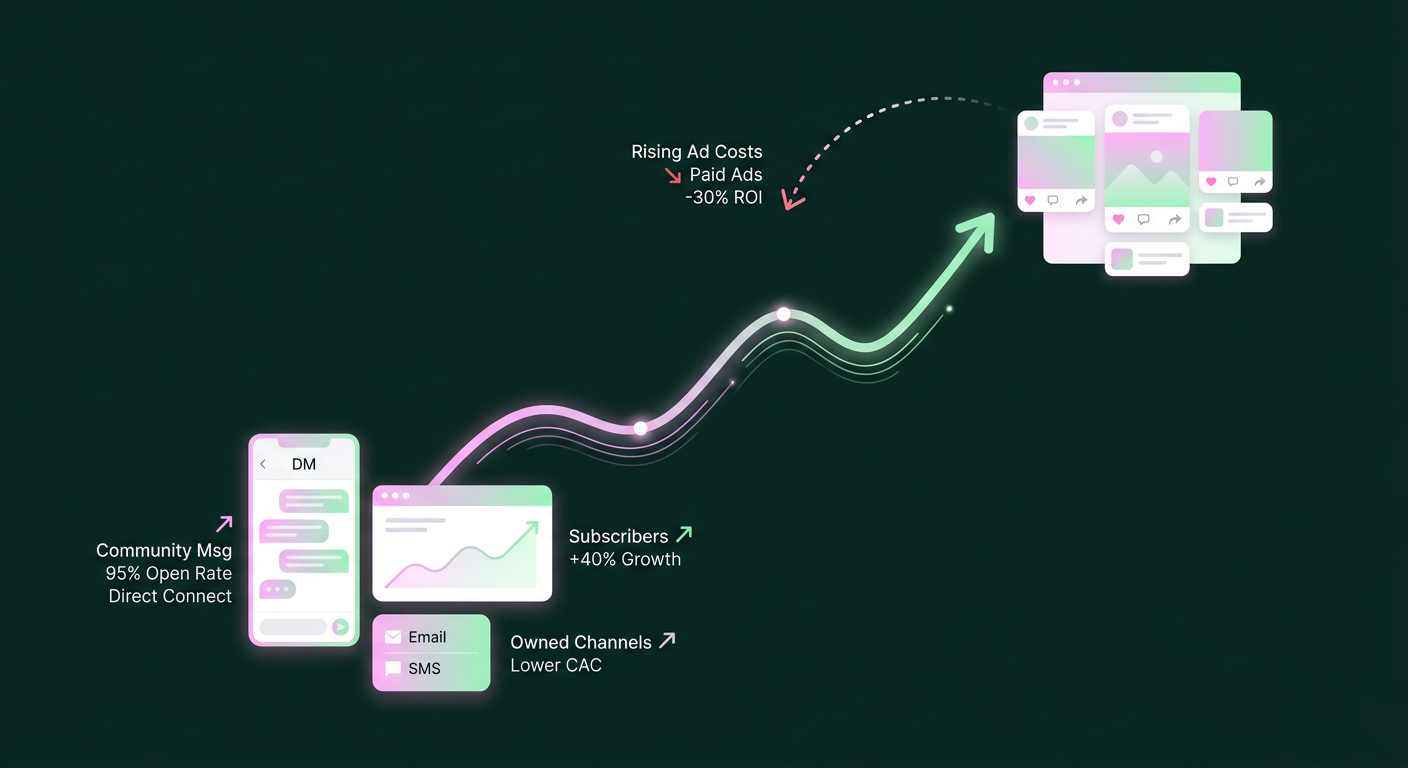
The playbook that built a generation of direct-to-consumer brands is broken. For years, the path to scale was simple: pour money into Meta ads, acquire customers at a predictable cost, and grow. But that engine has sputtered to a halt. For performance marketers and growth leaders, it’s now an unavoidable fact that [Meta’s advertising costs are climbing relentlessly], making the old model unprofitable. The numbers are unavoidable, with Facebook’s average cost per lead jumping 21% year-over-year in 2025. Meta itself even confirmed a significant increase in ad prices that far outpaced the growth in impressions. This isn't a temporary blip, but a structural shift that requires a new direct-to-consumer marketing strategy.
The Writing's on the Wall: The Era of Easy Meta Ad Wins Is Over
For any DTC brand built (opens in a new tab) on paid social, the dashboards are sending a painful message. Customer Acquisition Cost (CAC) is skyrocketing, campaign profitability is plummeting, and the algorithm has become an expensive, unpredictable gatekeeper between you and your customers. The core issue is that costs are rising (opens in a new tab) much faster than Meta's audience is growing. The platform’s own data shows a [14% surge in ad costs against a mere 6% increase in impressions], a clear sign that more advertisers are competing for the same finite user attention. The result is a vicious cycle where you have to spend more just to reach the same number of people, squeezing your margins until they vanish. The days of treating Facebook and Instagram as a scalable, affordable source of new customers are over, and brands that rely on it as their main growth lever will be left behind.
From 'Rented' Audiences to 'Owned' Channels
The fundamental flaw of that (opens in a new tab) old DTC playbook was that it relied on renting audiences. You paid platforms like Meta for temporary access to their users' feeds, but you never owned the connection. When costs (opens in a new tab) rose or algorithms changed, that access became more expensive or less effective, and there was little you could do. The only sustainable path forward is to move from this transient, "rented" model to one built on durable, "owned" channels where you have a direct line to your audience. This means building lists you control, whether that's through email, SMS, or, increasingly, private messaging apps.
The challenge, however, is that (opens in a new tab) building a real connection is harder than ever. Brands find it incredibly difficult to break through the noise of crowded inboxes and generic notifications. A recent survey found that [72% of consumer products marketers agree that it's becoming harder to engage with customers]. Just having an email list isn't enough. You need an owned channel where engagement is high, the format feels personal, and the communication is genuinely two-way. You need a place where you're not just broadcasting promotions but building real relationships, one person at a time.
Why an Owned Audience Is No Longer a 'Nice-to-Have'
Because that connection is so much harder to build, the payoff for getting it right has never been greater. An owned audience is no longer a secondary marketing activity; it's the central pillar of a resilient and profitable business. When you have a direct, high-engagement channel to your customers, you fundamentally improve your company’s financial stability. You gain control over your margins by reducing your dependence on expensive paid acquisition. You insulate your business from the volatility of ad platforms and their shifting algorithms. And perhaps most importantly, you own your first-party customer data, a critical asset for creating the personalized experiences that drive loyalty.
This isn't just theory. The power of a direct customer relationship creates a more durable business, as the economic shocks of the pandemic proved. While many traditional retailers struggled, DTC brands with strong direct connections thrived. One analysis found that [only about 22% of DTC brands reported sales declines], compared to a staggering 80% of their competitors who lacked that direct line to their audience. An owned audience is a moat. It’s an asset that appreciates over time, drives higher lifetime value, and provides a stable foundation for growth that paid ads alone can never offer.
The Shift in Action: Where the Smartest Brands Are Moving
The most forward-thinking brands are already making this pivot by moving conversations from public feeds into private, high-engagement direct message channels. Instead of running ads that push for a direct purchase, they're using their ad spend to acquire DM subscribers on platforms like Instagram and WhatsApp. This seemingly small change has a huge impact on both cost and engagement. While the cost to acquire a click might look similar on the surface, the value of that click is exponentially higher. You're not just hoping for a one-time transaction; you're gaining a subscriber with whom you can build a long-term relationship.
The performance metrics for this approach are compelling. Brands using this strategy are seeing first-DM engagement rates of 75%, which is orders of magnitude higher than a typical email open rate. The cost to acquire a long-term subscriber is often just $1.20, a fraction of what it can cost to acquire a single purchase through a traditional conversion campaign. By shifting the goal from a one-off sale to an ongoing conversation, these brands are building a powerful owned asset. They are turning passive scrollers into engaged followers and loyal customers, all while systematically lowering their dependence on the very ad platforms they use for discovery. The collection of performance [metrics speaks for itself], showing a clear path to sustainable growth.
How to Build Your High-Engagement Owned Channel
Making this transition requires a strategic recalibration of your entire marketing funnel. It's not about abandoning ads, but changing their purpose. Instead of optimizing every campaign for immediate conversions, the new goal is to use ads as an entry point to your owned channel. This means creating compelling offers that encourage users to start a conversation with you via DM, effectively turning your ad spend into an investment in a long-term asset.
A New Funnel: From Ad Click to DM Subscriber
The new funnel begins with an ad creative that invites a conversation instead of just selling a product. This could be a "Click-to-DM" ad promoting an exclusive offer, early access, a quiz, or a personalized recommendation. When a user clicks, they are taken directly into a DM conversation with your brand on Instagram or WhatsApp, not a generic landing page.
This is where the relationship begins. The first message can be automated to instantly deliver the promised value and welcome them as a new subscriber. From there, you can nurture this connection with personalized 1:1 DMs, guiding them toward a purchase when the time is right. The data from this approach is incredibly promising. Brands are acquiring DM subscribers for as little as $1.20 and then converting them through automated DM drip campaigns at an 8% rate. This two-step process, acquire the subscriber cheaply, then convert them through a high-engagement channel, is a far more cost-effective and sustainable model for growth. It represents a fundamental shift in [rethinking ecommerce customer acquisition cost] in today's environment.
What to Watch Next: The Future of DTC Is Conversational
The pivot to owned channels like DM is more than a tactic to combat rising ad costs; it’s the first step toward a much larger trend: the future of commerce is conversational. Customers are tired of being broadcasted to. They want genuine interaction and personalized experiences that make them feel seen and valued. Building your audience in a conversational channel allows you to meet this expectation at scale.
This shift directly addresses the difficulty of engaging customers that so many marketers now face. By moving away from the "rented" audience model and investing in owned, conversational channels, you are not only building a more resilient business but also aligning your brand with the future of customer relationships. The brands that master this approach will be the ones who build the deepest loyalty, command the highest lifetime value, and ultimately win the next decade of direct-to-consumer marketing. The focus has to be on building a community, not just a customer list.
Frequently asked questions
Why is my customer acquisition cost climbing so much?
If your customer acquisition costs (CAC) are climbing, you're not alone. The primary driver is increased competition on major ad platforms like Meta. Recent data shows a significant imbalance where [ad costs have jumped 14% while impressions only grew by 6%], which means more advertisers are bidding for the same limited ad space. This inflation, compounded by data privacy changes that make targeting less precise, directly leads to higher costs per lead. We saw this with a [21% year-over-year increase in 2025], forcing brands to spend more to acquire each new customer.
What are the best strategies to lower my Customer Acquisition Cost (CAC)?
One of the most effective strategies to lower CAC is to shift your goal from immediate conversion to subscriber acquisition. Instead of paying a high price for a single purchase, you can use ads to drive users into an owned channel like Instagram or WhatsApp DMs at a much lower cost. Brands using this strategy are acquiring subscribers for as little as $1.20. Once you have them as a subscriber, you can use automated, personalized drip campaigns to convert them over time, with some brands seeing an 8% conversion rate from these sequences. This approach dramatically lowers your blended CAC by creating a more efficient path to purchase.
As a growing brand, why is building an 'owned audience' so critical right now?
For a growing brand, building an owned audience is critical for survival and long-term stability. Relying solely on paid ads makes your business vulnerable to rising costs and algorithm changes that can destroy your margins overnight. An owned audience gives you a direct, reliable line of communication with your customers that you control. This builds resilience, which we saw during the pandemic when [DTC brands with direct customer relationships were far less likely to see sales declines] than their competitors. It allows you to own your first-party data, reduce your dependency on paid channels, and build a more predictable, profitable business.
How can I grow my store if I can't rely on Meta ads anymore?
You can grow your store without over-relying on Meta ads by investing in your own direct channels. A powerful strategy is to use ads not to sell a product directly, but to acquire a subscriber in a high-engagement channel like DMs. For example, you can run a campaign that drives users to message your brand on Instagram for an exclusive offer. The cost per subscriber can be as low as $1.20, which is significantly more affordable than acquiring a customer in a single transaction. This builds a valuable audience asset that you can market to for free in the future, creating a sustainable growth engine.
Does this mean I should stop running Facebook Ads altogether?
No, you shouldn't stop running Facebook and Instagram ads. Instead, you should change how you use them. The era of using Meta ads as your primary, low-cost customer acquisition engine is ending due to [steadily rising costs]. The new strategy is to use them as a top-of-funnel tool to feed your owned channels. Use your ad budget to drive awareness and encourage users to subscribe to your DM, email, or SMS list. This way, you're investing in a long-term asset you control, rather than just renting temporary attention.
What are the most effective alternatives to Facebook Ads for a DTC brand?
The most effective alternatives aren't just other ad platforms, but "owned" marketing channels where you have a direct relationship with the customer. While email and SMS have been the traditional options, conversational channels like Instagram DMs and WhatsApp are emerging as powerful alternatives because of their incredibly high engagement rates. Instead of fighting for attention in a crowded inbox, you're meeting customers on platforms they use for personal communication. Building a subscriber list on these channels allows you to nurture relationships and drive conversions in a way that feels more personal and is often more cost-effective than constantly paying for new clicks. !A conceptual illustration capturing the core idea of the section "Frequently asked questions" within an article about direct to consumer marketing strategy - depict the idea, not the literal words.