
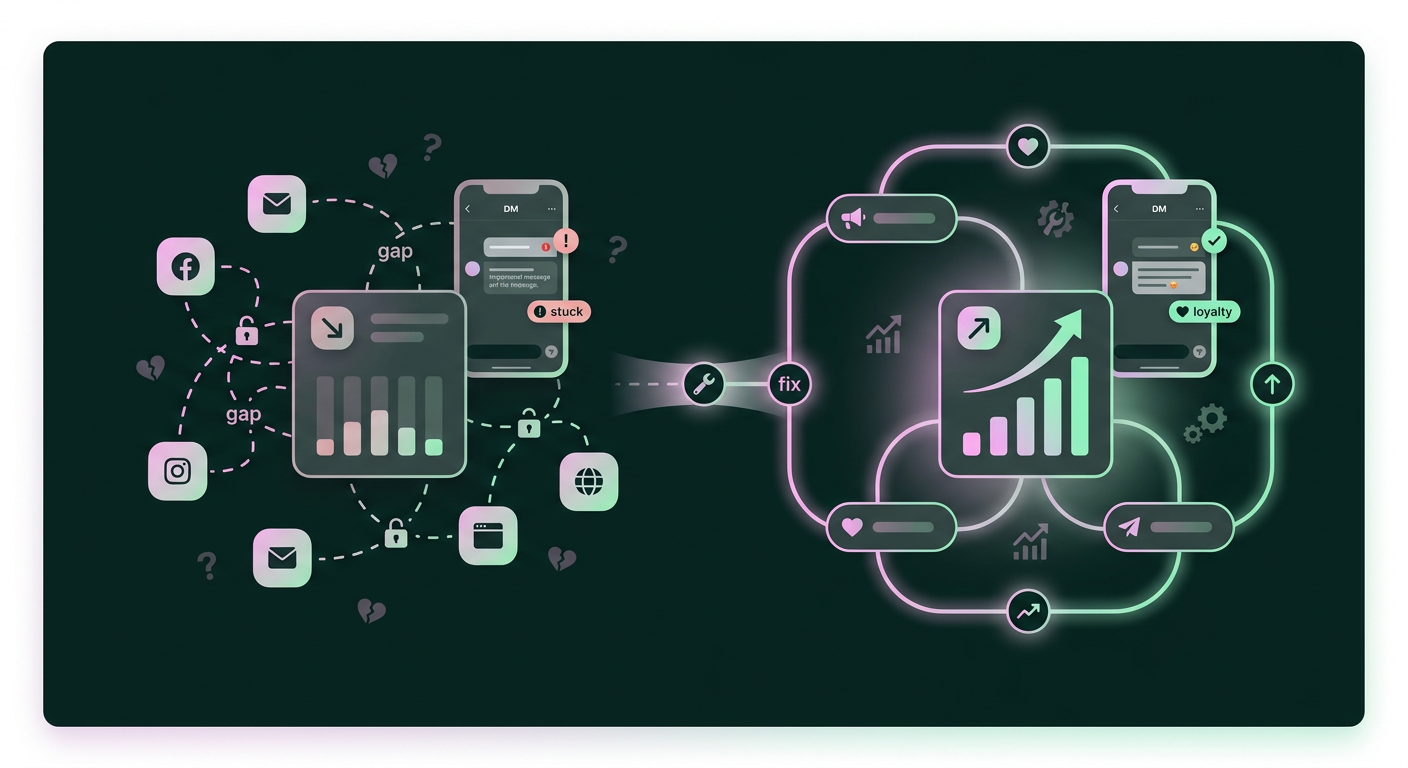
For many growing ecommerce brands, there’s a frustratingly familiar plateau. You're spending more on ads, your traffic is up, and new customers are coming through the door, but the business itself isn't growing. The revenue line stays stubbornly flat. This is the classic symptom of a low repeat purchase rate, a problem that turns your marketing budget into a leaky bucket. When the vast majority of your hard-won customers buy only once, you aren't building a business; you're just treading water on a customer acquisition treadmill. The numbers paint a stark picture: with a typical ecommerce repeat purchase rate hovering around 18.8%, a staggering 81.2% of customers in DTC e-commerce buy once and never return (opens in a new tab). That isn't a minor leak; it's a fundamental flaw in the growth model that keeps brands stuck.
The Leaky Bucket of Paid Acquisition
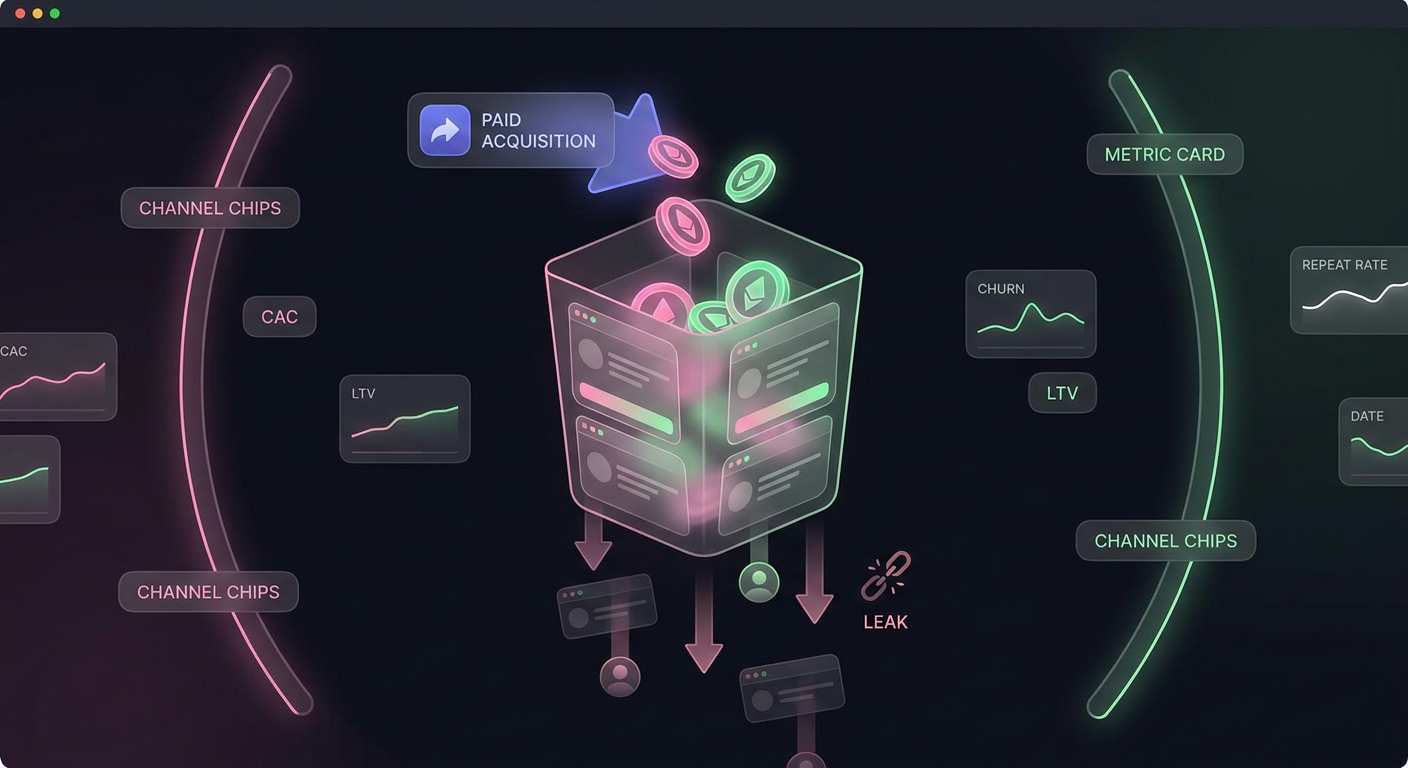
The cycle is predictable. A new customer sees your ad, clicks, and makes a purchase, which lights up your acquisition dashboards and feels like a win. You then reinvest that "success" into acquiring the next new customer, and the next. But while you're focused on filling the top of the funnel, you're ignoring the giant hole in the bottom where past customers are quietly slipping away. This isn't just inefficient; it's unprofitable. Your brand is effectively paying Meta or Google to acquire the same customers over and over, first as a new prospect and then later as part of a costly retargeting audience. You're trapped in a loop of expensive first dates instead of building lasting, profitable relationships.
So why do so many brands get stuck in this unprofitable cycle? It’s rarely because the product is bad or the ads are suddenly ineffective. The common excuses often mask a more systemic issue.
Surface-Level Excuses vs. the Real Reason for Churn
When faced with a stagnant repeat purchase rate, it’s easy to jump to the wrong conclusions by questioning product quality, second-guessing ad creative, or blaming pricing. While these factors matter, they usually aren't the root cause of widespread customer churn. The real culprit is a disconnect in post-purchase engagement. You spent a fortune to get their attention for the first sale but have no reliable, personal way to keep it afterward, which creates a critical weakness in your customer lifecycle strategy.
The 90-Day Engagement Gap
Data shows a clear window of opportunity for securing a second purchase. Of the customers who do decide to buy again, a huge majority, 76.4%, to be exact, do so within the first 90 days (opens in a new tab). After that three-month mark, the odds of them returning plummet. The relationship goes cold, and they effectively become a new, expensive prospect all over again. The reason for this drop-off is straightforward: for 90 days, your brand is still relatively top-of-mind from the recent unboxing and initial excitement. But if you fail to re-engage them in a personal way during this window, they forget about you. Your brand fades into the background noise of their inbox and social feeds, and the opportunity is lost.
The True Cost of Prioritizing Acquisition
The obsession with acquisition isn't just an oversight; it's a massive financial drain. It's a well-established marketing principle that acquiring a new customer is anywhere from five to 25 times more expensive than retaining an existing one (opens in a new tab). Despite this, many marketing budgets are still overwhelmingly skewed toward top-of-funnel ad spend. This is the leaky bucket in action. You're choosing the most expensive path to growth while neglecting the far more profitable one. A small shift in focus can have an outsized impact; research has shown that even a 5% increase in customer retention can boost profits by a staggering 25% to 95%. When you're perpetually chasing new buyers, you leave your most valuable asset, your existing customer base, untapped.
If the engagement gap is the problem, the symptoms are often hidden in plain sight within your current marketing efforts.
Diagnosing Your Retention Blind Spots
Most brands don’t intentionally ignore retention. They simply trust that their existing tools, email and retargeting ads, are doing the job. The problem is, these channels are often ineffective for the kind of personal connection needed to drive a second purchase. They create the illusion of a full-funnel strategy while failing to bridge that crucial 90-day gap, which is the first blind spot you need to diagnose.
Symptom: Your retargeting ads feel like shouting into the void
You've built the audiences and you're targeting past purchasers with new products and special offers, yet click-through rates are abysmal and your return on ad spend is barely breaking even. This happens because a generic display ad in a crowded social feed is a poor substitute for a genuine relationship. It isn't personal or timely; it's just another ad interrupting their experience, which makes it easy to ignore. This approach treats your past customers like cold prospects, trying to re-acquire them instead of re-engaging them.
Symptom: You have no direct, 1:1 channel for past buyers
Email open rates continue to decline, and even when an email is opened, it rarely feels like a personal conversation because customers know it's a one-to-many broadcast. This leads to the real diagnostic question: do you have a channel for a direct, one-to-one conversation with a customer who has already bought from you? For most brands, the answer is no. They lack a way to send a personalized, relevant message that feels like it came from a person, not a marketing machine. This is a critical missed opportunity, because the moment a customer makes a second purchase, their value skyrockets. Their likelihood of buying again jumps to 45% after a second purchase (opens in a new tab), and it keeps climbing from there. Without a direct channel to encourage that pivotal second sale, you’re leaving all that future loyalty entirely to chance.
Diagnosing this channel and engagement gap is the first step; the next is to fix it by fundamentally shifting your mindset and tooling.
The Fix: Shift from Re-Acquiring to Re-Engaging in DMs
The core of the problem is a channel mismatch. You're trying to build personal relationships using impersonal, one-to-many tools like email and ads. The fix is to meet customers on the channels they actually use for personal conversations: their messaging apps. By shifting your post-purchase strategy into Instagram and WhatsApp DMs, you can move from a model of costly re-acquisition to one of profitable, automated re-engagement.
Meet customers where they are (in their DMs)
Your customers, especially in the DTC space, live in their DMs. It's where they talk to friends, follow creators, and interact with brands they love. A message here doesn't feel like an intrusion the way a promotional email or retargeting ad does, because it feels native to the platform and personal to them. By building a presence in their inbox, you create a direct, 1:1 line of communication that stays open long after the first purchase. This channel allows you to deliver relevant, timely messages that cut through the noise and genuinely help the customer, whether it's an order update, a personalized product recommendation, or a simple check-in.
Automate lifecycle messaging, not just email blasts
Shifting to DMs doesn't mean hiring a team to manually type out messages all day. It means using modern automation to run your existing lifecycle marketing strategy in a more effective channel. With the right tools, you can connect your CRM or email platform, like Klaviyo or Braze, and run your proven customer journeys as personalized DMs. This is how you bridge the 90-day gap with automated, full-funnel messaging, from post-purchase check-ins and reorder reminders to win-back campaigns for at-risk customers. This strategy recognizes that building a loyal customer base is your most profitable path to growth. Prioritizing retention isn't just good practice; businesses that do so can see profits up to 60% higher than acquisition-focused companies. You turn what was once a leaky bucket into a powerful engine for long-term value, knowing that 80% of your future profits will likely come from just 20% of your current customers. Exploring a few proven use cases for DM automation (opens in a new tab) can provide a clear roadmap for what this looks like in practice.
Once you implement this shift, you’ll see the proof in the same metrics that were once stuck, which will become your clearest indicators of success.
How to Know It’s Working: Your New Retention Metrics
The goal of this strategic shift isn't just a better-feeling marketing plan; it's about producing measurable, bottom-line results. The very metrics that once caused so much frustration will start to move in the right direction, providing a clear signal that you've plugged the leak in your acquisition funnel and are now building a more resilient, profitable business.
Your repeat purchase rate climbs past the 20% benchmark
The most immediate sign of success is watching your ecommerce repeat purchase rate finally begin to climb. Where it was once stuck below the industry average of 18.8%, you'll see it start trending upward. The average repeat purchase rate for many DTC brands is in the 15, 30% range, with top performers pushing even higher.com/post/repeat-purchase-rate-ecommerce), with top performers pushing even higher. As you re-engage customers during that critical 90-day window and make a second purchase easy and appealing, this metric will naturally improve. It's the ultimate proof that you're no longer just acquiring one-time buyers but are actively cultivating a base of loyal customers.
Your customer lifetime value (CLV) trends up
As your repeat purchase rate goes up, another crucial metric will follow: customer lifetime value (CLV). CLV is the true north star of a sustainable ecommerce business, representing the total profit you can expect from a single customer over their entire relationship with your brand. By turning one-time buyers into repeat purchasers, you directly increase your CLV. This makes your initial acquisition spending far more efficient, as each new customer is now likely to generate significantly more revenue over time. Remember, a 5% improvement in retention can increase profits by 25% to 95%, a boost driven almost entirely by the growth in CLV. Learning how to increase customer lifetime value is the key to escaping the acquisition treadmill for good.
Frequently asked questions
My brand's growth has stalled. Could a low repeat purchase rate be the cause?
Absolutely. This is one of the most common reasons for a growth plateau in DTC. If you're constantly spending to acquire new customers but very few of them ever buy again, you're effectively running in place. Since 81.2% of ecommerce customers buy once and then disappear, a strategy that doesn't actively focus on bringing them back for a second purchase will always struggle to achieve sustainable, profitable growth.
How much more expensive is it to get a new customer than to keep an old one?
The data is very clear on this point. Depending on the industry and marketing channels used, acquiring a completely new customer is estimated to be five to 25 times more expensive than retaining a customer you've already won. This is why an over-reliance on paid acquisition can be so damaging to profitability, and why even a small investment in retention can yield such significant returns.
Should I focus my budget on acquisition or retention right now?
The most successful brands find a balance, but if your growth has stalled, it's a strong signal that your budget is too heavily skewed toward acquisition. Given that a mere 5% increase in customer retention can lift profits by 25-95%, shifting some of your focus and budget toward retaining existing customers is likely the highest-leverage move you can make right now. It makes your initial acquisition spend more efficient in the long run.
What's the best way to increase my customer lifetime value (CLV)?
The most direct way to increase CLV is to increase your repeat purchase rate. The more frequently a customer buys from you, the more valuable they become. The key is securing that pivotal second purchase. Once a customer buys a second time, their likelihood of returning again increases dramatically to 45%. Focusing on post-purchase engagement to encourage that second sale is the foundation for building high CLV.
As a DTC brand, why is tracking CLV so important?
Tracking CLV shifts your perspective from short-term sales to long-term business health. It tells you the true value of your customers and helps you make smarter decisions about marketing spend. For instance, knowing your CLV helps you understand how much you can afford to spend to acquire a customer while remaining profitable. It's a critical metric because a small group of loyal customers often drives a huge portion of future revenue; one study found that 80% of a company's future profits often come from just 20% of its existing customers.
Can I really use Instagram DMs to increase repeat purchases and lower my ad spend?
Yes. Instagram DMs are a powerful channel for retention because they are personal, direct, and have extremely high engagement compared to email or ads. By using automation to send timely, personalized lifecycle messages, like post-purchase follow-ups, reorder reminders, or exclusive offers, you can nurture the customer relationship in a way that feels authentic and drives repeat sales without having to pay for more ad impressions.