
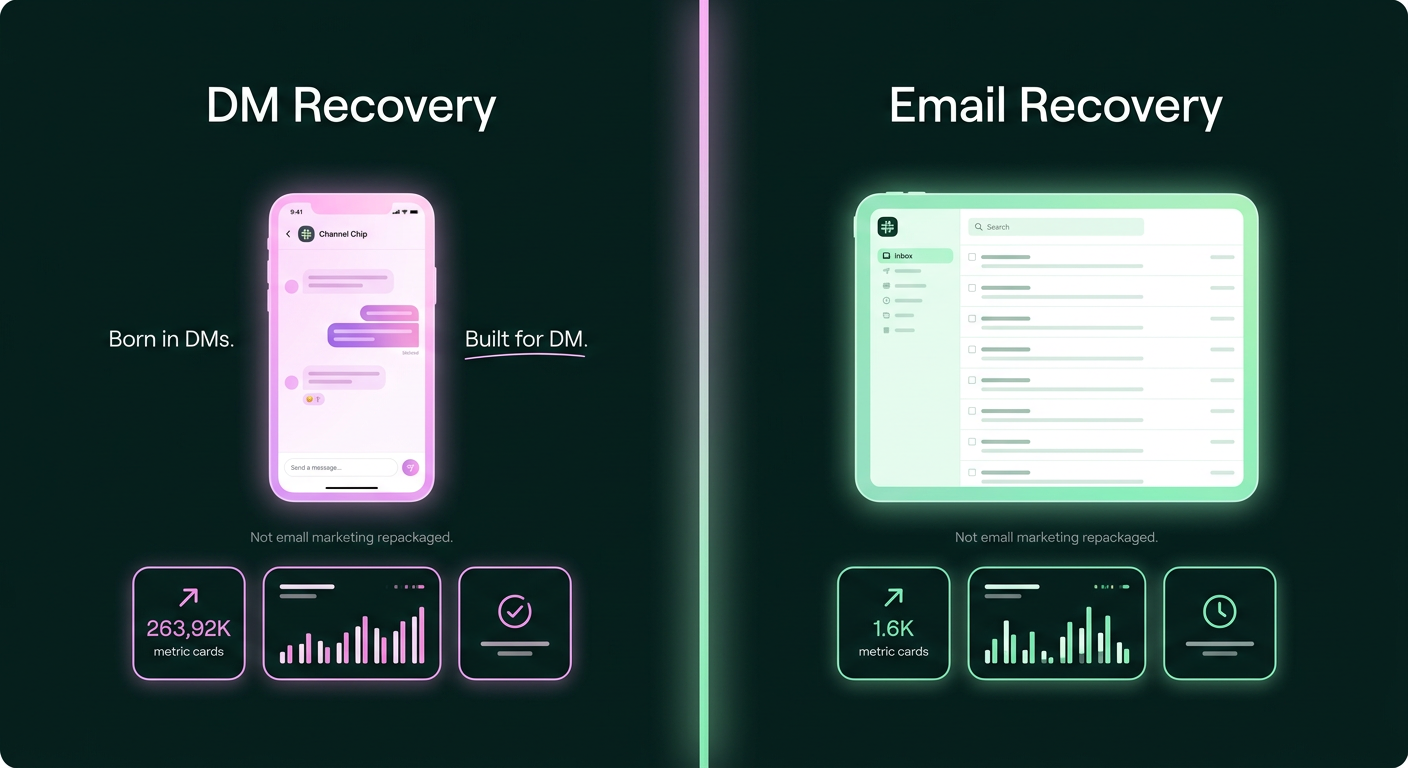
For any e-commerce growth lead, cart abandonment stats are a constant source of frustration. Seeing potential customers come so close to a purchase only to disappear feels like losing money you already had in your hands. The standard fix has always been a sequence of cart recovery emails, but a growing number of brands are finding that this old method just isn't moving the needle on lost revenue. The truth is, people are drowning in email, and the "Promotions" tab has become a digital graveyard for even the best recovery campaigns. This isn't just an inefficiency; it's a direct and growing drain on your bottom line.
Why Your Recovery Emails Aren’t Converting
The reason those recovery emails are falling flat is that email’s overall reach and engagement are in a steady decline. While it remains a foundational marketing channel, its power to cut through the noise for urgent, time-sensitive messages like cart recovery has faded, which means you're leaving significant revenue on the table.
The scale of the problem is immense. Across the web, the global average cart abandonment rate is a staggering 70.19% (opens in a new tab), a number that only gets worse on mobile devices where distraction is just a swipe away. This means for every ten shoppers who add an item to their cart, seven of them leave without paying. When you apply that percentage to your store's traffic, the potential revenue left behind is often eye-watering. For years, the default response has been an automated email workflow. But with marketing email open rates stuck in the low double digits and click-through rates in the low singles, the math just doesn't work. The vast majority of your abandoned cart emails are never even seen, let alone acted upon, rendering your recovery attempt invisible.
The 4 Pillars of High-Converting Cart Recovery
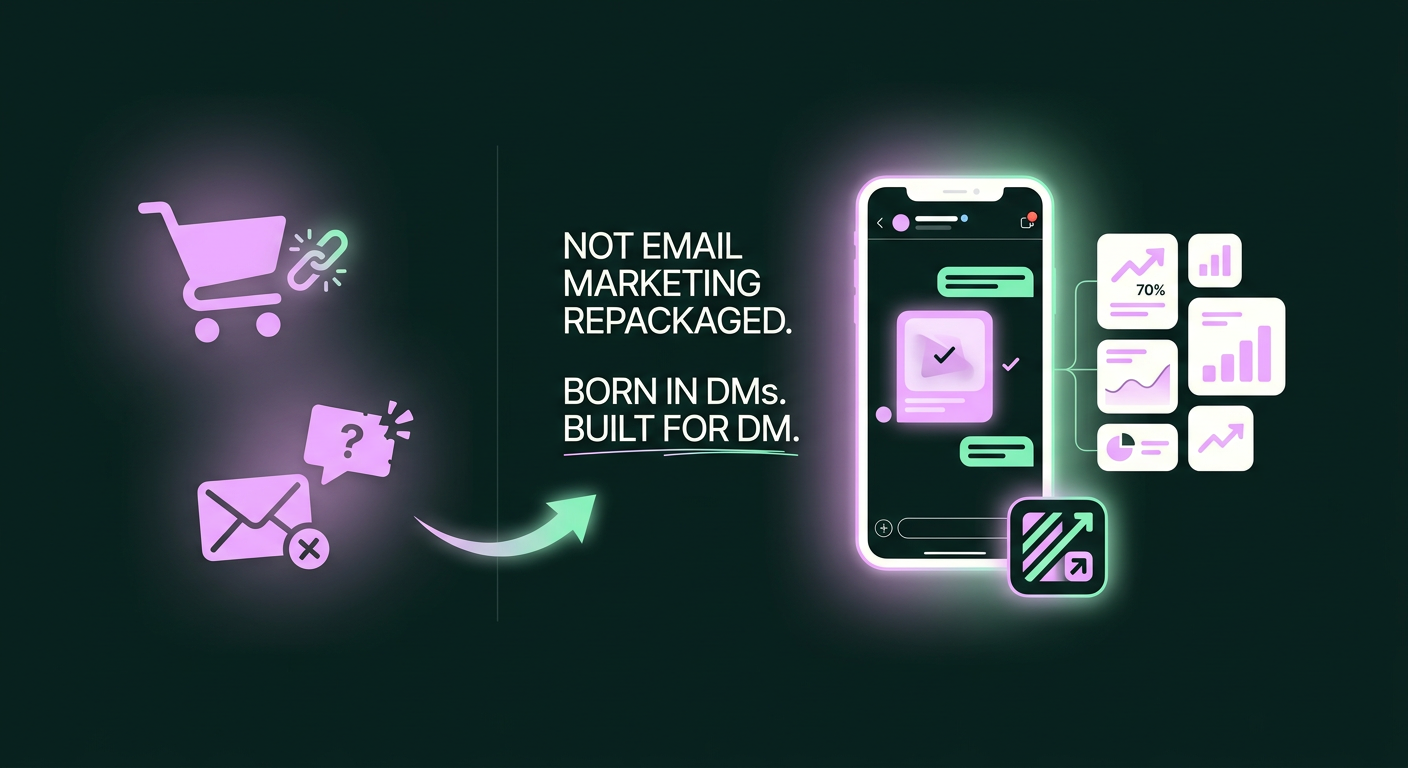
So if email isn't cutting it anymore, what does a modern cart recovery strategy actually need? Any approach that hopes to reclaim the revenue you're currently losing must be built on four key pillars: reach and engagement, automation, personalization, and raw conversion power. Simply sending a generic email and hoping for the best is no longer a viable strategy for growth-focused brands.
Reach & Engagement
The first question is the most important one: is your message actually being seen? A channel's effectiveness starts with its ability to demand attention. If your message lands in a crowded, low-priority space like an email promotions tab, its chances of being read are slim. Real engagement means reaching customers in a context where they are primed to interact, making the message feel less like a marketing campaign and more like a personal notification.
Automation & CRM Integration
At scale, a recovery system has to be intelligent and hands-off, because manually chasing down every abandoned cart is impossible. But powerful automation isn't enough if it operates in a silo. It needs to plug directly into your CRM, like Klaviyo or Braze, to pull customer segments and trigger workflows based on real-time behavior. This ensures the right message goes to the right person at the right time without adding to your team's workload, which is a cornerstone of any modern direct-to-consumer marketing strategy.
Personalization at Scale
Generic messages get generic results. An effective recovery message should feel like it was written specifically for the recipient, going beyond just using their first name. The ideal system can reference the exact items in their cart, suggest relevant alternatives, or even tailor the tone and offer based on their purchase history. Delivering this kind of personalized 1:1 communication to thousands of shoppers requires a system built for it, turning what would be a manual chore into an automated, high-impact flow. AI-powered personalization is becoming key to making these messages work.
Conversion Effectiveness
Ultimately, the only metric that matters is how much revenue the strategy recovers. This is the bottom-line test of any tactic. An effective system doesn't just get opens and clicks; it drives shoppers back to their carts to complete the purchase. This requires a combination of the previous three pillars: reaching the right person with a personalized message through a smooth, automated workflow. Measuring the conversion rate and the total revenue recovered provides the final verdict.
Head-to-Head: Traditional Email vs. Automated DMs
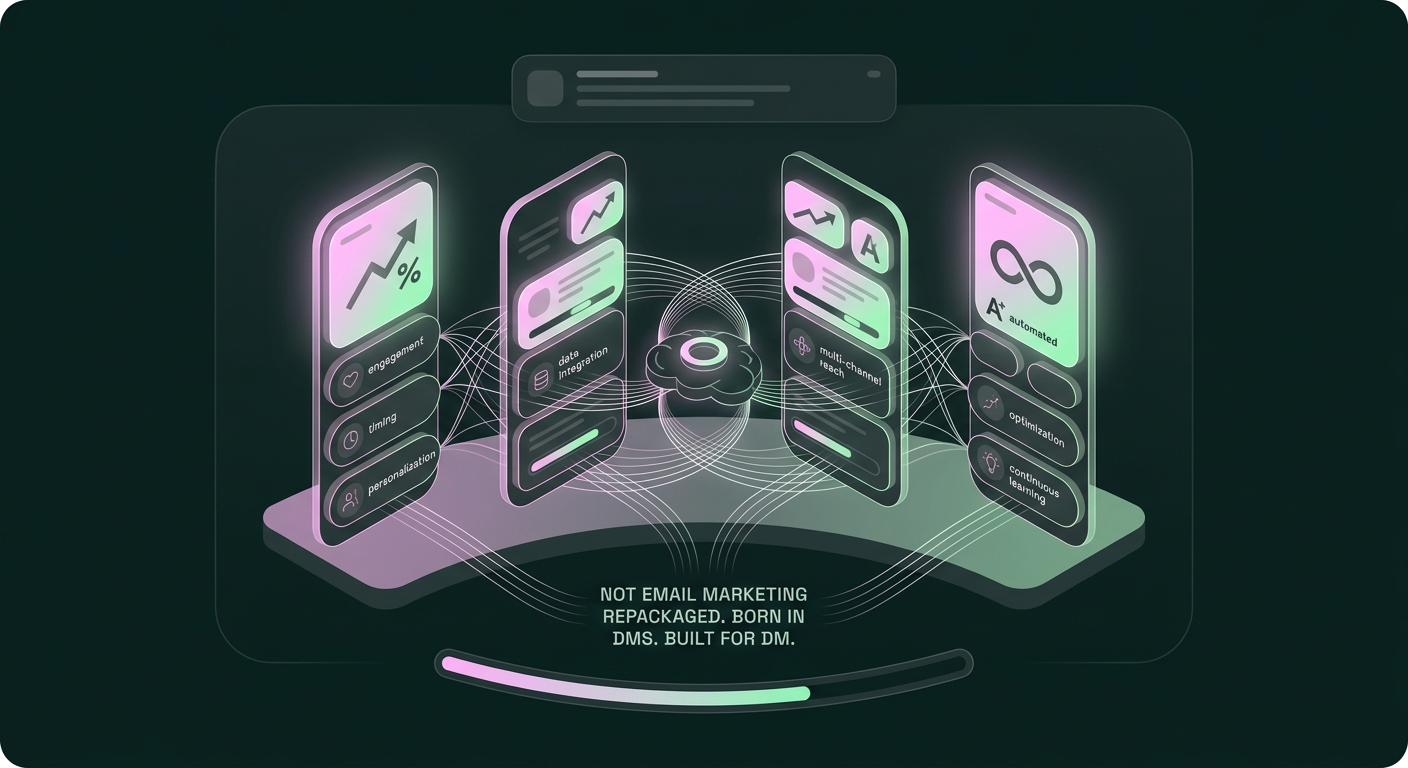
When you evaluate email and automated DMs against these four pillars, the comparison is stark. While email remains a useful baseline, automated DMs consistently outperform it in the areas that matter most for cart recovery: reach, engagement, and conversion. The limitations of email happen to be the exact strengths of direct messaging channels like Instagram DMs, WhatsApp, and Messenger.
The shift toward direct messaging isn't just a hypothesis; the performance data paints a clear picture. While email-only programs manage to recover a respectable 10% to 15% of abandoned carts (opens in a new tab), adding more direct channels can more than double that figure to between 25% and 30% of otherwise lost sales. This reflects a fundamental shift in user behavior. People open and reply to DMs in a way they simply don't with promotional email. The power of SMS is also undeniable, with a 2024 Intempt report noting its 98% open rate, though it comes with its own challenges.
The Verdict on Cart Recovery Channels
This table summarizes how each channel stacks up against the critical pillars of a successful cart abandonment strategy. The difference isn't subtle; it highlights a fundamental shift in where customers are paying attention.
| Criterion | Traditional Email | Automated DMs |
|---|---|---|
| Reach & Engagement | Declining; often ignored | Exceptional; high open rates |
| Automation & CRM Integration | Strong; mature ecosystem | Strong; modern API-first tools |
| Personalization at Scale | Good; uses merge tags | Excellent; AI-driven content |
| Conversion Effectiveness | Low to moderate | High; drives immediate action |
Interpreting the Trade-offs
The table makes the advantages of direct messaging obvious, but the "why" behind these numbers is what matters for your strategy. Email's primary weakness is its environment. It lands in a crowded inbox where it competes with dozens of other promotions and its engagement is passive. In contrast, an automated DM on Instagram or WhatsApp arrives in a personal, conversational space. It generates a push notification that users are conditioned to open immediately, creating a sense of urgency and personal attention.
This speed is a critical factor. According to one analysis, sending the first recovery message within one hour of abandonment yields a 20.3% conversion rate (opens in a new tab), a figure that plummets to just 12.2% if you wait a full 24 hours. DMs are built for this kind of real-time interaction, whereas email's slower cadence often means you miss that crucial one-hour window.
Furthermore, while SMS has long been seen as the high-engagement alternative to email, it comes with significant hurdles. As one report notes:
SMS has a 98% open rate and 15 to 20% conversion rate, but only works with explicit opt-in consent. , Intempt, 2024
This consent requirement can be a major barrier, limiting your reach to only a fraction of your audience. Instagram DMs, on the other hand, can be triggered by user actions on the platform, providing a compliant way to start a conversation with a much larger segment of your followers and ad-engagers. Modern DM automation platforms (opens in a new tab) are designed to integrate directly with CRMs like Klaviyo and Braze, allowing you to pull your existing "abandoned cart" segments and send personalized, AI-generated DMs without manual work. This closes the loop, combining the personalization of email with the superior reach and engagement of direct messaging, which is a key part of the new rules of abandoned cart recovery software.
The Right Recovery Strategy for Your Stage
So does this mean every store should drop email and switch to DMs? Not exactly. The right approach depends on your current scale and technical maturity, balancing resources against the potential revenue uplift.
For Early-Stage Stores: Stick with Email (For Now)
If you're just starting out, your primary focus should be simplicity and mastering the fundamentals. Email marketing platforms offer built-in abandoned cart flows that are easy to set up. The revenue you recover from a basic email sequence is far better than nothing, and it provides a solid foundation without the costs of more advanced tools. Some older automation platforms are known for pricing that can escalate quickly. As reviews have noted, their costs can swell by 2-3x as your contact list grows (opens in a new tab), which can be a burden for a young brand. Start with email, perfect your messaging, and then look to add more powerful channels once you have a stable revenue base.
For Growth-Stage Brands: Add Automated DMs
If you're a growth-stage or enterprise brand, you've likely already maxed out what email can do. You have a sophisticated CRM, you're running paid acquisition, and every percentage point of conversion matters. For you, email is no longer enough. The diminishing returns are real, and leaving that 15-20% of recoverable revenue on the table, the gap between an email-only and a multi-channel strategy, is unacceptable.
This is the point where integrating an automated DM platform becomes a critical growth lever. By connecting a tool like Dynamo to your Klaviyo or Braze instance, you can automatically trigger personalized DMs to your abandoned cart segments. This doesn't replace email but complements it, creating a powerful one-two punch. You can send a DM within the first hour to capture high-intent shoppers and follow up with an email 24 hours later as a secondary reminder. This flow meets customers where they are most likely to engage, dramatically increasing your chances of recovering the sale.
Your Next Move: Recapture Lost Revenue
Your existing cart abandonment strategy is leaving money on the table. The most direct way to reclaim it is by adding a high-engagement channel that complements your current email efforts. The data is clear: shoppers respond to direct messages in a way they no longer respond to email, and the technology now exists to automate this process at scale with the CRM and customer segments you already use.
Waiting for customers to find your recovery email in a crowded promotions tab is a passive and increasingly ineffective approach. By proactively reaching them with a personalized DM in the critical first hour, you transform a low-percentage marketing shot into a high-percentage customer service interaction. This shift in strategy is the single most impactful change you can make to improve your recovery rate and turn lost interest into completed sales.
Frequently asked questions
How can I use my CRM data for personalized cart recovery?
You can connect a smart automation tool directly to your CRM, such as Klaviyo or Braze. This allows the tool to pull your pre-existing customer segments, like "abandoned cart in last 60 minutes," and use that data to trigger a personalized message. The integration can also pull specific details like the customer's name and the exact items in their cart to craft a highly relevant message that drives them back to finish their purchase.
What’s the best way to send a personalized DM after a cart is abandoned?
The most effective way is to use an automated platform built for this. These tools integrate with your e-commerce platform and CRM to detect an abandoned cart in real time. They can then automatically generate and send a personalized 1:1 DM on a channel like Instagram or WhatsApp. The best systems use AI to make the message feel natural and can include details like the product image and a direct link back to the pre-filled cart.
How soon after someone abandons a cart should I message them?
Speed is essential. Data shows that sending your first cart recovery message within one hour is critical for maximizing conversions. A message sent within that first hour can achieve a 20.3% conversion rate, whereas waiting 24 hours causes that rate to drop significantly to around 12.2%. Automated DMs are perfectly suited for this immediate follow-up.
Which CRMs work best for automated cart abandonment campaigns?
Modern DM automation platforms are built to work with the leading e-commerce CRMs. Look for deep, API-based integrations with platforms like Klaviyo and Braze, as they are market leaders for e-commerce and mobile brands. A good integration allows for seamless data syncing, segment-pulling, and workflow triggers without requiring manual effort.
How should I segment my customers for cart recovery?
For a more advanced strategy, go beyond a single "everyone who abandoned a cart" segment. You can create segments based on cart value (e.g., high-value carts get a special offer), customer history (e.g., first-time vs. repeat customers), or the specific products in the cart. This lets you tailor the message, timing, and incentive to maximize the recovery chance for each group.
What kind of conversion rate can I expect from a multi-channel recovery campaign?
While results vary, moving from an email-only approach to a multi-channel one produces a significant lift. According to industry data, email-only campaigns typically recover 10% to 15% of abandoned carts. By adding channels like SMS or automated DMs to the mix, brands often see that recovery rate climb to between 25% and 30%, effectively doubling their results.